Showing posts with label gothic. Show all posts

Tuesday, January 16, 2018

A Skinful of Shadows, by Frances Hardinge

If you've read my blog you know that Frances Hardinge is one of my auto-buy, drop-everything-and-read-now authors. So I can't believe that I didn't know she'd come out with a new book in October. I love the feeling of suddenly having a new favourite author's book to read! It's like finding a 100$ bill in the pocket of your coat!

I dropped everything as soon as I found out about A Skinful of Shadows and read it in two days. It was everything I've come to expect from Frances Hardinge: rich, layered setting, fierce, lovable characters, and beautiful, poetic-without-being-flowery writing.

If you've read Lois McMaster Bujold's Penric novellas, then you'll be familiar with the central premise of Hardinge's novel: Makepeace has the ability to house other souls inside her (in this case ghosts rather than demons, but it amounts to the same thing). It's a scenario that is usually confrontational, as the ghosts try to take over from their host, but Makepeace, like Penric, discovers there's another way to go about it.

Hardinge loves to play with names, and our heroine Makepeace has more than her share of them. We never find out the name she was born with, just as Makepeace doesn't know who she truly is or what she's capable of. She's labelled with a Puritan name so she can fit in with her Puritan aunt and uncle, but she never quite fits in, and her defiance and temper seem to belie her name. She's given a noble name by Royalists who want to use her, and she chooses yet another when she escapes them, deliberately naming herself after Judith who cut off her enemy's head. But in the end, Make Peace is what she proves most able to do. And she defines herself, thank you very much.
"I am not changed," she said. "You never knew me. None of you ever knew me."
Classic Hardinge character!

The setting was one of the more unique aspects of the book: I'm pretty sure I've never read a fantasy set during the English Civil War. (Pretty sure I've never read anything set during the English Civil War.) It's a period of history I know almost nothing about, but with her deft descriptions and deep understanding of context, Hardinge plunged me right into the middle of the Catholic/Protestant, Royalist/Parliament conflict. The political happenings are tied in quite brilliantly with the plot, as Makepeace is thrust from one side of the conflict to the other, and each side tries to use her in pursuit of their own agenda.

The huge old manor house of Grizehayes is a character in its own right: spooky, looming, a prison for Makepeace but also a home, with nooks and crannies only she knows about. Makepeace's inhabitation of Grizehayes, the way she turns its oppressiveness inside out and makes it serve her instead of containing her, is a sort of inverted metaphor for what she does with the ghosts who inhabit her. By knowing them, she stops fearing them; by allowing them to know her, she turns them into allies.

Okay, as I write this I'm getting more and more impressed with this book. Layers of theme interwoven with plot and character and setting—man, she's a good writer! I have to stop this post from becoming a dissertation!

Just go read it. You'll love Makepeace, her courage, her compassion, her desperate attempts to be herself. You'll love Bear—I don't want to spoil anything, but the scene where they meet is just—wow. The villains are super creepy, there are spies and disguises and plots and counterplots, and you never know who you can trust. Suspenseful, exciting and supremely satisfying.

Seafood chowder, because it's something Makepeace might have made in the kitchen of Grizehayes, and because it's rich and flavourful with multiple textures so that every bite is a little different but it all works together as a harmonious whole. Also I made some last night and there are leftovers for lunch today, so yay!

Thursday, October 23, 2014

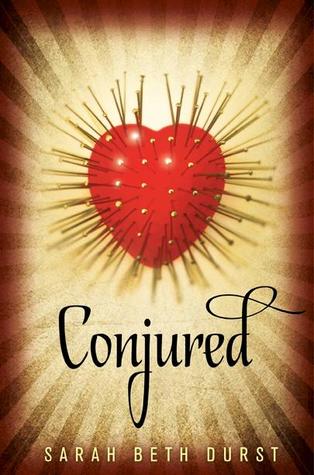
Conjured, by Sarah Beth Durst

I guess it must be the season subconsciously influencing me to pick spooky books. Or maybe there's a dark magic spell influencing all the authors I like to write spooky books. The last Sarah Beth Durst book I read was Vessel, which was a great desert adventure fantasy. Conjured is something entirely different, and I couldn't put it down.

First line: "Your name is Eve. Remember that."

Main characters who have forgotten everything about their past are always fun. The mystery of identity has to be the central mystery of everyone's life. So a character trying to piece herself together from a very few clues and dreams is always compelling and sympathetic. Said character instantly becomes more interesting when she can do odd magical things without knowing why. Suspense is added when she doesn't know who is telling the truth or who she can trust, and when everyone around her seems pretty terrified of something awful happening to her.

Conjured has all these excellent building blocks and out of them Durst creates a fascinating, terrifying, heartwrenching, living, breathing tale of love and freedom and what it means to be a person. Eve doesn't know how to undo a seatbelt, can't remember that she licked jelly donut off her fingers last week, doesn't know why the agent she's supposed to call Malcolm makes her feel safe and the one called Aunt Nicki doesn't like her. But out of all her emptiness her personality shines. She is creating herself before our eyes with every choice she makes. She chooses to cooperate, to pretend to be normal, but as "Malcolm" and "Aunt Nicki" introduce her into the world, her choices broaden. Particularly when she meets Zach at the library. (I really liked Zach.)

The visions that may or may not be pieces of her past are excellent creepy carnival scenes, textured with colour and scent and emotion. At first they're so cryptic they make no sense, but as the images build they start to hint at their own story. Like Eve, we're given all the puzzle pieces but it's hard to put them together without knowing what they're supposed to look like.

I just went to Goodreads to get the link for this book, and I was surprised by some of the negative reviews, but I can understand them. You have to be patient with this kind of narration: it's frustrating to spend half the book not knowing what's going on—but that's the frustration Eve is living through, so for me it created empathy and suspense.

The writing is beautiful. Durst uses all her senses in her descriptions, and she has surprising and apt metaphors. I love how her magic is wondrous and beautiful even when it's underlain with horror.

Another excellent Halloween read, and I guess that's why pumpkins seem appropriate. Maple pumpkin pie, I think, another invention of my daughter's that I didn't get to try because I'm a five-hour flight away.

Monday, October 13, 2014

MMGM: The Boneshaker, by Kate Milford

Have you heard the song "The Devil Went Down to Georgia?" If not, go listen to it here.

Have you read Ray Bradbury's Something Wicked This Way Comes? If not, October is the perfect month to rectify that grave omission! It's such a wonderful October book.

Now imagine a cross between that song and that novel.

And then throw out whatever you imagined because Kate Milford did it even better.

The Boneshaker is delicious on so many levels. The ghost town at the crossroads. The dusty little community with secrets. The creaky old carnival rolling into town. Such an evocative setting, and evoked with such loving detail!

Then there are the characters: Old Tom Guyot, who can play his guitar like nothing and nobody and who has a story about that crossroads. Inexplicable Simon Coffrett living alone in his mansion on the hill. Grandiose Dr. Limberleg with his wild red hair and his suspicious glares and his increasing desperation.

And Natalie herself, the odd, determined heroine who senses something not right about Dr. Limberleg's Nostrum Fair and Technological Medicine Show. She pokes her nose in where it isn't wanted until she finds out far more than is safe about what's really going on.

So much to love about this book! Natalie's beautiful bright red Chesterlane Eidolon, fastest bicycle in the world, built just for her by her father, that to her endless shame she hasn't figured out how to ride. The stories Natalie's mother spins for her, the magic of stories that Natalie begins to figure out for herself. Natalie's prickly relationship with her friend Miranda. Terrible moral dilemmas. The hints of a more complex mythology, only just touched upon in this book. (Now I want to read The Broken Lands and the two Arcana books, all set in the same world.)

Oh, and great illustrations.

My daughter just told me she's making a masala-spiced turkey with rice stuffing and butter chicken gravy (butter chicken gravy???). I wish I could go to Ottawa and try some! I imagine that meal would make a good metaphor for The Boneshaker: complex flavours redolent of tradition but with a spicy twist.

I first heard of The Boneshaker from the Marvelous Middle-Grade Monday crew over at Shannon Messenger's blog. You can be sure to find more wonderful recommendations there every Monday.

Thursday, October 9, 2014

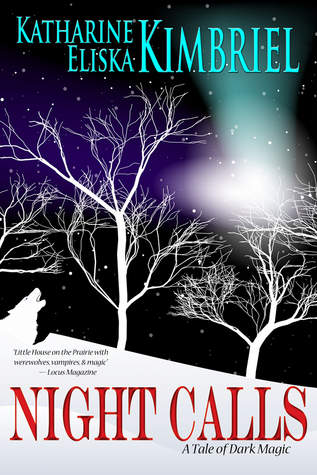
Night Calls, by Katherine Eliska Kimbriel

Sherwood Smith is responsible for a lot of my reading pleasure, not just because of the books she writes, but because she lists the books she's reading on her blog, and it turns out that she has great taste in books! I've taken to buying the books she recommends if they're not in the library because I'm so sure I'll like them. I haven't been disappointed yet.


The latest I've read is a marvelous coming-into-one's-magic story set in a spooky alternative version of early 1800s Michigan. In Night Calls, Alfreda learns she has the Gift when she can hear the werewolves calling. (Just to be clear, these are scary, dangerous werewolves, not hot sexy ones.) Her large extended family takes her in hand and devises an educational plan for her, because an untrained Gift is a danger to herself and to others. Alfreda may not like the idea at first, but her magic is a responsibility that she learns to accept. Pretty standard plot, really, but it felt entirely fresh and new.

 I like frontier America as a fantasy setting: there are so many possibilities to explore. I really enjoyed Patricia C. Wrede's Thirteenth Child series: it's big and adventurous with grand, sparkling magic and fantastic dangerous beasts. Night Callsis the Jane Austen version: it's cozy and quiet with creepy dark demons (okay, pretty sure there were no demons in Jane Austen; ditto werewolves, vampires and witches. But I stand by the comparison.) Kimbriel is all about the characters—great, vivid characters!—and their relationships, about towns and how they function, about families. One of the early dramatic moments is Alfreda's confrontation with the minister about having a service for dead werewolves. It's a credit to Kimbriel's writing that this scene is just as gripping (if a tad less scary) than a later confrontation with a vampire.

Kimbriel gives her world so much texture and depth I was completely immersed in it. She must have done a ton of historical research; there is a Little House on the Prairie feel to the book just because of all the authentic details of frontier life. But the magic feels just as meticulously researched (and I'm pretty sure she made that up!)(Although she does incorporate many different folk traditions, so that's probably why it seems so authentic.) I loved all the various magical objects.

The cover says it's a tale of dark magic, and this is Halloween-worthy stuff. Not horror, quite (I don't read horror!), but there are pretty nasty creatures out there, and Kimbriel does a great job of setting up suspense and tension. Again, it's all in the details: the letter covered in a miasma of evil just because it came through the haunted town; the odd behavior of the townspeople; the grim look on the practitioner's face.

This book is definitely something with pumpkin in it. A hearty pumpkin apple soup maybe, something made with stores from the root cellar that could simmer on a hook over the fire and warm the belly on a cold, dark winter night.

This cover plays up the fear factor maybe a little too much!
I like this one, but maybe it's not scary enough? Covers are difficult!

Thursday, September 11, 2014

Cuckoo Song, by Frances Hardinge

Holy sainted cows out standing in their field—this woman can write! She can write like a house on fire, like your brain is the house and she sets it on fire.

I didn't know she had a new book out—why am I not following her ravenously like a puppy??—and when I saw this book mentioned on a blog I forgave Amazon for all their faults and bought it on Kindle right away. Then I pretty much put my life on hold for a day and finished it in as close to one sitting as I could manage without my children starving and my house burning down around my ears.

Take a deep breath. Okay. Here's my rational, coherent review of Cuckoo Song

Go read this book!! No one can prepare you for it; it isn't like anything else you've ever read, except maybe another Frances Hardinge book, and it isn't like any of them either. It's a little like Neil Gaiman, maybe. Yes, she's up there with him. 

Cuckoo Song starts out a little ordinary, and for a while you think it's just a very well-written, slightly creepy story about an ordinary, completely dysfunctional family. And then it goes sideways, and you think, okay, it's about some really weird magic stuff happening to this extraordinarily dysfunctional but otherwise ordinary family. And then it goes even sidewaysier and you realize that you have no idea what ordinary even means anymore.

I love Triss, love her with heart-gasping terror like she is my first born child. All the characters, they're all so real and deeply complex and full of needs and hopes, how can you not love them. Pen is so perfectly a nine-year-old girl and her relationship with Triss was absolutely real. And marvelous.

I love the setting. The city is fantastic, with its hills and bridges and zig-zag streets. It takes place in the 1920s, and everything about the time is subtly and inextricably woven in with the plot and the themes: jazz; independent women; cars; belief in progress; the lingering impact of the First World War.

I love the Besiders. I don't want to say anything about them, except that Hardinge draws from familiar superstition and myth but her creation far surpasses the source material. Very cool, and completely believable.

Scary villains, but, as with all Hardinge books, there aren't good guys and bad guys. Even the scariest have reasons for what they do; even the kindest do things they shouldn't. It's wonderful to be rooting for different people with entirely conflicting desires and wonder how on earth Hardinge is going to solve it so that everyone gets what they need.

Gorgeous language, as always. (I'd quote, endlessly, but Kindle books are annoying to flip through looking for quotations.)

Cuckoo Song will probably be shelved in the middle-grade section of a library or bookstore, but I wouldn't call it middle-grade at all. Not that a precocious young reader couldn't enjoy it (it's creepily scary like Coraline, but has nothing in it a nine-year-old couldn't handle), but it has so much more going on in it. No adult should pass this by thinking it will be simplistic or insubstantial. Hardinge doesn't do insubstantial!

I'm currently harvesting endless tomatoes from my garden and they are mind-bogglingly delicious. You don't know what tomatoes taste like until you grow some yourself; when you first try a real tomato it's like discovering an entirely new color you have never seen before, and going back to the store-bought ones is like willingly blinding yourself. Cuckoo Song is a bowl full of red, gold, orange, yellow tomatoes of all different sizes, that you can eat with a little balsamic vinegar and olive oil, or quickly saute with some garlic and basil and serve over fresh pasta, or simmer until they reduce down into the most intensely flavoured tomato soup you've ever had, or . . . (if you have more suggestions, I'm open to them. I have a lot of fresh tomatoes to eat!)

Monday, September 8, 2014

MMGM: Scare Scape, by Sam Fisher

I picked this one up on a library browse because it had the maple leaf sticker indicating it was Canadian. The cover was appealing—assuming you find scary, slimy monsters appealing! (Which I don't, usually, but I figured I could probably handle middle-grade horror.) The premise has been done before—scary comic book turns out to be real—but I was willing to give this one a try, and I'm glad I did. Scare Scape is an excellent, well-written adventure story with wide appeal.

Strong characters, great family interactions, genuinely spooky but funny too—it reminded me a little of Diana Wynne Jones' The Ogre Downstairs. It has a similar wishes-gone-wrong plot, but Ogre (despite it's title) is straight-up fantasy, while Scare Scape is definitely horror. Creepy old Victorian house, a gargoyle that grants wishes, monsters that come alive, a blind comic book writer who may or may not have died in the well in the back yard—Fisher uses old tropes in fun ways and comes up with a few new ones of his own. I loved Melissa's endless closet and what she does with it.

I liked Morton and his strange obsession with a scary comic—a flaw that ends up being a strength (no one else knows each monster's weakness!) The story is fast-paced with a few interesting plot twists; there are themes of trust and loyalty; the final showdown requires courage and cleverness and all the kids working together. It was a thoroughly enjoyable read, and I'm betting this one will fly off the library shelves.

Nutty and sweet like the trail mix I have perfected over years of backpacking: peanuts, cashews, tamari roasted almonds and craisins, liberally mixed with chocolate-covered peanuts, gummy bears, jelly bellies (only my favourite flavours) and swedish red berries. Every bite has something I like!


Marvelous Middle-Grade Monday is hosted by Shannon Messenger on her fun blog, and has a great line-up of contributors every week.

This is book 7 of my Canadian Book Challenge (five of them are adult books I reviewed on Goodreads). I think I might make it to 13 this year! For more Canadian recommendations, head to John Mutford's blog and see what the other challengers are reading.

Friday, March 21, 2014

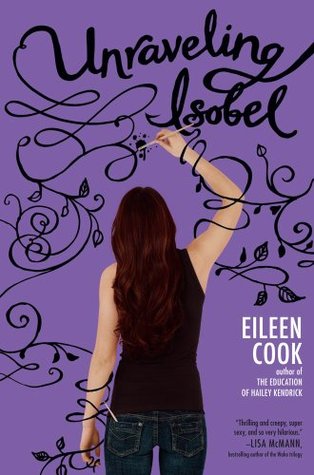
Unraveling Isobel, by Eileen Cook

Haunted house on an island. There's a trope that never gets old. And even if it could, Eileen Cook would be able to shake it up. I went looking for another Cook novel after being pleasantly surprised by The Education of Hailey Kendrick (surprised because I don't usually enjoy realistic "I'm having problems with my social life" novels, but this one really worked for me). Unraveling Isobel sounded like it had the potential to be a fun ghost story (and I was in ghost mode after In the Shadow of Blackbirds and The Time of the Ghost).

The opening hooked me:
When the minister asked if anyone knew any reason why these two shouldn't be married, I should have said something. I could think of at least five reasons off the top of my head why my mom shouldn't have married Richard Wickham.
We've got a potentially evil stepfather ('cause he's a stepfather: they're always potentially evil), a good-looking but brooding stepbrother, and the mystery of what happened to the first wife and daughter. Plus the rumours about the big house they're moving into being haunted. And the west wing of the house is closed (cue Twilight Zone theme).  It's all there, and Cook does fun things with it.

She's a very funny writer. There are spooky bits, and a great spooky twist, but this is a lighthearted, laugh-out loud book. It also managed to deal sensitively with a number of issues, like having a disabled sister, what to think when you have a parent with a mental illness, whether to completely suppress your personality and join the cheerleading squad just to fit in. And whether it's okay to make out with your stepbrother. (Not such a serious issue, I suppose! But you never know: it might come up!)

Unraveling Isobel is Mayan Hot Chocolate: rich and creamy with a spicy kick (depending on where you get it, could be cinnamon, could be cayenne).

I am proud to say Eileen Cook is not only Canadian, but Vancouverian. For more Canadian books, John Mutford has a great blog and a challenge. This is my fourth Canadian book I've reviewed since last July 1. I've got to triple my efforts to reach 13 by June 30!


Thursday, March 13, 2014

DWJ Month: Let's celebrate Diana Wynne Jones!

It's Diana Wynne Jones month, you say? Who says? Who decides these things? Well, in this case it's Kristen at We Be Reading, who is going to have a DWJ post EVERY DAY this month. I salute her boundless energy and ambition! My ambitious plan is to read all Kristen's posts so that I can be reminded of DWJ books I haven't read for a while (or at all), and then read as many of those books as I can this month. And I might post once or twice about them.

This is great fun because I love rereading books when it's been long enough that I don't remember what happens in them. That was the case with Time of the Ghost and House of Many Ways.

House of Many Ways is a sequel to Howl's Moving Castle. Sophie and Howl show up as supporting characters in several very amusing scenes, but the heroine is the quietly stubborn Charmain, who would really rather be reading a book, thank you very much, but if she absolutely has to go take care of her great uncle's house while he is being treated by elves for a strange illness, then fine, at least it gets her away from her annoying parents. Little does she know what she's getting herself in for! I love the house, which similar to Howl's castle in its space-bending magic, but with its own personality and rules. I love Charmain's relationship with the unexpected apprentice who is rubbish at magic. (Charmain echoes Sophie's way of dealing with magical disasters: you just have to tell things very firmly what you want them to do!) I have a special spot of affection for the well-meaning King and Princess, who are doing their very best even though they have no idea what's going on under their very noses. I don't think it's too spoilery to say that the villains get a very satisfying comeuppance at the end!  A bit quieter and lighter than Howl's Moving Castle, but the same world, the same magic, the same fun.

Time of the Ghost has an entirely different feel to it: spooky and twisty, more like Fire and Hemlock or Hexwood, except for a slightly younger audience. It's a book that I don't want to spoil by revealing anything about the plot, because nothing is as it seems and you figure things out at the same time as the narrator does. I will say that DWJ gets the experience of being a ghost down perfect.* And I'll also say that this book convinced me never to participate in a seance or pretend to worship an imaginary ancient being: you never know what you might inadvertently awaken! (Reminds me of Verdigris Deep, by Francis Hardinge: better not wish on a wishing well, either!) There's some beautiful landscape description in this book, and it's also very interesting to read it after reading DWJ's autobiography, since many aspects of the family are taken from her own childhood (a rather terrifying thought).

*Because I totally know what that's like.