Showing posts with label E. K. Johnston. Show all posts

Monday, November 15, 2021

Aetherbound, by E. K. Johnston

No E. K. Johnston book is like any other book in existence, including any other E. K. Johnston book. She has very specific stories to tell, and each book is told in the just right way for that story, which probably won't conform with any standard structures or tropes you're familiar with. So you have to come to each new book with an open mind and trust that Johnston is going to give you the story you need that you didn't even know you needed.

All that is preamble to say I didn't know I needed a retelling of the Fisher King myth, set in space with magic, but now my heart is wrung and my mind is slightly blown and I'm not sure how to review it. (Full disclosure: I have only the vaguest understanding of the Fisher King myth, and a quick google search is not helping me understand it any better; I didn't recognize this as a retelling until a reviewer mentioned it, even though Johnston specifically tells the Fisher King story in the middle of the book!) (To achieve healing you have to ask the right question—that's as far as my understanding goes.)

Right. The review. There's some harsh stuff in this book, no doubt about it, and it's very spoilery to tell you what it all is, but if you're concerned my Goodreads review has the spoilers. The reason you don't want to be spoiled is that we start with Pendt as a five-year old to whom all this is normal, and we only gradually discover, along with her, that it's unbearable. This is a book about autonomy, freedom, choice, and I think it's important to be in Pendt's head as she grows into a person who can make choices, who sees her opportunity and escapes, and sees her next opportunity and grabs it. I think the first section of the book is brilliant in the way Johnston controls POV so that we are a little appalled, then more appalled, then fiercely excited and terrified when Pendt escapes. (That's not a spoiler: it's on the book jacket!)

Then we get part 2, and another set of characters who are imprisoned in an entirely different way. The way Pendt's need to escape leads to a unique solution to all of their dilemmas is weird and strangely affirming. And all that is told as more of a background to the developing friendship among three young people who are essentially good and kind and trying to do the right thing in a very twisted universe.

One of the things I love about E. K. Johnston is her ability to portray goodness and kindness. In the end, I think that's what all her books are about, and the plots are just vehicles, scenarios in which goodness and kindness can play out. All the more highlighted when the universe is so completely the opposite of good and kind. I can't tell you how much I love Pendt and Ned and Fisher! (And there had better be a sequel, because that Stavenger Empire needs to be taken down!)(She hints at a sequel at the end, so here's hoping!)

Johnston's pacing is always odd, because she tells you what you need to know when you need to know it, and only shows you the things she thinks are important. Things can seem rushed and abrupt because she trusts her readers to keep up. She's doing it all very deliberately, so pay attention to where she spends her narrative time. (She definitely doesn't tell the story that most authors would tell and most readers would expect.) I need to reread and pay more attention myself to see all I missed the first time around.

Oh, and don't ask what the LGBTQ+ rep is, because you don't want to be spoiled! I thought the way she dealt with this particular character was quite brilliant and fun, and also very pointed. (It's never explicitly stated, because it shouldn't have to be.)

This isn't a book for everyone: the reviews will tell you that! But if you've liked more than one of Johnston's books (or if you like Patrick Ness—he's maybe the only comparable author out there*), and you're willing to go along for a very interesting ride, I can highly recommend this. (I think it's my second favourite of her books, after Exit, Pursued by a Bear.)

*If Johnston and Ness ever collaborated on a project, I'm pretty sure the universe would collapse into a singularity from so much originality and depth.

Cross-posted on Goodreads, and I should really post my other E. K. Johnston reviews there too.

Wednesday, December 6, 2017

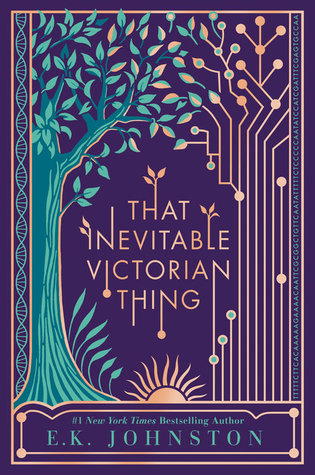
That Inevitable Victorian Thing, by E. K. Johnston

That Inevitable Victorian Thing is such a quintessentially Canadian book! From the landscape, to the quiet politeness of the narrative, to the unquestioning acceptance of a monarchy we know is ridiculous but we like anyway. Most Canadian of all is the simple, puzzled plea of a theme: why can't we all just get along?

I want to meet E.K. Johnston: she is so fiercely optimistic! I imagine her musing on racism and bigotry of all kinds and thinking, "this is a problem we should be able to solve; I mean, come on, people!" And then thinking, "well, maybe if we altered history just a bit ..."

I won't go into the details of the world-building, because you can get that from the book blurb, but what she's attempted is to draw a picture of a world that isn't racist. Did she do a perfect job? No, of course not, that would be impossible. But it's so, so important to try! We have to be able to visualize what it might look like to have everyone treat each other equally with absolutely no regard for their genetic makeup. Does it seem a little contrived? Well,  it would be hard not to. But she's created a quirky, fun sandbox to play in.*

(Can I just say that I am all for imagined futures or alternate presents that are better than the current reality? Enough despair and dystopia! Yes, we need social criticism, but we also need vision! We need our Star Treks!)(End of mini-rant.)

A princess in disguise, a reluctant socialite and a young lumber baron walk into a ball. Our three protagonists are very, very Canadian, both in their identities and their characters. (It's not that all Canadians are nice, but I think we might be unique in the high social value we place on niceness.) Margaret, Helena and August are all genuine, kind and reasonable people. The plot in the first half of the book, in fact, suffers a little from everyone being too nice to each other: there's not a whole lot of conflict, just secrets that everyone is keeping from each other.

I almost quit reading halfway through, because I thought I could see where it was going. I particularly dislike plots that involve people lying and then things getting messed up and everyone getting hurt because of all the deceit going around. But of course Johnston did entirely different things than I expected. I loved the way all the secrets were revealed, and the consequences that fell out from them.

I laughed out loud at the solution our characters came up with to get out of the tangle they fell into. I had predicted it, but I still laughed when it happened, because of the way it came about. It's an eminently reasonable, practical, Canadian happy-ever-after. (It would never actually work, in the real world, but this is a fairy tale (she tells us so!). Or possibly a Shakespeare play—I'm not well-versed enough to recognize which one it might be, but it has that sort of feeling to it—the comedic inevitability of how everything turns out.)

The whole narrative is suffused with a quiet enjoyment of the absurdity and tenderness of human relations. There's a gentle, self-depreciating humour that sometimes breaks out into hilarity. And sometimes there's just the loveliness of simple pleasures: dressing up for a ball; jumping into a cold lake; baking butter tarts; fishing. Summer in a cottage by a lake. (I was a little disappointed that no one got kidnapped by pirates, but this isn't that kind of a book.)

This isn't a book for everyone. Even if you've liked Johnston's previous work, this one might be a little too slow, the humour too quiet, the plot too quirky. But if you can find your inner Canadian, it will bring a smile to your face and a lingering pleasant aftertaste.

Sparkling raspberry lemonade. (This book would probably be best enjoyed at the height of summer. In a cottage. By a lake. Sipping lemonade.)


*I get far too much glee out of the fact that the pirates on the Great Lakes are Americans. (Sorry!)

Monday, November 20, 2017

Library books I don't have time to read right now!

I went to the library to get a copy of The Goblin Emperor, so I could reread it and get ideas for twisty court politics (for the novel I'm currently writing)(29287 words so far; I'm falling behind target, but there's still a chance I can make 50,000 by the end of the month!). Also I just love The Goblin Emperor so much.

But look what else I found!


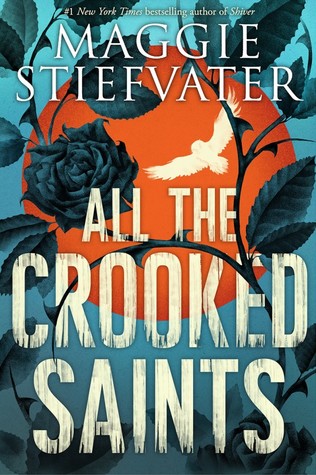
Maggie Stiefvater's latest, All the Crooked Saints: it looks like magic realism and I'm really curious about the miracles. People say it's very different from her other books, but I'm willing to go there with her.

Another new one from E.K. Johnston! I didn't even know this one was coming! Everything about That Inevitable Victorian Thing is exciting to me, from the title and cover to the premise: in a near-future Victorian Empire with genetically arranged matchmaking, a princess, a shipping magnate and a scientist spend a summer together of "high-society debutante balls, politically-charged tea parties, and raucous country dances." What is not to like about that plot?!

M. T. Anderson has a really intriguing-looking short book called Landscape With Invisible Hand, about invading aliens who have a thing for "classic" Earth culture. Sounds like lots of potential for satire. The name of the aliens (the vuvv) totally reminds me of The True Meaning of Smekday, one of the funniest books of all time, so I am predisposed to like this one.

Spare and Found Parts, a debut novel by Sarah Maria Griffin about a girl with a mechanical heart who decides to build the boy of her dreams. Sounds cool!

I haven't had time to read any of these, yet, but I'll let you know when I do!

In the meantime, a few pics from Nepal:


Okay, not technically in Nepal. But we stopped to see the Taj Mahal on the way! (Along with 20,000 other people, of course.)

Typical scenery: rice paddies, hills, and four-story buildings.

The ancient royal city of Bakhtapur


One of my favourite pics.

Tuesday, October 31, 2017

Spindle, by E.K. Johnston

Hey, all. I've been taking a bit of a blog hiatus, but I had a good excuse: I was in Nepal for most of October. Very cool place. When I'm finished sorting through the 1700-odd photos I took, I might post a few of them!

I probably won't be posting much in November, either, since I've decided to participate in NaNoWriMo. It always seemed like a rather ridiculous thing to do (as in: there's no way I could ever do that!), but I'm at the stage in my WIP where a clearly defined writing goal will be a good thing. Right? This is going to work for me. I have confidence. Ahem.

I didn't get as much reading done in Nepal as I thought I would (and I was reading more non-fiction than fiction), but I did finish E.K. Johnston's companion novel to A Thousand Nights, and it was every bit as good. My only complaint was that it ended too soon!

Spindle is set generations after the events of A Thousand Nights, and you don't have to have read the first book before you read Spindle (Spindle does spoil A Thousand Nights, though). Spindle is another transformative reinterpretation of a fairy tale, this time (as you might guess) Sleeping Beauty.

I love me a good fairy-tale retelling.

Spindle's narrator and protagonist is Yashaa, the son of one of the spinners who are out of a job (and exiled from the kingdom) after a demon curses the Little Rose. I love, love, love, that Johnston explores the realistic, economic implications of ending an entire industry. "And then they burnt all the spindles in the land." That's going to have consequences, people!

The curse itself is fascinating and complex (and an important part of the plot, so I can't tell you about it without spoilers). Yashaa and his three friends (also impacted by the above economic consequences) go on a quest to end the curse which is destroying not just their lives but the entire kingdom. I love, love, love that this is a buddy story: Yashaa, Arwa, Tariq and Saoud are all flawed, lovable characters in their own right, and their bond of friendship and loyalty is a treat to watch. There's a sweet little romance, but it's not the focus.

The demon is also an interesting character; Johnston almost gets us to sympathize with her. She's got a long-term, carefully planned out scheme to regain the power stolen from her people, and she just has to be patient a little longer before it all pays off, if those stupid meddling kids don't mess everything up! I really enjoyed the scenes from her point of view.

The magic creatures are lovely and magical, and I wanted more of them. I also wanted more of the ending: Johnston could have written another hundred pages and I would have gladly read them. (A warning of sorts: Johnston's endings always take a left turn from where you think they're going. It's as though you think you're reading a certain kind of story that's going to have a certain kind of ending, but really she was writing a different story all along, and the ending you were expecting is more of an afterthought. Those of you who've read it, what did you think of the ending?)

Spindle was delicious and multi-layered and resonant with magic. Backlava, I think, oozing honey and crunchy nuttiness. I sure love E.K. Johnston's writing!

Friday, July 15, 2016

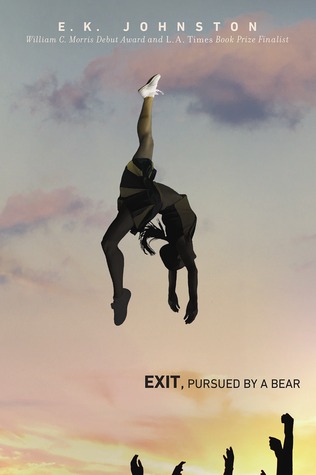
Exit, Pursued by a Bear, by E. K. Johnston

This Canadian YA author keeps astonishing me with every new book she writes. Her books are so completely original in setting, premise, plot, writing, that there's no way to compare them to anything else, except to other E.K. Johnston books. And this new one is completely different from anything else she's written. For one thing, it's contemporary realism. For another, it's a retelling (sort of) of Shakespeare's The Winter's Tale.

The Winter's Tale is one of Shakespeare's lesser-performed works, probably because the plot is kind of weird and disjointed. Johnston takes the essence of it—a queen falsely accused of infidelity, the king who refuses to believe her, and her loyal friends who stand up for her in a number of different ways—and transforms it into a YA novel about a cheerleading team captain and the friends and family who stand by her when she goes through a traumatic event. (The book blurb tells you what the event is, but I refuse to be spoilery, because knowing ahead of time what happened affected the way I read the first part of the novel, and I would spare you that if it were only up to me.)

If I were an expert on The Winter's Tale, I would probably be even more amazed at the clever things Johnston does with Shakespeare's plot, but even if you've never heard of Shakespeare, Exit, Pursued by a Bear is a brilliant, compelling story that everyone should read. It made me cry—but I was crying with happiness. The strength and fierceness of Hermione and her best friend Polly were overwhelmingly beautiful. Not to mention every other character who was there for Hermione in whatever way they were able to be, from her teammates to her devastated parents to the police officer to her therapist.

And you might say, well, it's not very realistic then, is it, because most people who go through something like this face a lot of rejection and feeling alone. And that's true. But Johnston chooses to show us what it would look like if someone did get support, and I think that's incredibly important. Hermione's healing process is slow and difficult, there's a lot of grieving that has to happen, and there are certainly people who make it worse (including the character named after the king, for obvious reasons), but this is a powerful parable that healing can happen, that an event like this does not have to define a person for the rest of their life.

I fear I am utterly failing to convey what a good book this is. (I was reading it in the bath, and I was reading for so long the bathwater got icy cold and I didn't even notice.) Hermione's voice is spot on; her friends are all real, interesting, varied people; her relationships with everyone are the messy, complicated relationships people have. I cared about every single character in the book. But, oh, Polly. Polly I loved. You have to meet her. Everyone should be so lucky as to have a Polly in their lives. Have I mentioned fierce?

It's a stunningly positive book. I want to emphasize this, because you might not want to pick it up if you hear about the trauma, the grief, etc. I know I probably wouldn't have read this if I didn't already love E.K. Johnston's work, and I would have missed out on so much.

Read it if you love good writing. Read it if you love strong female friendships. Ditto kick-ass heroines. Read it if you've ever known someone who went through something difficult and you didn't know how to help them. Give it to your best friend. Make your daughters read it. And your sons.

I will read anything this woman writes.

Thursday, January 21, 2016

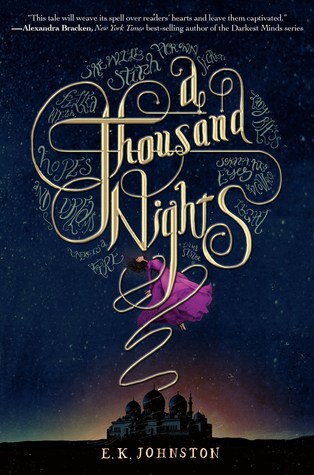
A Thousand Nights, by E. K. Johnson

E. K. Johnston is a unique voice in YA fantasy. When I heard she was doing a retelling of the story of Scheherazade I knew she was just the writer to attempt it. It's a story that pretty much demands compelling prose—prose that could save someone's life.

A Thousand Nights is a beautiful book. The writing glows. The voice resonates like a legend; it reminds me of Robin McKinley's early writing, that sort of fairy-tale cadence that lifts every-day actions into greater significance:
Lo-Melkhiin killed three hundred girls before he came to my village looking for a wife.
She that he chose of us would be a hero. She would give the others life. ... She that he chose would give hope of a future, of love, to those of us who stayed behind.
She would be a smallgod for her own people, certainly, in the time after her leaving. She would go out from us, but we would hold on to a piece of her spirit, and nurture it with the power of our memories.

In the hands of a lesser writer, this kind of narration gets old rather quickly. But right after that opening passage, just when I might have rolled my eyes and put the book down, we learn that
parents would bring sweet-water flowers, even in the height of the desert wilt, and pickled gage-root to leave as offerings. She that he chose of us would never be forgotten.
She would still be dead.
Johnson gives us the little details that bring a world to life (what on earth is pickled gage-root? but I can imagine what it tastes like), plus a glimpse into the narrator's attitude that convinced me her story would be worth following. She's a determined young woman who knows her own worth, and her story is vibrant with detail about the world she loves.

She's never named. No character other than Lo-Melkhiin is given a name. People are referred to as "Lady Mother," "Daughter of my heart," "Sister of mine," and I thought this was beautiful and in keeping with the tone of the narration. It's also thematically significant, as the protagonist's relationships with her family and community are what give her strength.

I loved the notion of becoming a smallgod. I have lots of things I could say about the way A Thousand Nights explores the nature of power, but what I loved was the way our heroine gained her magic from little, every-day tasks, unnoticed, discounted by the villain. Women's work. The love and care that hold a community together. This is what saves her. And everything described in such evocative prose that even though I've never spun or woven I could feel the thread beneath my fingers, and completely believe that magic could arise from it.

This is not a book to read for plot. There's hardly any action, and the conflict plays out straightforwardly, no twists or sudden revelations. This is a book to savour for its descriptions, for the  sensory world it builds. I delighted in the sisterhood and the friendships, and I was compelled by the heroine's quiet defiance, her determination to live, and her pleasure in the power that Lo-Melkhiin doesn't understand.

Very dark, smooth chocolate, possibly with an unusual spice like cardamon, or maybe ginger. Eaten one square at a time, with the flavour lingering on your tongue for the rest of the evening.

Friday, March 6, 2015

The Story of Owen, Dragon Slayer of Trondheim, by E. K. Johnston

The cover and the blurb of The Story of Owen were enough to make me pick it off the New shelf at the library. And lo and behold it's by a Canadian author, so double excitement!

I love the premise: imagine a world exactly the same as our world in every respect, except that it's infested with dragons. Not your wise, telepathic dragons, either; these are just pests, mindless, destructive, fire-breathing beasts, particularly dangerous to modern humanity because they are attracted to carbon emissions.

This book was funny with the kind of sly, satirical poking at society I really enjoy. Of course there are dragon slayers in this world (and there's a perfectly valid explanation for why dragons have to be killed single-handedly, with swords), and of course dragon slayers are required by international law to spend a certain amount of time defending oil fields, and when their Oil Watch tour of duty is over most of them are hired by big corporations or governments to defend big population centres. Leaving little towns like Trondheim, Ontario in the lurch:
When a dragon attacked you had to petition town hall (assuming it wasn't on fire), and they would send to Toronto (assuming the phone lines weren't on fire), and Queen's Park would send out one of the government dragon slayers (assuming nothing in Toronto was on fire). By the time the dragon slayer arrived, anything not already lit on fire in the original attack would be, and whether the dragon was eventually slayed or not, we'd be stuck with reconstruction. Again.
The juxtaposition of glorious dragon slaying with petty politics and bureaucracy hits my funny bone at just the right place. So does the incongruity of skinny adolescent Owen, who is failing algebra, as the latest in a long line of famous dragon slayers.

The story is narrated by Siobahn, a music student who is good enough at algebra to tutor Owen. His family asks Siobahn if she will be Owen's bard—a noble, traditional role that's been on the decline ever since the Beatles started singing songs that weren't about slaying dragons. Turns out the bardic job really means being a PR manager, because of course dragon slayers are celebrities and they want to be able to spin their publicity the right way. More juxtaposition of epic myth with modern reality. Johnston really gets our society, right in the solar plexus!

But you can't help rooting for Owen and his family, because they're just trying to do their job and do right by their town. Owen is courageous and competent and despite all evidence to the contrary he has faith in what he's doing, in the people he's protecting, and in Siobahn, who has her own courage and selflessness when it counts. We may have written off Michigan, but darn it we're not letting the dragons get southern Ontario!

I think some of the politics of dragon slaying might go over the head of younger readers, but there is plenty of sword-swinging action, and the developing friendship between Owen and Siobahn is a treat. (Very slight spoiler: they don't fall in love! How novel!) There are great, believable family dynamics, too.

The Story of Owen was loads of fun, intriguingly original, and very Canadian. The sequel just came out, and I think I'm going to buy it rather than waiting for the library to get it. It's worth owning.

It's like one of those fusion dishes that are so popular in restaurants now, where they take a traditional dish from one country and prepare it with ingredients or spices from a different tradition, and it ends up being really good in a surprising way and makes you look at both food traditions differently. Like butter chicken poutine. (Because, poutine. And butter chicken. And if you've never tried either, you should come to Canada and try them! Separately and together.)

This review counts as book 9 toward this year's Canadian Book Challenge. For more wonderful Canadian books, don't forget to visit John Mutford's blog, and check out all the reviewers who read way more than the minimum 13 Canadian books a year!