Showing posts with label Susan Juby. Show all posts

Tuesday, September 8, 2015

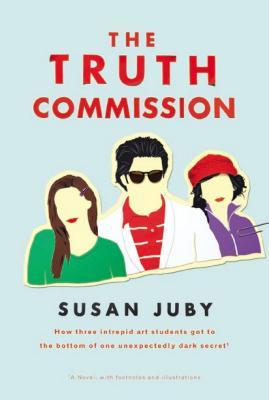
We Are All Made of Molecules, by Susin Nielsen, and The Truth Commission, by Susan Juby

Apparently there's a secret society of Canadians named Susan/Susin who write quirky, funny, moving, painfully accurate stories about teens trying to survive adolescence.

I've raved before about Susan Juby, whose Alice books are a treat and whose Woefield Poultry Collective had me in stitches the whole way through, so I was looking forward to The Truth Commission.

It's not quite as side-splitting as her earlier books, but it's a fun read with a terrifically engaging narrator. Norm (short for Normandy) is writing a narrative non-fiction project for one of her classes at a fine-arts high-school. It's sort of a diary on steroids, because she includes lots of footnotes and meta-textual observations addressed to her English teacher. Also illustrations. All very entertaining.

The story Norm tells is about her and her friends' attempts to find out the truth about various people at school (hence "the Truth Commission"), but the real story is Norm finding out the truth about her sister. She ruined Norm's and her parents' lives by turning them into the subjects of her famous graphic novels, and is now being even more nastily manipulative and exploitative. I was a little disappointed in the Truth Commission concept, because it didn't seem to go anywhere (so much potential for social blunders that wasn't realized), but once the plot about the sister got into gear: woah! Lots of themes about what is art and what is truth and who gets to tell it.

What I loved most about the book was Norm and her two friends, Neil and Dawn. They were hilariously quirky and their friendship was a delight. And I loved Norm's voice, and all the thematic threads arising from Norm telling her story, allowing her long-silenced voice to be heard. Lots of layers of plot, structure, theme, character development come together very satisfactorily.

Fish tacos. I don't know why; maybe because fish tacos are kind of quirky, in a delicious way.

Susin Nielsen apparently went to the same class on voice as Susan Juby. The two narrators of we are all made of molecules are brilliant characters with equally hilarious voices. Stewart and Ashley are from opposite ends of the high school social spectrum, and being thrown together in a step family causes predictable conflict. The plot isn't particularly unique, but the voices kept me riveted to the page.

I kept thinking that they were both a little caricatured—awkward smart kid and clueless mean girl—but people really are that weird, and that hateful, and that oblivious, and that selfish. Giving us the two perspectives in first person narration means that we both laugh at and sympathize with both characters, even though Stewart is immediately loveable and Ashley is mostly hateable, until she finally gets her comeuppance and actually gains a little insight.

There are serious issues dealt with, from bullying to homophobia to date rape, but I'd still say it's middle-grade appropriate (nothing bad actually happens; it just might have). The ending is perhaps a bit too rosy, but it's a light-hearted book, for all it can sometimes hit you in the solar plexus. I definitely had tears in my eyes at some points, and was laughing out loud at others.

Other things I liked about it: the parents are all real, realistic, present characters, not perfect but doing their best to be parents. I really liked both kids' relationships with their parents and stepparents (and I think that's what got me over how really horrible Ashley was: the fact that she had a mom and dad who loved her and were trying hard to be patient with her).

I loved the cover and the title, too; they definitely got me to pick up the book, when just reading the blurb I probably wouldn't have. Maybe I should read more contemporary realistic fiction! (But only if the author's name is Susa/in!)

Lasagne. All the ingredients are familiar, but when it's well-done, it transcends comfort food (while still being ultimately comforting).

For more great Canadian reads, head over to John Mutford's blog. These two books make 4/13 for my  Canadian Book Challenge. I'm on track so far!


Friday, June 10, 2011

Canadian Book Week: Susan Juby

Alas, I am a fickle blogger! I'm not quite sure what has happened to the last three weeks. Perhaps I got caught in a time vortex because the Tardis was in the neighborhood. (Have you been watching the latest Doctor Who season? Crazy weird plot-lines! I loved the Neil Gaiman episode. But I digress.)(I actually know where the last week went, because since I began this review we decided to sell our house and buy a townhouse, and for some reason we decided to do everything this week, just because we weren't busy enough already. Sneaking the time to write this review was a bit therapeutic.)

I promised to do a Canadian book every month, and I'm a little late for May's, but we can pretend it's still May, can't we? Because I really must blog about Susan Juby. I just finished her latest, The Woefield Poultry Collective, and I was laughing so hard I was crying--which made the people in the park look rather strangely at me!

I think humour might be the hardest thing to write well, and Susan Juby is brilliant at it. She began with a young adult trilogy: Alice, I Think; Miss Smithers; and Alice MacLeod, Realist at Last

Alice is a teenager in the very small (and quite real) town of Smithers, BC, homeschooled by her vegetarian, pacificist, feminist mother ever since "a series of unfortunate social failures in first grade, connected to my mistaken belief that I was a hobbit." In Alice, I Think, she tries out high school, with mixed results, and "personal expression via fashion experimentation," with even more mixed results. In Miss Smithers, she becomes the Rod and Gun Club representative in the Miss Smithers Pageant, much to her mother's dismay:
My mother has been attempting maternal guidance. Her unsuccessful efforts have revealed the fascist tendencies just below the surface of most New Age practitioners and cemented my commitment to civic participation. If I wasn't already entered in the Miss Smithers contest for personal growth and financial gain, I'd now be in it for spite.
In Alice MacLeod, Realist At Last, her mother goes to jail after an environmental protest, her boyfriend leaves for Scotland after an awkward goodbye ("Our last chance to consummate our love. Ruined by a moose"), and Alice writes a screenplay. "I've channeled some of my anxiety into my art, but I still have quite a bit left over." Exotic fish, leather pants, and knitting play key roles in Alice's adventures, and she's helped through her self-actualization by a therapist nicknamed Death Lord Bob, a best friend ("More accurately, she is my only friend") who "looks sort of like how I used to before I started making an effort," and a younger brother who is "the only genuinely together person in our family. . . We all try to take our cues for how to behave from him." As the highly suspect narrator of her own embarrassing mishaps, Alice forges through all the issues of adolescence with a gawky sense of elan. If you have ever felt like you don't quite fit in, you will love Alice.

The Woefield Poultry Collective is Juby's latest, and her first for an adult audience. Doesn't it have an awesome title? (Be sure you get the Canadian edition: they named it Home to Woefield in the States, which is the lamest alternate title I've ever seen. Is "poultry" too difficult a word for Americans? Or is it "collective" that's the problem, with its scary socialist implications? What were the publishers thinking?)

Woefield has four hilariously unreliable narrators: Prudence, a city girl from New York who inherits her uncle's farm on Vancouver Island and decides to become an organic farmer; Earl, the old farm hand who doesn't know much about farming but plays a mean banjo; Seth, a twenty-something alcoholic recluse who shows up on Prudence's doorstep after his mother kicks him out; and Sara, a twelve-year old girl who raises competition chickens while her family falls apart. As if they didn't have enough problems between them, Juby throws in Bertie the depressed sheep, Eustace the very good-looking vet who disagrees with all of Prudence's environmental beliefs, and a bluegrass festival. Absurd situations abound (there's nothing like sheep for a little absurdity), and the characters' disparate reactions to each new crisis add layers to the humour.

You will find it particularly funny if you, like me, are a city girl with pretensions to sustainability: if you've tried vermiposting, if you've read The Omnivore's Dilemma and think small scale wholistic organic farming sounds wonderful, if you feel guilty every time you grocery shop because everything you buy harms something in some way. I was hooked from the moment Prudence described the death of her worms from being overwatered during a heat wave: "The poor things drowned and cooked, leaving a sort of warmed-over red wriggler soup."

Warning: there is strong language. Normally I would object, but I have to say that this book wouldn't be the same without Earl's colorful voice (several swear words in the following quotation):
I was trying to stay the hell out of the way, but when I saw the first shithouse fall off the truck, I thought, goddamn it, I'm going to have to get involved. No way around it.
That right there sums up the theme of The Woefield Poultry Collective: you deal with sh*t by getting involved.

Juby doesn't shy away from issues (even in her YA writing): alchoholism, divorce, sex, bullying are all treated realistically and with compassion. No easy answers, but perspective. Her humour is never cynical nor mocking (at least, not the bad kind of mocking, only the good kind): we are laughing with her characters, not at them.

If you need a good belly-laugh; if you need to feel that in the chaos of the universe events still might turn out for the best, I recommend Susan Juby. Like popsicles on a hot day, she's just the thing.