Showing posts with label Fledgling. Show all posts

Sunday, March 27, 2022

Sherwood Smith's Phoenix Feather series solves The Protagonist Problem

 "The Protagonist Problem" is a great essay in Uncanny Magazine by Ada Palmer and Jo Walton, and I think you should read the whole thing, but here's the gist:

Jo Walton coined the word protagonismos in 2010 to mean “the kind of person stories happen to,” but I’m extending that meaning here. We tell a lot of stories in which one special person has the power to save the day, make the difference, solve the problem, and change everything. They might be superhero, a long-lost royal scion, the last of their race, a child of prophecy, or they might—like Frodo—be an everyman who has that special courage or other quality which saves the day. Protagonismos is the protagonist spark, that quality some characters possess which means the plot will not advance until our hero comes to lead the action, be it to victory or defeat.

The authors make the argument that while this kind of hero-centred story is great, it becomes a problem if that's the only kind of story we tell.

When some stories center protagonists, while others center teams, movements, families, etc., that teaches us that there are many ways a world can change, but when almost every story has protagonismos, it teaches us that all worlds work this way, and leads people to see the real world and real history as resting in the hands of real-world protagonists. This is harmful. It’s harmful when people see themselves as not protagonists, and differently harmful when people see themselves as protagonists.

Novels have become more and more protagonist-centred in recent decades, to the point that writing instruction often assumes protagonismos and considers it a flaw if a story lacks it (see writing advice like, "the plot has to be influenced by the protagonist; things can't just happen to her"). I had never thought about it before—and that's their point: we take it as a given, without examining the assumptions behind it. Like I said, read the whole essay; it's great.

I bring it up because I just finished the fourth (and final) book in Sherwood Smith's latest fantasy adventure series, The Phoenix Feather. Although it starts out seeming like a typical hero story (I described the first book as a martial arts hero origin story), it ends up with multiple POV characters, all of whom influence the outcome in essential ways. And it was very satisfying!


I absolutely loved that it's a story of a family—of more than one family, actually. It follows every member of the Afan family as they make their separate ways across an empire, always trying to protect each other no matter what other intrigue or danger or opportunity they are navigating. And in the meantime we get glimpses of the Imperial family—and the difference in the sibling bonds and parent-child relationships almost becomes heartbreaking, because we see genuine love and affection in both cases, even when twisted by ambition and fear.

I loved the conflict that is set up between the two families, and the way it plays out in long threads that tangle with each other and draw everyone inexorably together. I loved the braided nature of the narrative: following first one character, then another; hoping, fearing, knowing that their paths will intersect; watching the repercussions of each intersection ripple out and affect everyone else.

The Phoenix feather of the series title is an interesting plot device—an augur of greatness, it teases us over four books: to whom does this great fate belong? Who will fulfill the promised destiny? At different times you'll think you have it figured out, but you'll likely be wrong! In the meantime, you're rooting for all three Afan children, who pursue greatness in military, artistic and martial arts spheres, not to mention several other characters who befriend and help them and have great potential.

The setting is gorgeous; the magic is fun; the battles and spying and escapes and training montages and intrigue are everything you want from escapist fantasy: stressful enough to keep you engaged while never being in any doubt that everything will all work out somehow. I devoured all four books, and I can see myself rereading them frequently.

(The level of violence is almost middle-grade. It's not aimed at a young audience, but I think sophisticated younger readers would enjoy it. If you've read her earlier work, it's similar to the Inda series but less adult in theme and treatment.)

Sunday, November 13, 2011

Octavia Butler and Daughter of Smoke and Bone

It occurred to me that I might blog more often if I didn't spend three hours writing a blog entry. That last one could have been three posts, couldn't it?  Hmm. In the meantime, the writing is still happening, slowly. It feels rather like getting ketchup out of the bottle. I'm hoping for the sudden blurp when way too much ketchup ends up on your hamburger, but I'm still waiting. Like in the Heinz commercials. (It doesn't help that I checked on my geography today and discovered that a key plot point is impossible. (And this is geography I'm intimately familiar with, so I don't know why I came up with that plot idea in the first place.) The story is set in the future, though, so maybe I'm going to have to give Vancouver that earthquake that we're all waiting for and alter the geography so my plot still works. I love fiction.)

I know I mentioned Laini Taylor's newest a few weeks ago, and I've been meaning to blog about it, but I want to do it justice and I haven't felt like I could devote the time required. Which is stupid, because it means I'm not blogging about it at all.

But first I have to mention an adult science fiction writer I just discovered: Octavia Butler. I borrowed her novel Fledgling from a friend of mine. What a great title. (And I love the cover.) What an interesting, interesting book. This is a novel about vampires that you should not read if you generally like vampire novels. Intellectual is not quite the right word, but it's close. What if vampires didn't kill people; what if they entered into symbiotic relationships with them, relationships of love and trust in which the humans get whatever they want, but the vampires have all the control. Would that be okay? I found it fascinating how Butler kept my sympathy with the narrator: the young vampire does things that would be reprehensible if a human were to do them, but she does them within her own moral and ethical code, so they feel right. And the fact that they feel right feels seriously creepy. Fledgling has a plot with its own suspense, but to me the page-turning aspect wasn't what was going to happen next, it was what will I agree with next. Deliciously interesting. Like sushi.

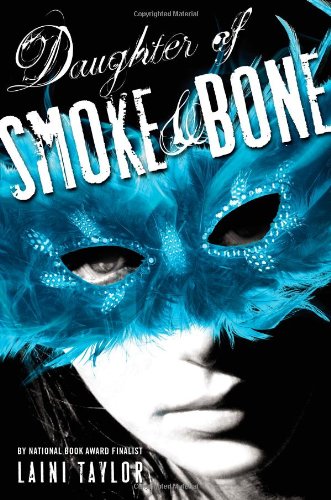
Okay, Daughter of Smoke and Bone, by Laini Taylor. It hardly needs my endorsement, since it's made all kinds of Best Books lists and everyone is raving about it, but I'll continue my Laini Taylor fandom and say you have to go read this book. It has everything I like about Taylor's writing:  lush prose, dense with colorful detail, incredibly imaginative world-building, traditional mythologies mined for their deepest gems and then turned into something entirely new (angels and devils, yes, but these are not the angels and devils anyone else is writing about). My favorite thing about this novel? It's set in Prague, the most beautiful, evocative, artistic city I've ever visited. I also loved Karou's best friend the puppeteer. And the shop with doors that open in places around the world. Best use of teeth in a fantasy. I could go on, but I don't need to. I was thinking I'd compare it to a Czech dish, something desserty you'd eat with coffee in the afternoon: maybe apple strudel or blueberry dumplings. I only hope that the success of this series (yeah, cliffhanger ending: there'd better be another book coming!) allows her to get back to the Dreamdark books.