Showing posts with label siblings. Show all posts

Sunday, March 27, 2022

Sherwood Smith's Phoenix Feather series solves The Protagonist Problem

 "The Protagonist Problem" is a great essay in Uncanny Magazine by Ada Palmer and Jo Walton, and I think you should read the whole thing, but here's the gist:

Jo Walton coined the word protagonismos in 2010 to mean “the kind of person stories happen to,” but I’m extending that meaning here. We tell a lot of stories in which one special person has the power to save the day, make the difference, solve the problem, and change everything. They might be superhero, a long-lost royal scion, the last of their race, a child of prophecy, or they might—like Frodo—be an everyman who has that special courage or other quality which saves the day. Protagonismos is the protagonist spark, that quality some characters possess which means the plot will not advance until our hero comes to lead the action, be it to victory or defeat.

The authors make the argument that while this kind of hero-centred story is great, it becomes a problem if that's the only kind of story we tell.

When some stories center protagonists, while others center teams, movements, families, etc., that teaches us that there are many ways a world can change, but when almost every story has protagonismos, it teaches us that all worlds work this way, and leads people to see the real world and real history as resting in the hands of real-world protagonists. This is harmful. It’s harmful when people see themselves as not protagonists, and differently harmful when people see themselves as protagonists.

Novels have become more and more protagonist-centred in recent decades, to the point that writing instruction often assumes protagonismos and considers it a flaw if a story lacks it (see writing advice like, "the plot has to be influenced by the protagonist; things can't just happen to her"). I had never thought about it before—and that's their point: we take it as a given, without examining the assumptions behind it. Like I said, read the whole essay; it's great.

I bring it up because I just finished the fourth (and final) book in Sherwood Smith's latest fantasy adventure series, The Phoenix Feather. Although it starts out seeming like a typical hero story (I described the first book as a martial arts hero origin story), it ends up with multiple POV characters, all of whom influence the outcome in essential ways. And it was very satisfying!


I absolutely loved that it's a story of a family—of more than one family, actually. It follows every member of the Afan family as they make their separate ways across an empire, always trying to protect each other no matter what other intrigue or danger or opportunity they are navigating. And in the meantime we get glimpses of the Imperial family—and the difference in the sibling bonds and parent-child relationships almost becomes heartbreaking, because we see genuine love and affection in both cases, even when twisted by ambition and fear.

I loved the conflict that is set up between the two families, and the way it plays out in long threads that tangle with each other and draw everyone inexorably together. I loved the braided nature of the narrative: following first one character, then another; hoping, fearing, knowing that their paths will intersect; watching the repercussions of each intersection ripple out and affect everyone else.

The Phoenix feather of the series title is an interesting plot device—an augur of greatness, it teases us over four books: to whom does this great fate belong? Who will fulfill the promised destiny? At different times you'll think you have it figured out, but you'll likely be wrong! In the meantime, you're rooting for all three Afan children, who pursue greatness in military, artistic and martial arts spheres, not to mention several other characters who befriend and help them and have great potential.

The setting is gorgeous; the magic is fun; the battles and spying and escapes and training montages and intrigue are everything you want from escapist fantasy: stressful enough to keep you engaged while never being in any doubt that everything will all work out somehow. I devoured all four books, and I can see myself rereading them frequently.

(The level of violence is almost middle-grade. It's not aimed at a young audience, but I think sophisticated younger readers would enjoy it. If you've read her earlier work, it's similar to the Inda series but less adult in theme and treatment.)

Monday, March 21, 2022

MMGM: The Barren Grounds, by David Alexander Robertson

I am a sucker for foster child/found family stories—don't know why; I just can't stand the thought of any child not feeling love and belonging. So The Barren Grounds drew me in right away when it introduced Morgan in her new foster family. They are trying so hard to welcome her and honour her aboriginal heritage, and she is rude and prickly because she can't let herself get hurt again. 

The most important relationship in the story is between Morgan and her younger foster brother Eli, whom she both sympathizes with and resents because he at least has memories of his family and his culture, whereas she was given away when she was a baby. Eli's skill at drawing is the magic that creates a portal in the attic, and Morgan has to go through the portal to find Eli and bring him home.

Found family, siblings and portal fantasies are all buttons for me, and the snowy icing on the cake was the wintery setting: in Winnipeg in the real world, and in the trapped-in-winter land of Aski. Robertson's depiction of a winter forest landscape rang very true and familiar to me. This is such a Canadian book! (I was only annoyed at Morgan not wearing enough clothes when she went through the portal: she would know how to dress better than that!)(At least she remembered her mitts.)

The homage to Narnia is genuine, and the integration of aboriginal mythology and values into a Lion Witch and Wardrobe retelling felt both fresh and satisfying. The environmental message (and the metaphor of colonialization) is clear but not, I think, too didactic.

The story itself is fast-paced and fun, a fairly simple adventure quest with enjoyable banter and realistic character development. I liked how Eli's and Morgan's different strengths were acknowledged, and I loved the bickering between Ochek and Arik. (I am embarrassed to be a Canadian who did not know there was such an animal as a fisher: kind of like a really large weasel. You would think I would have learned about them at some point!)

This is a strong beginning to a middle-grade fantasy series for any readers who like wilderness adventures and portal stories, and a book that should become a Canadian classic.

By Douglas H. Domedion - https://bloximages.chicago2.vip.townnews.com/niagara-gazette.com/content/tncms/assets/v3/editorial/1/dc/1dcd1294-0601-5f2d-85e8-70e12364647e/5e62c0efb7979.image.jpg, CC BY-SA 4.0, https://commons.wikimedia.org/w/index.php?curid=107662510


For more great Marvelous Middle Grade Monday reads, check out Greg Pattridge's blog, Always in the Middle


Thursday, January 27, 2022

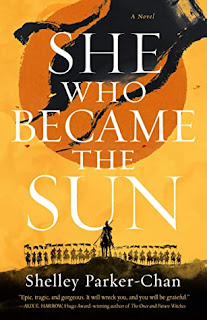
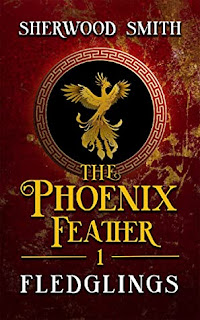
She Who Became the Sun and Phoenix Feather

I read these two novels back-to-back, and it was interesting to compare them, particularly since Iron Widow is still fairly fresh in my mind. All three have the Mulan trope at their heart: peasant girl (in Chinese-inspired world) disguises herself as her brother to go achieve goals in the wider world that involve fighting in battles, and she ends up kicking butt. Great trope! Three great novels with very different takes on it.

She Who Became the Sun, by Shelley Parker-Chan, is a historical fantasy based on the rise to power of the first Ming emperor—who was born a peasant, though was probably not actually a girl in disguise. (Though you never know!)

Fledglings is Book 1 of the Phoenix Feather series by Sherwood Smith, a secondary world fantasy based on the wuxia and xuanhuan traditions of Chinese novels: it follows three extraordinary children as they cultivate their talents and try to avoid the notice of an evil emperor.

Now, I'm going to stop my review right here and state that I am unashamedly biased in favour of the less realistic of these two premises. Because, much as I believe that it is possible to live by principles of justice and kindness, history generally doesn't. So, when I tell you that I enjoyed reading Fledglings more than SWBTS, it's entirely because I want my gentle, unrealistic world-view reinforced, and SWBTS is stuck with history. (Iron Widow is also stuck with history, but it has the advantage of giant fighting robots. Parker-Chan chose not to go that route, and I can't fault her for it, but I'm afraid she loses another few enjoyment points right there.)

Having said all that—She Who Became the Sun is a fabulous novel. We are drawn inexorably into a brutal world through the eyes of an unnamed, unvalued girl fighting for her life; we can't help but root for her as she uses her cleverness and her endurance to avoid starvation. Her decision to take on her brother's identity, Zhu Chongba, and with it his fate, is both terrifying and makes perfect sense. 

I loved the subtlety of the fantasy elements and the way Parker-Chan weaves them into her theme: there really is an external force of fate, and our two main characters take different approaches to their wrestle with its inevitability. Do we choose our destinies? Are the Heavens really watching? 

The writing is vivid with metaphor—I'm not going to say lyrical or poetic, and certainly not purple—Parker-Chan is utterly skilled at choosing the perfect metaphor to convey precisely what she means in every circumstance. (As opposed to those of us who rely too much on adverbs!)

I enjoyed Part I of the novel more, the coming-of-age and figuring out how to stay disguised as a boy part. But Part II starts getting really interesting when it introduces the eunuch general Ouyang, who ends up being Zhu's foil/nemesis character on the opposite side of the war. Parker-Chan kept me interested in all the complicated power dynamics at play by making all the players very real people with believable motivations. I am not a huge fan of revenge plots because I think revenge is dumb, but I was sucked into this one; I really felt for Ouyang.

[Slightly spoilery, except that the title spoils this, as does history!] There were parts of the latter half of the novel that reminded me of Macbeth: in many ways Zhu's rise to power is a tragedy ("I am in blood stepped in so far" is a speech that came to mind). Ambition is another motivation that I don't really get, but Zhu is so convincing; her every choice continued to make perfect sense, even as I wanted to close my eyes and not watch.

I don't know if I'm going to read the second novel. I know how it ends, and it's not with Zhu renouncing the world and achieving inner peace! But what I might do is read more of the history, and rewatch Empress Ki, and then read Parker-Chan's sequel with enough background to be fascinated by how she reimagines this pivotal moment in the history of China. Here's her explanation of the historical figures in the novel: it's quite fascinating!

Fledglings, on the other hand, is all about playing with fun story tropes: it's essentially the origin story of a martial arts hero, and it was just the immersive, familiar-feeling story I needed while I recuperated from whichever virus had me in its grip all week. Everything I love about Sherwood Smith's writing: excellent world-building details, great action scenes, wonderful character interactions. I particularly loved the depiction of the close-knit family, the parents trying to protect the children while the children chafe for the chance to pursue their identities. And of course off they go into the world, not quite the way they thought they would, and they still love and support one another, and it just gives me all the feels. A lighter version of Inda, very similar to A Stranger To Command. I've bought the second book and am going to start reading it now, so that's all I'll say about this one!

Monday, August 17, 2020

The Kingdom of Back, by Marie Lu


I am so happy this book exists, because it needed to, and then Marie Lu wrote it, so all is good with the universe.

Why did it need to exist?

  1. Wolfgang Amadeus Mozart had an older sister, nicknamed Nannerl, who was also a child prodigy; in fact, he was inspired to begin learning music by watching his father teach her.
  2. Nannerl apparently composed music as well, but she wasn't supposed to, because she was a girl. None of her compositions survive, and we only know about them because Wolfgang refers to them in his letters to her.
  3. As children, Nannerl and Wolfgang invented a fantasy world called the Kingdom of Back and told each other stories about it.
If that isn't the making of a fantasy novel, I don't know what is! And Lu's execution nails it.

Lu is obviously a musician herself, because she writes about music beautifully, from the inside—she knows how it feels to practise, to master, to inhabit music, to be inhabited by it. She knows the connection between music and imagination, and she uses it so well to weave the fantasy into the real.

Nannerl is a complex, fascinating character, and Lu hits all the right notes (sorry, couldn't help it!) in creating her fraught relationship with her more famous brother. She loves him, she cares about him, worries about his ill health, loves to see him succeed, and is hopelessly, furiously envious of his success and the life he will be allowed to live that she is denied. She also simply loves music—loves hearing it, loves playing it, has an instinct for it, is a perfectionist about it—and so to be denied it because she is a woman is heartbreaking. Also stupid and unfair and just arrrggghhhh!

So, what if there were a fantasy bargain Nannerl could make that would allow her to create music and, more than that, be recognized for her talent and her creations? (There is historical speculation that some of Wolfgang's works might have actually been written by Nannerl, and Lu makes clever use of that in her plot.) Nannerl wants to be remembered, and a mysterious, attractive boy in a strange, beautiful forest full of haunting music says he can help her if she will help him reclaim his throne.

The fantasy kingdom Lu creates is gorgeous, evocative, imaginative, and just creepy enough. I don't know how much source material she had to work with (apparently there is a map of the kingdom the Mozart's manservant drew at the children's request, but I don't know what else there is), so I don't know how much was Mozarts and how much was Lu, but she comes up with a coherent, believable and compelling world. I love the way it melds with the real world: at one point a real flower grows out of Nannerl's music notebook. I also love the ambiguity: is it real or is it just a dream? Are they both just imagining it because of their stories? Are the stories they tell influencing the reality of the forest world? Are their actions in the forest actually influencing real-world events, or is that just coincidence? Lu plays with imagination and creation and choice and truth in interestingly layered ways.

Nannerl's conflict is so real, so frustrating, and the stakes are so high—at one point I stopped reading because I thought she was going to make a certain choice, and I both wanted her to make it and didn't want her to make it. I thought I knew what she was going to do, because history, but the story really wasn't predictable so I knew it could go either way. Lu doesn't take the easy route and doesn't make the obvious choices, and I loved the resolution she came up with. 

I now want to find out more about Nannerl, and I've started learning some Mozart Variations! Apparently there is a movie called Mozart's Sister that I now need to find.

(PS: the new Blogger is worse in every possible way: how could they have made it so much more clumsy and awkward??)

Tuesday, January 30, 2018

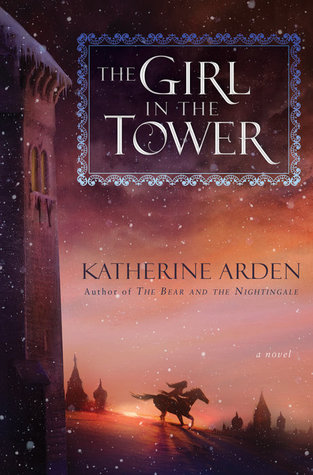
The Girl in the Tower, by Katherine Arden

I loved this book. Loved, loved, loved every minute of it!

I really liked the first book, The Bear and the Nightingale. I loved Vasya, the girl who sees spirits and can't be tamed to fit the role expected of her; I loved the evocative, wintry, oppressive, vast Russian setting, and the way the folklore is entirely integrated and believable. Of course there is a frost demon! How could there not be? I loved the family dynamics: complex, deep, hurtful, healing, strong, strong bonds. I hated/loved the twisted priest and the way his view of the world influences everyone in ways Vasya simply can't fight, and the way she chooses to fight anyway.

In The Girl in the Tower, Arden gives us all those things but more! and better! Vasya chooses to risk freezing to death in the Russian taiga rather than submit herself to being shut away in a house or convent, and oh! how cold it is! Wear a blanket and slippers while reading this and have a stew cooking in the oven because you'll need it. Vasya is clever and stubborn and knows how to interact with the spirits that inhabit the landscape, but she wouldn't survive if Morozko the frost demon hadn't given her a magic horse—Solovey is so awesome! Best character in the novel!

The relationship between Morozko and Vasya is brilliantly suspenseful, and the development of his character is one of the highlights of the novel. I'm not going to say any more, but there are some lovely bits.

So, we've got Wo/Man vs Nature and Man vs Himself and Woman vs Expectations, and then Vasya encounters some burned villages and decides she has to do something about the whole Man vs Man thing that's going on with those darned Tartars. And she's disguised as a boy, so there's lots of Lies vs Truth vs Being Found Out (I know that wasn't one of the standard high school Conflicts, but it's one anyway), and she ends up going to Moscow and getting pulled in all sorts of directions. (Wo/Man vs Society). Then a bad guy worse than the priest shows up, so there's seriously Wo/Man vs Evil.

All the conflict and tension you could possibly pack into a novel, continually ratcheting up in a lovely slow build, layer upon layer, and all the way through you are feeling the bite of the frost, hearing the crunch of the snow, smelling the smoke from the fires. Inhabiting Vasya and her world. There were times I had to put the book down because it was getting too intense. At one point I shouted out loud.

And I haven't even mentioned Vasya's family, who are wonderful, and who love her, and who are several of the directions she gets pulled in. And by the time the Firebird showed up my brain melted down and my heart exploded.

So, yeah. I think you should read this one. Cannot wait for the third book!

Osso Bucco (I know it's not Russian: you can substitute your favourite Russian stew if you want): meat falling-apart tender and satisfyingly chewy, sauce savoury/tangy with a hint of sweetness, every bite making your eyes roll back in your head a little because it's so perfectly, completely delicious.