Showing posts with label sci fi. Show all posts

Wednesday, September 4, 2024

Liberty's Daughter, by Naomi Kritzer

 Hope you all had a marvellous summer! When I wasn't backpacking or hiking or at music camp, I was rereading the Vorkosigan series by Lois McMaster Bujold, following along with this delightful blog. Lois herself is going to appear on the last episode, airing sometime this month!

Naomi Kritzer is becoming an auto-buy author for me. I first encountered her with the short story "Little Free Library," on Tor.com—a delightful, sweet, but also deep and moving story. Then I happened to read Catfishing on CatNet (my review at the link) and its sequel Chaos on CatNet, without realizing it was the same author. Kritzer has this way of seeing our current society with ruthless clarity that she translates into fun, entertaining spec fic with a hidden punch.

Liberty's Daughter is another plausible near-future scenario: what if a bunch of libertarians decided to hook some sea-platforms and old cruise ships together to create a sea-stead in international waters? (It's plausible because people have already tried to do it. Great story!) I love that Kritzer is able to envision all the nitty-gritty logistics of how such a living arrangement would work. Limited availability of just about everything, for example, leading to our MC's part-time job: finding very specific items for people and negotiating trades. Really great world-building here.

Kritzer is also cognizant of all the unpleasant maintenance jobs that someone is going to have to do, and her story hinges on the debt-slavery that is a sadly plausible solution. Beck Garrison is a privileged teenager because of her father's position, and until she's asked to help find someone's missing sister, she is naive about her narrow little world. But when she discovers nefarious dealings, she plows ahead determinedly to investigate the literal and figurative underbelly of the sea-stead. 

Everything about this book is just so interesting. The fast-paced plot pinballs through all sections of the unique setting and society, exploring a raft (get it?) of physical, political and social implications. Kritzer's critique is funny, nuanced and ultimately hopeful. Yes, people can be greedy and selfish and cruel, but they can also pull together and care for each other and stand up for each other. And human ingenuity can solve as many problems as it creates!

Beck might be a bit too confident and capable to be believable, but it sure is fun watching her bulldoze her way through greed, corruption and incompetence. She has some genuine dilemmas; her character growth isn't huge but it's satisfying. The bad guys aren't flatly evil, either. 

Thoroughly enjoyable, and I look forward to seeing what aspect of society Krizter will choose to poke at next! 

You might enjoy her discussion of the genesis of the book on John Scalzi's blog, but be warned, it's fairly spoilery.

Saturday, May 1, 2021

Dogman, Murderbot and other things that made me happy this week


New Murderbot novella!!!! Fugitive Telemetry came out on Tuesday, and I couldn't quite drop everything to read it right away, but finished it yesterday. A little murder mystery set on Preservation Station, before the start of Network Effect. Our favourite sarcastic SecUnit has a dead human and some new annoying live humans to deal with, and it is as funny and heartrending as ever. "Fortunately, I had a lot of experience being screamed at and stared at by terrified humans." 

A Goodreads reviewer mentioned Murderbot's deep integrity, and now I want to reread the novella with that in mind, because I think it's a theme Martha Wells rather brilliantly weaves through it. Along with the usual friendship, selfhood, decency, and other things a rogue killing machine has to figure out for itself while trying to avoid more humans getting dead. Also my favourite cover of all of them so far.

And then I went to my local bookstore to pick up 13 Ways to Eat a Fly, a cleverly grotesque counting book by Sue Heavenrich (often seen on Marvelous Middle-Grade Monday). I now know far more than I ever wanted to about the disgusting eating habits of insectivores! I think this will be hugely popular among my nephews (and at least one of my nieces). Kudos to Sue and her illustrator David Clark for presenting so much detailed science in such an engaging way. 

While at the bookstore I noticed the two latest Dav Pilkey graphic novels: Dogman: Grime and Punishment and Dogman: Mothering Heights. I happen to think Dav Pilkey is one of the best comic writers out there, and The Adventures of Super Diaper Baby is a masterpiece of literature, but I have not been keeping up with his Dog Man series. The idea of Wuthering Heights and Crime and Punishment given the Dav Pilkey treatment* was too good to pass up, so I had to bring them home.

So I had another afternoon of laughing out loud, pounding the couch cushions, tears running down my face. And then Pilkey sucker-punched me with the sweet, wise denoument of this story arc about the redemptive power of love.

Trigger warning: Many people seem to object to the diarrhea-themed song parodies in Dog Man, so if that's an issue for you, you've been warned! I found them hilarious, but I have a particularly nuanced sense of humour.


The last thing that made me happy this week was the discovery that Becky Chambers has another book out in her Wayfarer's series: The Galaxy and the Ground Within. Will be reading that one soon. And if that weren't wonderful enough, she's starting a new series called Monk and Robot, the first novella of which, A Psalm for the Wild-Built, is coming out in July. The premise sounds amazing (and reminds me a little of the wonderful middle-grade novel The Wild Robot, also the Ghibli film Castle in the Sky) and I am so there for a robot who abandoned human civilization having conversations with a non-binary monk!


*For fans of Brontë and Dostoevsky: it's not a particularly close retelling of the classic novels. In case you were wondering! But Mothering Heights does contain "The Most Romantic Chapter Ever Written," complete with Romantic Advisory: Mushy Content, and Smooch-o-Rama, The World's Most Amorous Animation Technology. And there are various crimes and various punishments (and people getting dirty) in Grime and Punishment, though a grand total of zero dead humans.

Wednesday, October 28, 2020

Bloom, by Kenneth Oppel

Kenneth Oppel has done it again. He has to be one of the most versatile writers out there: every book he writes is different from the last, and they are all solidly good to fantastic. Bloom is on the fantastic side of the scale. It's the most entertaining plant-based apocalypse since Little Shop of Horrors.

There has needed to be a book about invasive aliens ever since the gardening world decided that's what they should call introduced plant species that run rampant over native species and become impossible to eradicate. Oppel has obviously had to deal with invasive aliens, because he understands how terrifyingly inimical to human life they can be. I know from personal experience that Himalayan blackberries have an intelligent malice and are actively hostile; so is Scottish broom. In Eastern North America I think it's kudzu. Alien plant species taking over the planet is an entirely plausible scenario! 


I love that Oppel sets Bloom on Salt Spring Island, iconic home to the most down-to-earth, organic, genuine, eccentric collection of farmers and artists in Canada. It just makes the wrongness of the black spiky grass that appears everywhere overnight that much more offensive. (Side note: I read a review that thought the community's swift and organized response to the crisis was unrealistic, but it didn't read that way to me at all. That's kind of how we do things here.)(*Waves Canadian flag a little bit.*)

I liked the variation on the Special Chosen One that Oppel sets up for his three young protagonists, and their different reactions to it, and the reluctant friendship that develops among them because of it.

I love the way he uses allergies: I don't want to say anything spoilery, but I think he also has personal experience of how disabling they can be!

Kudos for all the present, supportive and intelligent parent figures—they're actually involved in solving the problem but there's a plausible reason why the three teen protagonists have a key role.

Bloom is not as creepy as Nest, which was quiet, slow-burn, seriously-mess-up-your-head horror. Bloom is fast and loud and full of peril that can be attacked with chainsaws. (I love that everyone on Salt Spring Island knows how to use a chainsaw!)

Great fun! Hmm. Need a fun vegetarian meal for my food analogy—is that a contradiction in terms?! Maybe veggie pizza! Yes, with those banana peppers to give it some spice. And now I'm going to listen to the Arrogant Worms Vegetable song.


Saturday, May 9, 2020

Murderbot!!!! And my birthday present finally arrived! A good week!

Martha Wells' Murderbot novel, Network Effect, came out on Tuesday, and yay for the pandemic because I hardly had anything I needed to drop so I I could spend all day reading it! Also a good thing I was all by myself, because I was laughing out loud and crying (sometimes with laughter, sometimes not) and yelling at the characters, and having the most fun I've had all pandemic.

I may have mentioned one or two times how much I love Murderbot. The novel is everything I wanted it to be and more. We get Dr. Mensah's brother-in-law, who doesn't trust Murderbot and definitely doesn't like it, and Dr. Mensah's teen-aged daughter, who is miffed at Murderbot but also trusts it implicitly,  and ART, who—gah—can't say anything about ART! And new scary villains and weird scenarios that only Martha Wells could think up that require Murderbot to care about things. A lot. Also, some of the really terrible bad things that have happened to Murderbot may have caused some lingering trauma that might possibly be affecting its performance reliability.

I liked this quotation and Rachel Neumeier's comments about it: kind of sums it up, really! But amidst all the violence and mayhem there are the awesome character moments that punch you in the gut, and always Murderbot's sarcastic, defensive, sulky, exasperated, painfully human, wise voice.
You know that thing humans do where they think they're being completely logical and they absolutely are not being logical at all, and on some level they know that, but can't stop? Apparently it can happen to SecUnits, too.
I've told you this before: go read the Murderbot Diaries. Start with the novellas so that you'll be able to fully appreciate the novel. Trust me, you need this in your life right now!

(According to Goodreads there is a short story told from Dr. Mensah's point of view, but I can't find it anywhere! Anyone know where I can get my hands on it??)

Then on Friday, the book I had ordered for my birthday back in March finally arrived. It's the new Folio Society illustrated Howl's Moving Castle. Look how beautiful it is!


Tuesday, April 7, 2020

Sal and Gabi Break the Universe, by Carlos Hernandez

Based on the cover and title, I came into Sal and Gabi Break the Universe expecting a fun middle-grade romp with a science-fictiony feel. What I got exceeded my expectations by quantum orders of magnitude. (Actually, I don't know enough about the definition of quantum to know if it's actually expressing my meaning in that sentence, but it sounds good, doesn't it?)

There isn't any way to describe the book without spoiling a lot of the fun surprises, but I'll try to tell you what I loved while still being mysterious.

I loved Sal. I loved his voice, his self-depreciating wit (that's the best kind, in my opinion), his bold approach to life and problem-solving, his hilarious sense of humour. I loved that he's a magician (the sleight-of-hand kind). I loved that his dad is a calamity physicist. (A quick google search indicates that there's actually no such thing as calamity physics (google would know about it if there were, right??), but it's such a cool idea: it ought to exist!)

I loved Gabi even more, if that's possible. She's a force of nature, a warrior, the leader everyone didn't know they needed. I loved her quick, incisive mind,  her witty come-backs, her insistence on respect. She and Sal make a brilliant, hugely entertaining pair and I wish they had been my best friends in middle-school. (But I would never have dared!)

I loved their school! I know there are arts-focused schools out there that are probably pretty amazing, but wow, what a wondrously ideal education to imagine! I loved all the teachers and the principal, loved the projects we found out about, loved detention!

I loved, loved, loved Sal and Gabi's families. I cannot say enough about how this book models diverse, loving family relationships—what it looks like when families are there to support one another—gah, I just, I have no words. Brandy pointed out in her review how refreshing it is to have a middle-grade book with present, functioning, loving parents, and I agree. Loved that.

Loved the Cuban food, the language, the culture that came through so strongly. This is a deep, rich book and the specifics of Sal and Gabi's Cuban community were a big part of the depth and texture.

I loved the writing. I had a little scrap of paper with quotations written on it, but I can't find it, alas. You'll just have to read it yourself, I guess! Assured, solid, textured, hilarious.

The themes! I don't even know where to begin. Family, friendship, grief, identity, self-esteem, how to be a decent human being. Dense and meaty stuff, all woven through with humour and insight. Hernandez reminds me very much of William Alexander, another favourite middle-grade writer who doesn't underestimate his audience's capacity for wisdom.

I laughed, I cried, I bought the sequel! I don't know what else to tell you: just read this book!

The book describes a Cuban roast pork dish (the name of which I wrote on that scrap of paper I can't find) that seems like the perfect analogy: flavourful, savoury, hearty, spicy.

And because you are an audience that might appreciate my accomplishment, here are a couple of solitaire Bananagrams I'm particularly proud of! (I find this a soothing, meditative kind of thing to do.)


Saturday, March 28, 2020

The stories we tell ourselves matter: Internment, by Samira Ahmed

I've been meaning to review Internment for a while, as it was a favourite of the Cybils Spec Fic shortlist. But when Covid-19 started changing the world, I wondered if this was the right book to recommend now. In this time of anxiety and uncertainty, do we want to be reading a frighteningly plausible story of Muslim Americans being interned the way Japanese Americans were during WWII?

But then I thought, maybe this is exactly the book we need to be reading right now. Because it's about people standing up and speaking out and banding together to find hope when things seem hopeless, and most particularly it's about how to change the story people are telling about a situation, how to change us vs them into us.

Internment is tense and gripping, doesn't pull its punches (literally—trigger warning for violence), but is also full of hope and really positive messages about friendship, family, agency, girl power, the power of democracy. Rich, fully-developed, engaging characters, a great narrative voice with some fun snark and sass but also quite lyrical. I couldn't put it down.

It begins quite bleakly, with Muslims being rounded up and bussed to barbed-wire-surrounded camps. But Layla's voice pulls us into the exciting middle, when she assembles her allies and begins to fight back in creative, believable ways.

Ahmed can occasionally be heavy-handed in her message, but her real moral is delivered by Layla and her friends being clever, courageous and compassionate, and in the community they build, uniting people inside and out by telling their story.

I just read a fascinating article on Boccaccio's Decameron, a collection of stories written in 1353, during the Black Plague. In Italy. Eerily relevant. The article posits the importance of storytelling as "a means of community building," "intentionally creating and cementing social bonds," and gives examples of the stories we are telling ourselves now:
our pets as our new coworkers; jokes about how introverts have prepared for this day; pacts not to DM your exes in the loneliness of quarantine; ... the total absence of toilet paper from grocery store shelves.
I love the author's conclusion:
Let us gather round the bonfires of social media and share stories. The ones that help us to understand, or to escape, or to take some comfort in the continuing anxiety and ambiguity of modern existence. It has been, and always will be, the way our species survives.
Thinking about that, and about Internment, and about the stories happening in my community and being told among my friends and family, it seems to me we have a choice: are we telling ourselves that "we're all in this together," or that "it's every man for himself"? Because whichever of those stories we tell will become the truth.

I take much comfort from the resoundingly positive voices and actions happening all over the world. We are going to have stronger social bonds, more flexible infrastructure, a better safety net, more cohesive communities: I see all these stories being told and I believe that telling them is how we make them true.

Monday, August 26, 2019

Novellas get me out of my reading funk! Also dragons.

It helps that the novellas were written by Lois McMaster Bujold, Becky Chambers, and T. Kingfisher.  And the dragons are from Marie Brennan's series that I finally got around to starting, and why did I wait so long (though it's nice that all the books (I think?) are written now) because she is an amazing writer!

There is nothing like putting yourself in a capable writer's hands. Suddenly, the world seems like a more hopeful place.

Becky Chambers is infinitely imaginative and also owns a deep well of hope. I haven't reviewed her Wayfarers series, I guess because it's adult and I'm mostly a YA/Kidslit blog, but I adored it. So, so interesting—her world, her characters, her narrative style. How does she manage to be both thought-provoking and feel-good? When I saw a novella with yet another amazing title (she is hands-down the best title-er out there, just saying), I bought it right away. To Be Taught, if Fortunate is another fascinating exploration of humanity's possible future, while also being a deep character study of science—yes, of scientists, but also of science itself: what it values, what it's good at, why it's a hallmark of our species and the ultimate reason to have hope for where we're headed. By the end of the novella I cared as much about the future of science as I did about the characters—who were all lovely and interesting and maybe they got along a little too well to be believable, but isn't it sometimes nice to read a book where the conflict isn't about people being mean to each other? Just saying.

I have written quite a bit about Lois McMaster Bujold, despite her never writing anything remotely YA—I just love her so much I can't help myself. She's been dropping novellas about Penric and his resident chaos demon, Desdemona, like little surprise fruits for the past several years, and I'm always thrilled to get another one. Penric is getting pretty powerful these days, as he and Desdemona figure out how to work together, and in Orphans of Raspay he gets very pissed off. You shouldn't piss off someone harbouring a chaos demon. Just saying. What I love about this series (and the World of the Five Gods series, same world, same religion) is the way she explores how gods could work in the world without infringing on human agency. I also love the humour. And Penric. I just love Penric. He has to be one of the best depictions of an ethical character—his conflicts are all about how to be ethical when you have the power to do whatever the hell you want, and there's room for a lot of humour there.

Speaking of humour, I can always rely on T. Kingfisher. She understands that all plots are jokes (you have to set up your punchline), and her comedic timing is impeccable. Also she has a deep well of absurdity. Don't be misled by the young protagonist and his armadillo familiar: this is not a children's book. When Ursula Vernon is being T. Kingfisher, she can do pretty horrific violence and some genuinely scary bits. (Some reviewers have pointed out that kids do read scary and violent things. I would recommend reading it yourself before giving it to anyone under 13.) Minor Mage has everything I like about Vernon/Kingfisher: unflinching understanding of the worst of humanity combined with loving depictions of its best; not-particularly-special protagonists who muddle their way into heroism; folktale elements teased apart and turned into very weird, very brilliant world-building. And laugh-out-loud funny scenes juxtaposed with insight and wisdom, in the best Terry Pratchett style.

Speaking of science (we were a few paragraphs ago!), A Natural History of Dragons is another delightful exploration of the scientific method and the characters of people who are obsessed with Finding Things Out. (And if you think "delightful exploration of the scientific method" is an oxymoron, this might not be the book for you.) I loved Isabella, and I loved the narrative style, which pretends to be all distant and objective but actually reveals how deeply Isabella feels. (And is also quite slyly funny a lot of the time.) This first book of The Memoirs of Lady Trent describes a young Isabella desperate to study dragons but destined to lead the restricted life of a Victorian lady. The narrator is older, wildly successful dragonologist Isabella, so we know she succeeds, but the gap between where she begins and where she apparently ends up is a fascinating one to see slowly filled in. These books are gorgeous, with lovely illustrations, and I now have a terrible dilemma: do I buy the discounted e-book collection that has all five books, or do I fork out for the paper editions?

I'm feeling my way back into reading and writing, and authors who know what they're doing and who believe the world, and people, are full of potential and are worth saving are a lifeline to me. Have you read anything lately that has given you hope and confidence? Or just made you laugh?

Sunday, February 17, 2019

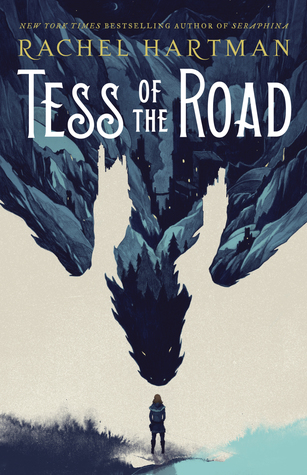
Tess of the Road wins Cybil award!

I'm so happy, and so proud of Rachel Hartman (she's not only Canadian—she lives right here in Vancouver!). Tess is such a deserving book. Here's my review of it, in case you need more convincing to try it out. Books like this are why I read and blog about YA literature.

I've been on an unintentional blog hiatus for the last several months. Life has been taking up too much brain space for me to feel like writing, particularly something as self-indulgent as a blog about books I like. But the announcement of the Cybils' winners seemed like a good reason to climb back onto the blogging wagon. There are worthy books out there, and if I can get even one more person to hear about a book they'll love, then maybe that's a tiny bit of good I'm doing the world.

I did want to highlight the other books on the YA Spec Fiction shortlist, because they were all fabulous—and so diverse—and it's too bad only one can win!


Dread Nation I reviewed here. It's gotten quite a lot of press, but it lives up to the hype, and I can't wait for the sequel. I'm really not a fan of zombies, but this was way too much fun to miss.

Mirage was gorgeous and entirely original, and held my attention through an audio book (which I normally can't sit through because they take so long!). It's got a space opera setting, but it feels like intimate fantasy, with a princess, her body-double, a hostage prince and a rebellion. Lovely, poetic but spare writing, believable characters, rich Moroccan-based mythology and imagery, a sweet, impossible romance but an even more compelling relationship between Amani and the princess she first hates, then pities, then comes to understand. Evocative and beautiful.

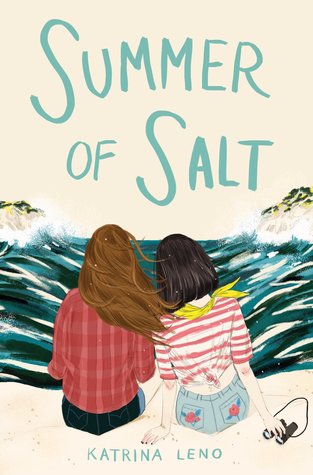
Summer of Salt: this one was quirky, magical and a little heart-wrenching, with heaps of weather-y island atmosphere and a fascinating cast of characters. Twin sisters from a long line of magical women, a famous, mysterious bird, a very odd murder investigation, lesbian romance and sisterly support. Funny and sweet with a core of wildness and the smell of salt in the breeze.

Not Even Bones is dark, gory, seriously twisted, and I can't believe I loved it as much as I did! A protagonist who dissects the dead bodies her mother brings home so the magical body parts can be sold on the black market—and who really enjoys her work—how could I possibly love this character? But Nita is so brilliantly crafted that I was on her side from the start. She's unapologetic, fierce, resourceful, thoughtful, ruthless and very self-aware. Then there's Kovit—you want complex villains? You want to know how to humanize a monster? You would want Heath Ledger to play this character, I'm just saying. I found this book utterly compelling and the twist at the end seriously messed me up: need sequel now!

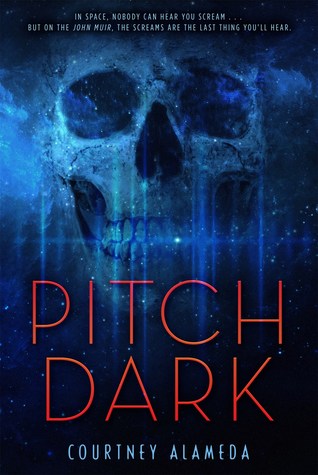
Pitch Dark: to be honest, the plot didn't make a whole lot of sense, but I didn't care, it was so much fun! It takes the whole woken-unexpectedly-out-of-stasis-on-a-spaceship-to-find-monsters-chasing-everyone space horror trope and mashes it (quite literally: they crash into each other!) with space-archaeologists-with-political-agendas-racing-to-save-humanity-from-terrorists (because, you know, that's totally a trope). Two strong, likeable protagonists narrate a thrill ride of non-stop action with a side-order of social commentary. If you liked the Illuminae series, you'll love this.

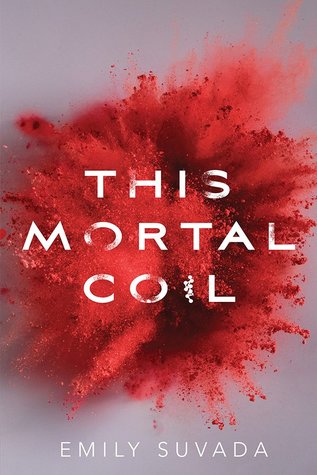
This Mortal Coil has yet another insane premise: people can now rewrite their own DNA, and our survivalist heroine is a genius gene-hacker hiding from a "shadowy organization" that has kidnapped her father, the only man who can cure the plague decimating the world. There's post- (or rather mid-) apocalypse on-the-run-from-scary-people-while-trying-to-save-the-world (with-a-really-hot-soldier-you-probably-shouldn't-trust) shenanigans and enough plot twists to make you question your own version of reality, as Cat certainly has to question hers.

So many good books! Such diversity of characters, writers, settings, atmospheres and themes. This is why YA literature is so awesome! Yay Cybils for celebrating all these good writers: go check out all the categories and find out what you have to read next.

Sunday, September 23, 2018

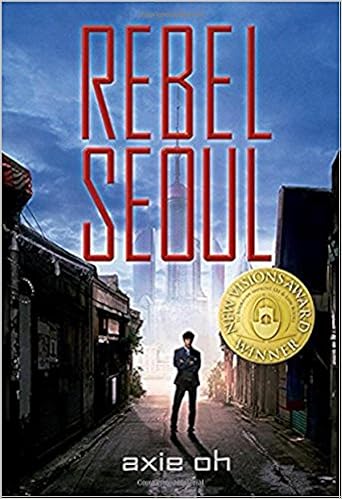
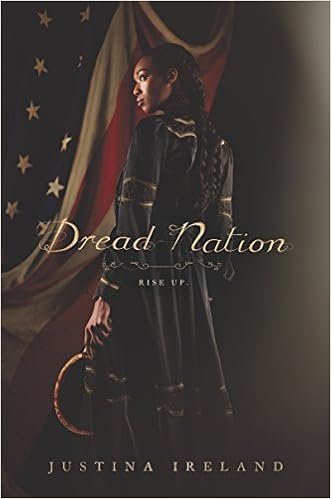
Dread Nation and Rebel Seoul: for all your action/adventure needs!

Cybils nominations are almost open! From Oct 1-15 you can nominate your favourite kid/YA books in a bunch of different categories. This year I'm a round 1 judge for YA Spec Fiction, so I'm trying to get a head start on reading the books I'm pretty sure will be nominated. And these two are definitely going to be nominated!

If you like adventure with a sci-fi flavour, set in a futuristic city with giant fighting robots, then have I got a book for you! Or if you prefer alternate-history fantasy with corsets and zombies, then I also have a book for you! (Not the same one. That would be, well, I guess that would be a time travel book, and I don't have one of those for you today!)

I've been looking forward to reading these two books for a while, because they have such awesome premises: Rebel Seoul, by Axie Oh, has a sort of 1984 dystopian vibe, with the world divided into constantly warring states, except it's more fun because GIANT FIGHTING ROBOTS! Ahem. (I would like to state for the record that I find the concept of giant fighting robots entirely ridiculous.)(End of disclaimer.) Our main character Jaewon grew up in a gang in Old Seoul, but he can escape all that if he excels at the military academy, (which appears to consist mostly of playing video games, so, yeah!) He's got a complicated past that I would like to have seen more of (prequel maybe?? hint, hint) but basically he's driven to succeed and he's pinned all his hopes on becoming a Neo Seoul soldier. But guess what: all is not shiny and bright in Neo Seoul. There's some unethical stuff going on about supersoldiers (something always goes wrong with supersoldiers: will dystopian governments never figure that out?)(except for Captain America, apparently. that one was fine for some reason??) and Jaewon ultimately has to decide where his loyalty lies. This one definitely reminded me of Marie Lu's Legend series: if you liked that one you need to check Rebel Seoul out.

Dread Nation, by Justina Ireland, hashes the American Civil War and slavery together with zombies and adds a cynical, short-tempered, zombie-slaying black narrator. There was no way this could not be good, and it was. As a young Negro in a post-slavery but terribly prejudiced zombie-overrun America, Jane is required to attend combat school and prepare to defend well-bred white ladies from the undead. Jane has opinions about this, but she is very good at her training. She's not very good at doing what she's told, however, and she gets sent to a scary utopian settlement (utopian for the white folks, that is) and meets even nastier people than the zombies. Many zombies are decapitated or otherwise killed in grisly ways; Jane kicks butt in zombie-slaying as well as in friend-rescuing and standing-up-for-justice; slavery and prejudice and institutionalized injustice are examined with the interesting perspective that zombies add. (For the record, zombies are an inherently ridiculous concept and I don't usually like the kinds of plots that they inevitably produce, but they do make great metaphors for whatever societal ills you happen to want to excoriate.) Jane is an entirely enjoyable narrator to ride along with: I particularly loved her letters home describing Miss Preston's School of Combat.

Both these books are wonderful at creating fascinating, unique, immersive settings. They also both have lots to say about economic and social disparities: the settings aren't just fun sandboxes to play in (though they are certainly that); they also point very pointed fingers at the inequities of our own world. In an entertaining, you-are-an-arrogant-bigot-so-I-will-blow-you-up kind of way.

Cliffhanger warning: not terrible cliffhangers, but these are both first books and the story continues! (Yay!)

Start thinking about the books you want to nominate: I can't wait to see what everyone thinks were the best books in 2018! (And being a round 1 judge means I have to read most of them, so that will be fun!)


Thursday, August 23, 2018

I just don't blog in the summer, but Murderbot is still awwwwwesome!!!!

This is what I do instead of blogging in the summertime:


I also tend to reread instead of reading new books. But when the latest Murderbot came out (which happened to be in the middle of a hiking trip, but at the tops of the mountains we had pretty good reception, so I was still able to download it. Kind of love the whole ebook thing*) I used up all my phone battery reading it in my tent. Murderbot: Rogue Protocol is every bit as fun and deep and heart-wrenchingly funny as the last two. "I hate caring about stuff. But apparently once you start, you can't just stop." And I just can't stop caring about Murderbot.

All Systems Red totally deserved its Hugo win. Lots of cool Hugo winners this year, actually. Lois McMaster Bujold got best series for World of the 5 Gods, much deserved. Did you see N.K. Jemisin's speech? Fantastic:


"I look to science fiction and fantasy as the aspirational drive of the zeitgeist." Damn, this woman can write.

* There are millions of books floating around in the sky, people, and you can stand on top a mountain and grab exactly the one you want. Is that not the coolest thing ever?? Imagine what Chaucer would think.

Sunday, June 10, 2018

In which I decide Martha Wells is a favourite author

How is it June already? I guess my excuse is that I was in Spain and Portugal for half of May. (I'll put a few pics at the bottom of this post, if you want to see any.)

And what did I spend all my travel time reading? Turns out that Martha Wells was my go-to read, out of all the options I loaded onto my phone. And after finishing all 5 novels and two short-story collections in the Raksura series, and the two published Murderbot novellas, I can confidently say that I really, really like Martha Wells!

The Raksura series has a lot of awesome stuff going for it. Flying people, for starters. Better yet: shapeshifting flying people who can pass as normal groundlings (no humans in this world, just lots of varieties of bipedal human-shaped people)—but when they shift they get wings and tails and claws and crests. Yes, kind of like dragons, but also totally original and just really cool.

Raksuras also have a fascinatingly unique social structure (with some clever gender-reversal going on, just for fun), and they live in these completely awesome magically hollowed-out tree colonies—Wells' settings are endlessly inventive and interesting; a great world to get immersed in.

Moon is an entirely empathetic character in whose perspective to enter this world. He starts out not even knowing what species he is, just knowing that he has to hide his shapeshifting ability from the groundlings he lives with. His journey from exile to hero is the compelling thread that ties all the books together, but there are also lots of cool bad guys to fight, interspecies diplomacy to manoeuvre, ancient ruins to discover, and romantic entanglements to, uh, untangle.

Written for adults, but I think it would go over very well with a YA audience. Lots of fun and incredibly imaginative. (If you liked Avatar I bet you'll enjoy these books.)

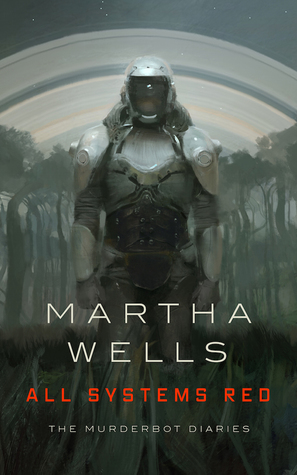
It looks like The Murderbot Diaries will end up with at least four novellas, and one can only hope there will be more. I can't tell you how much I love the character of Murderbot. I was hooked from the first line, and it only got better from there:
"I COULD HAVE BECOME a mass murderer after I hacked my governor module, but then I realized I could access the combined feed of entertainment channels carried on the company satellites. It had been well over 35,000 hours or so since then, with still not much murdering, but probably, I don’t know, a little under 35,000 hours of movies, serials, books, plays, and music consumed. As a heartless killing machine, I was a terrible failure."
I don't want to give away too much of the plot, but Murderbot the character is hilariously sarcastic, self-depreciating and incisively observant. The corporate-run future world is a brilliant commentary on our current corporate-run world, and Murderbot's journey to figure out its identity ("If people won't be shooting at me, what will I be doing?") is surprisingly touching.

Very different from Ancillary Justice, but Murderbot and Breq are kindred spirits, I think.

Also appropriate for YA audiences.

So now that I know how much I like Martha Wells, I think I'd better try her Ile-Rien books. Will let you know how that goes!

Here are a few photos from the area around Ronda, in southern Spain. Pretty spectacular scenery!


Monday, December 11, 2017

Landscape with Invisible Hand, by M. T. Anderson

If I tell you Landscape with Invisible Hand is about the transformative power of art, will you roll your eyes and move on to the next book? Because you should really stop and read this one before you go. It won't take you long.

This was an artfully crafted little book full of sadness and hope. I thought it was going to be satirical, but really it's just straight up angry. The vuvv have come with advanced technology to solve all the world's problems, but it turns out they only solve them for the rich, and the poor are stuck with unemployment and a ravaged environment. Sound familiar?

By raging against aliens shaped like coffee tables, rather than real-world perpetrators of real-world injustices, Anderson can get away with a lot of serious social commentary without coming across heavy-handed. It's a bleak book with a lot of really, really funny stuff in it. I kept thinking I'd put it down because Adam's life was just getting too depressing, but then a scene would happen that made me go ???!!! I have to see where this is going! (Like the chainsaw artist.) Also Adam's voice is hilarious and I loved being inside his head.

I love that each chapter is a vignette explaining a work of Adam's art. There's layers of—I want to say self-reference, but I'm not sure that's quite what's going on—prose describing art and also describing the artist creating the art and the reactions of people seeing his art, which we can't see but can only imagine. It's interesting and immersive. The art brings Adam's poignant frustrations closer but at the same time sets them in a context that allows perspective. (I guess that's kind of what art does, isn't it!)

I loved the ending; it was funny and hopeful and believable. Remarkably uplifting for such a scathing book.

Miso soup. Just when you think it's too salty, you realize that it's perfectly salty enough.

A Cybil's nominee for YA Speculative Fiction.

Monday, April 24, 2017

MMGM: This list should keep my 13-year-old nephew busy all summer!

This started in response to my sister-in-law's request for book recommendations for her 12-year-old son last year, and I've been very (very) slowly fulfilling it, one post at a time. Sorry, Stacey, it's taken me so long to compile this, and this is by no means a complete list, but I think it's long enough now! Be sure to visit my previous posts, here, here and here, and check the comments for more recommendations.

Science Fiction

The Fog Diver, by Joel Ross. Earth is covered in a dangerous nanite fog, so people have to sail around in airships. There are pirates.
Mars Evacuees, by Sophia McDougall. Dangerous adventures on Mars with a hilariously useless robot companion.
Ender's Game, by Orson Scott Card. Classic military academy adventure.
Nomad and Ambassador, by William Alexander. Kid chosen to be ambassador to aliens (because adults just aren't open-minded enough.)

Adventure in non-modern (usually fantasy) settings

Airborn trilogy, by Kenneth Oppel. Straight up adventure with airships. Great series.
Leviathan trilogy, by Scott Westerfield. More adventure on airships, but these ones are whales. No, really, it's awesome.
Sabriel series, by Garth Nix. Really cool magic and necromancy. The Old Kingdom is one of the best created worlds out there.
Graceling trilogy, by Kristen Cashore. Kick-ass heroine who's even better at using her brain.
A Stranger to Command, by Sherwood Smith. Might be hard to find, but if you liked Ender's Game, this is similar (just not in space).
The Thief series, by Megan Whalen Turner. If you like tricky, unpredictable main characters, he's the best. (I don't know what happened to my copy of The Thief, but you can see sequels The Queen of Attolia and The King of Attolia in the photo.)
Jinx trilogy, by Sage Blackwood. Reluctant hero has to save enchanted forest; he's quite grumpy about it. Very fun.
The Floating Islands, by Rachel Neumeier. Flying people, what more do I need to say?

Dragons

Wings of Fire series, by Tui T. Sutherland. Magic, friendship, adventure, finding out what you're good at: Harry Potter except everyone's a dragon.
Dragonhaven, by Robin McKinley. Boy grows up in a natural reserve for dragons, rescues a baby dragon. Turns out dragons are very hard to raise.


Adventure (possibly fantastical) in modern settings

Submarine Outlaw series, by Phillip Roy. Canadian libraries might have this one. Kid builds his own submarine and sails around the world having adventures.
Heir series, by Cinda Williams Chima. For everyone who knows they're really a warrior/wizard/dragon/sorcerer at heart.
Inkheart trilogy, by Cornelia Funke. A classic for a reason: books come to life. Because they do.
100 Cupboards trilogy, by N. D Wilson.  Not just one door to another world, but 100.
The Grimm Legacy trilogy, by Polly Shulman. What if you could borrow fairy tale objects from a library?
The Chronus Chronicles, by Anne Ursu. Looking for more Greek mythology after Riordan? These are really well done, and funny, to boot.

Humour

The True Meaning of Smekday, by Adam Rex. Aliens invade and it's really, really funny.
Terry Pratchett. If you like witches, try the Wee Free Men series. If you loved The Borrowers, try the Bromeliad trilogy.
Skullduggery Pleasant, by Derek Landy. A wisecracking skeleton solves mysteries with a snarky 12-year old.

Intriguing mysteries (fantastical or not)

The Mysterious Benedict Society trilogy, by Trenton Lee Stewart. For geniuses only. (The Society, not the books.)
Any and all of Frances Hardinge's books. They're fantasy, but I'm putting them under mysteries because they all have a certain creepy mysteriousness about them.
Greenglass House, by Kate Milford. A bunch of strangers trapped by a blizzard in an old house with a history of smuggling.

Phew! Isn't it wonderful how many wonderful books there are? Please add more to my list in your comments!

For ongoing recommendations, every Monday you can go to Shannon Messenger's blog for Marvelous Middle-Grade Monday. Also Boys Rule Boys Read! is a great blog aimed at boys: always new books to find there.

Friday, February 17, 2017

Cybils Awards Announced!

Ahem. Two days ago, actually. But in case you're as behind the times as I am, here's the link to all the winners. And the book we chose for YA Speculative Fiction is . . .

Illuminae, by Amy Kaufman and Jay Kristoff. I reviewed it last year when I first read it, and on a reread I still found it a lot of fun. We judged that it would have a ton of appeal to teen audiences, and we were impressed by the innovative format, which made the whole reading experience a little meta.

We did have a lot of debate before deciding on Illuminae, however, because we got a stellar short list to choose amongst. So I want to highlight the rest of the books, because they all deserve notice and recognition.

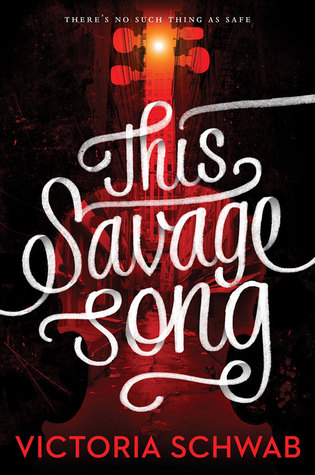
This Savage Song, by Victoria Schwab, is a dystopian Romeo and Juliet (sort-of, except they don't actually fall in love, so really not at all, but it totally has the "Two households both alike in dignity" thing going on) in the same vein as Marie Lu's Legend series. I really liked the monsters—the concept of how they're created, and the way the story questions what it means to be a monster. I liked the way music is used; I liked the way family relationships are explored. I loved both protagonists, their struggles with their own identities, and the prickly friendship they develop. The story comes to a satisfying close but definitely needs a sequel, which I will be eager to read.

Still Life With Tornado, by A.S. King. Brilliantly written book about an artist who can't do art anymore. Or about a family falling apart, or starting to heal. It kept surprising me, as King's books tend to do. It didn't seem like speculative fiction, except that it was definitely surreal. The protagonist is incredibly annoying at first, but just funny enough to put up with, until she breaks your heart. It's one of those books with lots of pieces that are interesting enough on their own, but when they finally all come together you have to gasp a little at how beautiful the final picture is. Not an easy book to describe, but a book you have to read.

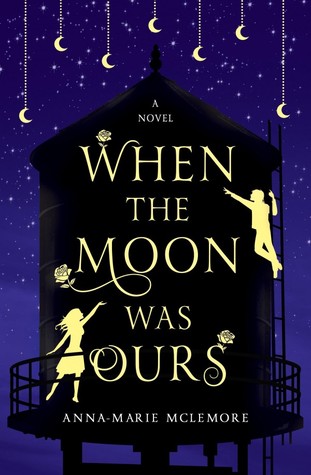
When The Moon Was Ours, by Anna-Marie McLemore is gorgeous, lovely, luminescent, tender, and a little bit unsettling. Magical realism at its most magical, it's a love story between Miel, who grows roses from her wrist, and Samir, who has a secret that, above all else, the four Bonner sisters cannot find out. There are glass pumpkins and cures for lovesickness and paper moons, and it's really not like any other book I've read. It has important things to say about choosing our own identity, and it says them beautifully.

I'll highlight the other three in my next post!

Monday, October 10, 2016

The Swan Riders, by Erin Bow

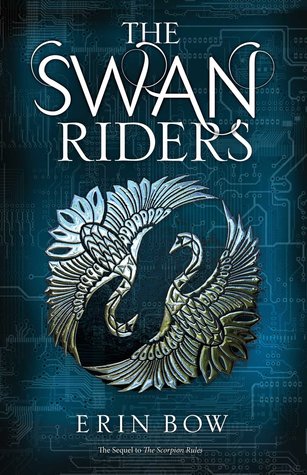
I was so excited to get this one in my mailbox. I loved The Scorpion Rules, and when I was offered a chance to review the sequel I had to edit all the exclamation points out of my enthusiastic reply. Erin Bow is simply an astonishing author; and this book is possibly even better than the first one (except that's actually impossible—when I reviewed The Scorpion Rules I said I wasn't sure I would reread it because of how intense it is, but I reread it before reading The Swan Riders, and loved it all to pieces even more).

Note that I will do my bestest not to spoil Swan Riders at all in this review (you really don't want it to be spoiled, trust me!), but it's impossible to talk about it without spoiling Scorpion Rules, so if you haven't read the first book, go read it now before you even look at the blurb for Swan Riders!

And if you've read Scorpion, then all you really need is this pretend blurb from E.K. Johnston:
"All the emotional punches of THE SCORPION RULES, but with horses instead of goats."
Very true. But, okay, I'll rave a bit more about it. LAST CHANCE NOT TO BE SPOILED FOR THE FIRST BOOK. Ahem. The Swan Riders starts right after the end of Scorpion.

Awesome first line:
So. It is perhaps not everyone who asks to be murdered, gets their wish, and then, three days later, finds that their most immediate problem is that they cannot ride a horse. 
Greta is riding across the Saskatchewan prairie with Talis (in Rachel's body) and two Swan Rider escorts, Francis Xavier and Sri. New characters that you will come to love with as much intensity as you loved Xia, Thandi, the Abbot, etc.  (Just so you don't get disappointed: Xia doesn't get any screen time in this book, though she's still an important emotional presence. But Elián does. Oh, Elián!)

We find out about Swan Riders—how and why they were created, their powers and limitations, why they choose to become Swan Riders, their relationship with Talis and the other AIs—and Bow has lots of room here for her trademark heartwrenching moral and existential dilemmas. Oh, Francis Xavier!

We find out more about Talis—oh, Talis! Some of the best scenes in the book are interludes from his point of view, memories that pack in a lot of world-building and explanation while being equal parts funny, creepy and heartbreaking. We meet a few more AIs, and learn more about why they are going insane (and why Greta might, if she can't get a grip on herself).

And, of course, because this is what the best science fiction does, Bow uses the idea of artificial intelligence, and Greta, who is turning into one, to explore what it means to be human. "The who of me. The why of me." What love means. Why it matters.

I said this in my CM Magazine review (I try to sound dispassionate and scholarly in these reviews, but sometimes my raving voice leaks through): Bow’s writing is elegant and exact: she illuminates rather than explains the technological and metaphysical complexities that underpin the novel, always bringing every idea back to the impact it has on an individual.
He'd seen it over and over: how a single memory rose from the organic mind, and then from the datastore, and then (reinforced, and stronger) from the organics, and then (reinforced, and stronger) . . . it was two mirrors reflecting each other. It was feedback squealing through a microphone. A single moment building to an intensity beyond what any psyche could endure.
 How could there be no circuit breaker? How could there be no grace? 
Those sentences that punch you in the gut. Lots of them in this book. (Talis learned how to "make it personal" from Erin Bow, just saying.) Lots of tense, visceral moments; lots of rock-you-back-on-your-feet plot twists. And humour, still so much humour. Talis being snarky, Elián being Elián, horses (with names like NORAD and Gordon Lightfoot) being horses.

I keep trying to write sentences that explain how wonderful Bow is at exploring really cool philosophical ideas with gripping drama, and my sentences keep getting tied up in themselves (like this one). Bow is just a master of metaphor and symbol and character and pacing, and everything, really.

The short version? If you loved Scorpion, you won't be disappointed in Swan, so just go read it already!
I've got the smell of roasting ham wafting through my house, and it's actually a good food metaphor for Swan Riders: salty, savoury, a bit smoky, meaty, all kinds of complex goodness.

Happy Canadian Thanksgiving, by the way! I'm thankful that we have awesome writers like Erin Bow in our beautiful country!