Showing posts with label noble heroes. Show all posts

Friday, November 15, 2024

MMGM: The Demon Sword Asperides, by Sarah Jean Horowitz

First off, this title is the best, isn't it? The catchy rhythm, the intriguing concept. Who doesn't want to read a story about a demon sword? And Asperides does not disappoint. World-weary, hell-weary, bitter and sarcastic—I loved the voice and perspective of a sword wielded for centuries by power-hungry villains.

Particularly when this sword ends up in the hands of a hapless, naive boy. Nack Furnival is desperate to prove himself to his family of brave knights, but he's really no good at sword fighting. It's easy for Asperides to trick Nack into believing he's an angel sword, and off Nack charges on a quest to right wrongs and save the innocent. Meanwhile an evil sorcerer has been resurrected, and he wants his sword back. Shenanigans ensue.

The Demon Sword Asperides is very funny—lots of snarky commentary from the sword, lots of hilarious juxtapositions of assumptions and intentions along with great slapstick and situational comedy. But it's also very—I want to say sweet, but I don't want you to think it's saccharine. Maple syrup sweet—it has depth and complexity. I'm willing to compare it to Terry Pratchett's humour, because there is real character growth and some pointed commentary about the world underlying the shenanigans.

I don't want to spoil anything, but Asperides has his own character arc. His relationship with Nack is the best kind of starts-off-unequal-with-deception-and-trickery turning into genuine care and each changing the other for the better. Nack learns that the heroes he worshipped might not be worthy of him and gets to choose who and what he values, including valuing himself. Satisfying all around.

I picked this one up from the library while waiting for The Dark Lord Clementine, which I am now even more eager to get my hands on. If you like Ursula Vernon and Eva Ibbotsen, Sarah Jean Horowitz will be right up your alley.

Marvelous Middle-Grade Monday is a long-running feature hosted by Greg Pattrige at Always In The Middle. Be sure to check out all the other great middle-grade recommendations this week! (I know, it's a little early for a Monday post. Time is arbitrary, ok?)

Thursday, January 27, 2022

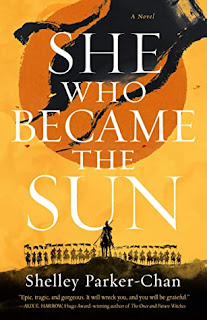
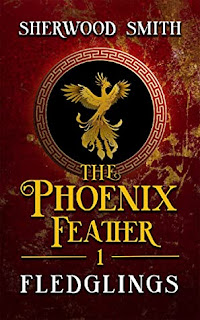
She Who Became the Sun and Phoenix Feather

I read these two novels back-to-back, and it was interesting to compare them, particularly since Iron Widow is still fairly fresh in my mind. All three have the Mulan trope at their heart: peasant girl (in Chinese-inspired world) disguises herself as her brother to go achieve goals in the wider world that involve fighting in battles, and she ends up kicking butt. Great trope! Three great novels with very different takes on it.

She Who Became the Sun, by Shelley Parker-Chan, is a historical fantasy based on the rise to power of the first Ming emperor—who was born a peasant, though was probably not actually a girl in disguise. (Though you never know!)

Fledglings is Book 1 of the Phoenix Feather series by Sherwood Smith, a secondary world fantasy based on the wuxia and xuanhuan traditions of Chinese novels: it follows three extraordinary children as they cultivate their talents and try to avoid the notice of an evil emperor.

Now, I'm going to stop my review right here and state that I am unashamedly biased in favour of the less realistic of these two premises. Because, much as I believe that it is possible to live by principles of justice and kindness, history generally doesn't. So, when I tell you that I enjoyed reading Fledglings more than SWBTS, it's entirely because I want my gentle, unrealistic world-view reinforced, and SWBTS is stuck with history. (Iron Widow is also stuck with history, but it has the advantage of giant fighting robots. Parker-Chan chose not to go that route, and I can't fault her for it, but I'm afraid she loses another few enjoyment points right there.)

Having said all that—She Who Became the Sun is a fabulous novel. We are drawn inexorably into a brutal world through the eyes of an unnamed, unvalued girl fighting for her life; we can't help but root for her as she uses her cleverness and her endurance to avoid starvation. Her decision to take on her brother's identity, Zhu Chongba, and with it his fate, is both terrifying and makes perfect sense. 

I loved the subtlety of the fantasy elements and the way Parker-Chan weaves them into her theme: there really is an external force of fate, and our two main characters take different approaches to their wrestle with its inevitability. Do we choose our destinies? Are the Heavens really watching? 

The writing is vivid with metaphor—I'm not going to say lyrical or poetic, and certainly not purple—Parker-Chan is utterly skilled at choosing the perfect metaphor to convey precisely what she means in every circumstance. (As opposed to those of us who rely too much on adverbs!)

I enjoyed Part I of the novel more, the coming-of-age and figuring out how to stay disguised as a boy part. But Part II starts getting really interesting when it introduces the eunuch general Ouyang, who ends up being Zhu's foil/nemesis character on the opposite side of the war. Parker-Chan kept me interested in all the complicated power dynamics at play by making all the players very real people with believable motivations. I am not a huge fan of revenge plots because I think revenge is dumb, but I was sucked into this one; I really felt for Ouyang.

[Slightly spoilery, except that the title spoils this, as does history!] There were parts of the latter half of the novel that reminded me of Macbeth: in many ways Zhu's rise to power is a tragedy ("I am in blood stepped in so far" is a speech that came to mind). Ambition is another motivation that I don't really get, but Zhu is so convincing; her every choice continued to make perfect sense, even as I wanted to close my eyes and not watch.

I don't know if I'm going to read the second novel. I know how it ends, and it's not with Zhu renouncing the world and achieving inner peace! But what I might do is read more of the history, and rewatch Empress Ki, and then read Parker-Chan's sequel with enough background to be fascinated by how she reimagines this pivotal moment in the history of China. Here's her explanation of the historical figures in the novel: it's quite fascinating!

Fledglings, on the other hand, is all about playing with fun story tropes: it's essentially the origin story of a martial arts hero, and it was just the immersive, familiar-feeling story I needed while I recuperated from whichever virus had me in its grip all week. Everything I love about Sherwood Smith's writing: excellent world-building details, great action scenes, wonderful character interactions. I particularly loved the depiction of the close-knit family, the parents trying to protect the children while the children chafe for the chance to pursue their identities. And of course off they go into the world, not quite the way they thought they would, and they still love and support one another, and it just gives me all the feels. A lighter version of Inda, very similar to A Stranger To Command. I've bought the second book and am going to start reading it now, so that's all I'll say about this one!

Friday, April 23, 2021

Digger, by Ursula Vernon


I just finished making my way through all twelve volumes of Ursula Vernon's webcomic Digger, and what a glorious, mind-bending, hilarious ride that was! It's all available now for free online, so you can go become obsessed too!

You know already I'm a rabid Ursula Vernon/T.Kingfisher fan. Well, now I'm rabider. (The vampire squashes may have had something to do with it: you have to keep your eye on those.) I also have an addition to my list of favourite heroines*: she's a practical-as-nails engineer who doesn't truck with magic or gods or prophecies, she's a mean hand with a pickaxe, and she's a wombat.

Yup. A wombat. Do you even know what a wombat is? I had to look them up. They're adorable. Digger-of-Unnecessarily-Convoluted-Tunnels, however, would give you a Look if you called her adorable. (And possibly favour you with a pithy wombat curse: her curses are the best!)

The thing about this comic is that it apparently started on a whim, and Ursula thought it would last for a few panels and be done. She threw together a bunch of random stuff like wombats, the elephant-god Ganesh (or a statue of him, anyway), an exiled hyena, a baby shadow-thing that doesn't know what it is, other awesome creatures I don't want to spoil for you—and if it were only the random juxtaposition of weird things with clever dialog and delightful art, it would be wonderful. But she kept going, and somehow she gathered up all her threads of weird randomness and wove them into a narrative of heartbreaking, breathtaking wisdom about how to be a decent, compassionate being in a world that doesn't make sense.

And because it's Ursula Vernon, the humour is laugh out loud, snort your tea all over the screen funny, and the philosophy can sometimes explode your brain.

Also, this web-archive includes comments from fans that greatly enhance the reading experience, as they reference everything from Star Trek to Terry Pratchett to Lord of the Rings, and debate archeology and geology and mythology and everything else.

Definitely worth a week or two of your life (there are around 800 pages!). It won a Hugo, after all.

Ursula Vernon writes for children, but I would say Digger is more appropriate for her T. Kingfisher readers (that's her pseudonym when she writes for adults). Not because of anything particularly graphic**, but, well, here are a few pages and you can judge for yourself:


And if those few pages don't make you want to read Digger immediately, then it probably isn't for you, and I despair of you, my child, I really do!


*which is going to get a blog post, really, I promise!

** I mean, other than the fact that it's a graphic novel. Get it? Graphic ... never mind.

Saturday, May 30, 2020

Tuyo, by Rachel Neumeier

You may have noticed that I'm a big Rachel Neumeier fan, so when I heard about Tuyo I was more than moderately excited. New story in an entirely new world! And she's so good at making worlds!

I did not anticipate how intensely I would adore this book. Ryo captured my heart from the moment we meet him kneeling in the snow tied to a stake, and I was unable to put the book down after that. I think it might be safe to say this is now my favourite Neumeier novel. It turns out I have some buttons, and Tuyo pushes all of them. In no particular order, things I loved about this book:

Intriguing world-building. Neumeier always creates fascinating fantasy landscapes and, even more important, believable societies to inhabit them: given the constraints of this landscape and these laws of physics/magic, what society would work to deal with them? Tuyo is set in a world divided by climate: the vast, snow-bound, moon-ruled winter lands and the gentle, fertile, sun-ruled summer lands. And I believed entirely in the Ugaro of the winter country and the Lau of the summer country—and in the reasons for their conflict.

Learning about a culture through fish-out-of-water characters. The two main characters are both competent and respected in their own country and confused and inept in the other, and this makes for a humorous and organic way to explore the world.

Military stories. I do not know why I enjoy these: I who have never held a weapon, never taken a martial arts class, believe strongly in peace and diplomacy and think war is a dumb way to solve problems. But it makes for great plots! I loved the two military societies: the tribal Ugaro with their harsh but fair laws governing conflict; the Roman-esque Lau with their orderly hierarchy and comradely soldier culture. I particularly loved watching characters from each society come to appreciate and value those from the other. And I was glad the fighting was not the main focus of the plot, even though there were some great action scenes. I love it when a conversation is more intense than a swordfight.

Heroes with integrity. I love plots that explore what honour is and the conflict of characters determined to do the right thing but not sure what that is. Ryo and Aras are on opposite sides of a war; they are loyal to different countries and believe in different goals; but they are both honourable men who keep their word. I loved watching Ryo negotiate between his duty, his loyalty and his word. I loved how oaths are used in Tuyo: so powerful.

Loyalty and trust. These are themes that stir me deeply, and Neumeier deals with them especially well. One of the main reasons I love the Black Dog books so much is the relationship between Ezekiel and Grayson Lanning—so many punch-in-the-guts moments between them—and the main relationship in this book is possibly even better.

Bromance. See above, re: loyalty and trust. All the feels here. I will not spoil who the bromance is between, but it's the best.

Interesting explorations of women in society. Love it when fantasies try out different ways of imagining women's roles, because, hey, it's fantasy—why wouldn't you?! I enjoyed what Neumeier did with women in the Ugaro society, and the contrast with the Lau and how the characters dealt with it. Female characters didn't play a huge role in this novel, but they were awesome!

Loved the world, loved the characters, am happy to know she intends to write more about them!

Monday, October 15, 2018

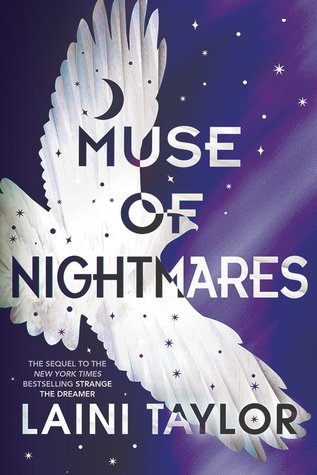
Muse of Nightmares, by Laini Taylor

Laini Taylor has done it again. She has exploded my brain, and all the little brain bits turned into stars and flowers as they floated down around me. (That's the kind of thing Laini Taylor says all the time, but she says it more elegantly so it doesn't sound stupid!)

Muse of Nightmares is the conclusion to Strange the Dreamer, and you cannot possibly read it if you haven't read Strange the Dreamer, so go read Strange the Dreamer now (I told you to a year ago, so if you didn't listen to me then you should rectify that lapse immediately.)

I'm not going to spoil either book in this review. If you've read the first book, you don't even have to read this: I'm sure you had Muse of Nighmares on preorder! (That cliffhanger! It's up there with LOTR and Riddlemaster of Hed, right?) All you need me to tell you is that it doesn't disappoint. It's tense, heart wrenching, shocking and entirely satisfying.

Strange the Dreamer introduces a crazily fascinating world with all of Laini Taylor's brilliantly imaginative touches: a city that no one can remember; a floating castle shaped like an angel; blue-skinned gods with terrible powers; a librarian no-one notices who has a knack for languages and who defines the world in kinder ways than anyone else.

Muse of Nightmares takes that world and expands it fractally, going forward and backward in time to explain and warp our understanding of everyone and everything

Strange the Dreamer gave us a cast of loveable, hateable, pitiable, admirable, terrifying and deeply understandable characters. (Most of them are all those things at one time or another, or all at once, like real people.) Laini Taylor must be a telepath, or a super-psychologist or something, because she is so good at understanding what goes on inside people's heads. I think Lois McMaster Bujold is the only other writer I know who is as good at forging character motivations out of their history. Everything each character does is completely inevitable based on who they are and what they've been through, even when they completely surprise you (as her characters often do).

Muse of Nightmares takes all those characters and gives them arcs you never would have dreamed of, mostly based on throwing them into even worse situations than you have imagined. And she adds a few more characters, because we need to understand how the gods got there and why they did what they did. Strange the Dreamer was about Lazlo and Sarai discovering themselves, and each other. Muse of Nightmares follows them but also dips into several other points of view as it answers why, and how, and WTF, and questions whether redemption is possible. When unthinkable things have been done to save people from even more unthinkable things, can there be forgiveness?

Minya is one of the best characters I've ever read. So broken. So strong. Can she be defeated? Can she be saved?

My other favourite character arc is Thyon Nero's. One of the many things Laini Taylor is great at is making all of her characters have agency, even the minor ones. She creates these ridiculously insoluble crises for her protagonists that you can't see how they can possibly get out of it, but you forgot about that other character who's been busy doing something you thought was irrelevant but turns out to be crucial and changes everything. Awesome plotting.

Since I can't say anything more specific about the plot, I'll just give you some favourite quotations:
... it spidered a crack through the atmosphere of threat.
... an affinity, a rush—like the turn of a page and a story beginning.
And when her hearts resumed beating, she imagined she could feel a spill of light into the veins that carried her spirit.
Lazlo's chances came without warning, and when they did, he didn't dither, and he didn't stop to pack.
[A character], earthbound, felt every choice he'd made, every action he'd taken, as a weight he carried with him. He wondered: Was it weight he could shed or throw off, or was it forever a part of him, as much as his bones and his hearts? 
Also, Laini Taylor is the absolute best chapter namer of anyone, ever:

  • From a Long Line of Indignant Nostrils
  • Like Eating Cake in Dreams
  • The Sea Stared Back
  • "Dead" Was the Wrong Answer
  • Like a Man Tearing Out His Own Beating Heart
  • Dread Was a Pale-Haired Goddess
  • Peace and Pastries
  • It Would Be Stranger If There Weren't Dragons 
And two quotations that probably define Laini Taylor best:
Even under dire circumstances, there is a unique pleasure in introducing the bizarre and inconceivable to others.
New dreams sprout up when old ones come true, like seedlings in a forest: a new generation of wishes.
Keep sprouting dreams for us, Laini. We need you in our brains!

Every once in a while I taste a cheese that makes my eyes roll back in my head it's so sharp but with so much depth and richness to the flavour; it does different things to every part of the tongue and keeps revealing new sensations as the after taste lingers. I tasted a cheese like that in Spain. Then they gave me a second piece with some quince jam spread on top, and my tongue and my brain exploded in much the same way as when I read this book. I just didn't know it was possible to taste/feel that much all at once. I'm still processing. (The book and the cheese!)


Saturday, March 17, 2018

The Clocktaur Wars, by T. Kingfisher

You'll have to excuse me while I fan-girl some more about T. Kingfisher. She just presses all the right buttons for me.

A few facts you need to know about her:

1. She goes by Ursula K. Vernon when she writes graphic novels and kids' books, and they're all fantastic and quite well-known (see: Harriet the Hamster Princess). Anything written as T. Kingfisher is probably not appropriate for readers younger than, say, 13-ish? It's not just that there might be sex, and possibly more daggers through eyes than you might want a younger reader experiencing, but her themes are deeper, her focus is more ... philosophical, for want of a better word. The world is a more complex place, both grimmer and more humane.

2.  She really gets fairy tales. As in, she has obviously imbibed so many, from so many different traditions, that folk-tales run through her veins, but also she has a genuinely weird imagination that works easily with fairy tale logic. The things she comes up with!

3. She is hilariously funny.

Clockwork Boys and The Wonder Engine—really just one novel broken into two—are a bit different than the others of hers that I've read. Not so much fairy/folk-tale inspired, but more of a re-imagining of the fantasy quest, with a healthy serving of vaguely steampunky Lovecraftian horror thrown in (and if you think that sounds weird, you're right!)

I was sucked in from the first scene, in which a forger fetches a murderer from a dungeon to go on a suicide mission. Oooh, dark, grim, edgy, you're thinking, and yes, it is, but the forger has a mysterious sixth sense that manifests as an allergic reaction, so she's sneezing to death the whole time. Plus her interactions with both the prison warden and the murderer (who is actually a paladin knight who got possessed by a demon, so that's a little complicated) are off-beat and unexpected (by both warden, paladin, and reader), so the whole scene is mind-bogglingly, hilariously interesting.

Then they go off to get the horrifically inventive safety measure that ensures they have to complete the mission (don't want to spoil it for you, but if they don't die trying they will just die painfully), and they meet their team-mate the assassin ("I don't like people unless I'm stabbing them."). Then they meet the 19-year-old self-righteous scholar who's never been outside his monastery and thinks women will turn his bowels to water. Who is also coming on the mission.

So it's the most extreme version of incompatible quest-mates I've ever encountered: the banter and drama is endlessly amusing. (As in, every second sentence made me smile, and every second page I was laughing out loud. Then came the scene with the horses, and I was gasping and wiping tears from my eyes the whole chapter.) Kingfisher knows how to structure a running joke, and that's basically what the whole first book is. (Something along the lines of "I wonder if we're going to kill each other before we even get to the place where we're likely all going to die.")

But, by the end of Clockwork Boys, the trust the four of them have built in each other is as moving as their differences were funny, and I genuinely cared about each one of them and about the fate of the team. Slate, Caliban, Brenner and Learned Edmund kill me in all the best ways, whether they're trying to kill each other or not.

The Wonder Engine is still funny, but it's also an intriguing mystery, a realistic adult romance, and a brilliantly explicated treatise on prejudice and marginalized people. When I wasn't laughing my jaw was dropping. Or I was just straight-up crying, because now these people I care so much about are having serious character development in some seriously tense situations.

Also, most hilarious torture scene ever written.

I think if you like Terry Pratchett you'll probably like T. Kingfisher. She's an auto-buy author for me now; I have yet to be disappointed in anything she's written.

The Clocktaur Wars is a balsamic/maple braised pot roast with red peppers and sweet potatoes (and I threw some kale in because you can hide kale in a sauce this rich and flavourful). Sweet, tangy, not exactly your normal pot roast, but still hits the pot-roast receptor in your brain most satisfyingly.

Tuesday, April 26, 2016

In which I discover anime

I didn't know very much about anime (still don't!): I'd seen My Friend Totoro and Howl's Moving Castle, and I'd heard of Sailor Moon (I'm revealing my age here, I know!). People whose taste in books I like often refer to Avatar: The Last Airbender in glowing terms, but the one time I tried watching it I was put off by the stylized way emotions were depicted and didn't get past the first episode.

But I kept seeing intriguing looking titles on Netflix, and I thought (as one does, with Netflix): what the heck, why not try something. So I did, and now I'm hooked. I'm running out of anime on (Canadian) Netflix I want to watch, so I need recommendations of where to go next.

Here's what I've liked so far:

Sword Art Online: I'm a sucker for dark-eyed loners with kind hearts and superior swordsmanship, so online game hero Kirito was the perfect gateway drug for me. I loved the art in this one: the stunning, imaginative online world, and the way the real world was subtly different, depicted in small details (like water dripping from a faucet). The character development kept me interested in the story, in particular the strong female characters. Just don't watch the second plot arc of the first season (starting in episode 16). It's awful. But Sword Art Online II redeemed itself.

Moribito: Guardian of the Spirit: a beautiful tale about a prince who hosts a water demon and the female bodyguard who swears to protect him until the demon can be born. Everything about this one is lovely: the art, the landscapes and period details, the characters, the gentle humour. Very sweet.


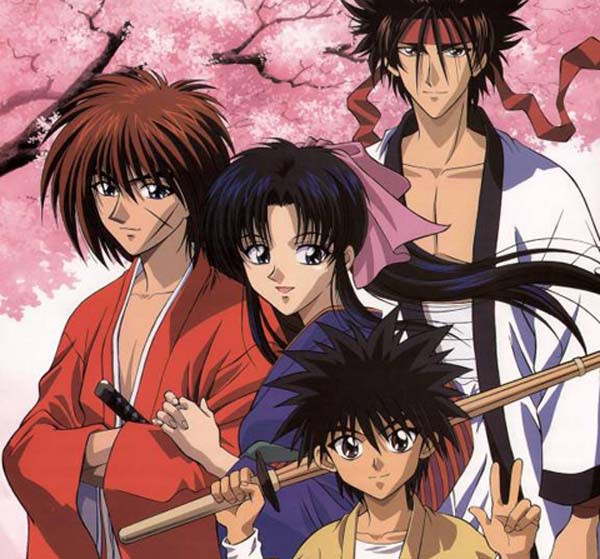
Ruroni Kenshin: a wandering swordsman protects the innocent with his reverse-blade sword, as atonement for the many people he killed during the Meiji Revolution as Battosai the Manslayer. Sounds serious, and there are some nice serious bits to it—mostly centered around Kenshin's struggle not to return to his former violent self—, but this one is mostly light and fun. It has a more "cartoony" art style with the exaggerated facial expressions I originally found annoying (eyes and mouth turn into geometric shapes to show various extreme emotions) but I'm getting used to now. The first season assembles a "team" that gets into various kinds of trouble against all sorts of bad guys. You can't take the plot too seriously, but I love all the character arcs. I also love all the historical references to the Meiji era. Plus, I might even love Kenshin more than I love Kirito ...

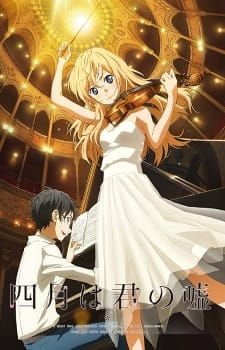
Your Lie in April: contemporary, realistic story about a pianist prodigy who stops playing when his mother dies, and the free-spirited violinist who rekindles his love of music. Gorgeous, gorgeous art, and a spectacular soundtrack. Depicts with grim accuracy the stress of competitions for young musicians, but also beautifully conveys the power of music to heal and transform. Quite impressive.

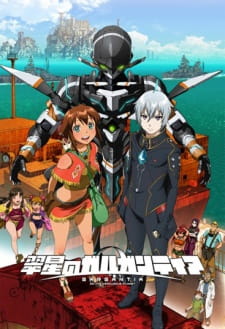
I also tried a couple of "mech-anime" titles, with giant fighting robots (because, giant fighting robots, of course!). I particularly enjoyed the world-building and plot arc of Gargantia on the Verdurous Planet, about a soldier from space who lands on a water-covered Earth and discovers there is more to life than fighting (Don't worry, there's still plenty of fighting. With giant fighting robots, of course. I loved the robot's personality!)


And I really liked the characters in Aldnoah.Zero, though the story of the Martian empire attacking earth was a little far-fetched.


Have you seen any anime shows you've particularly enjoyed? And where else can I go once I've exhausted Netflix's limited offerings?

Sunday, October 28, 2012

Sherwood Smith's amazing fantasy world

Whew! I'm finally finished all four of Sherwood Smith's Inda books. (When you download ebooks, you don't get a sense of how long they are: you don't get that satisfying heft of a thick book.) Now I can finally be productive again. (I've done pretty much nothing else but read for a week and a half, because they were so compelling.)

Sherwood Smith's name isn't as well-known as Robin McKinlay, Megan Whalen Turner, Orson Scott Card--but it should be. She has the ability of all the best fantasists: to make a world and a set of characters leap off the page and take residence in your brain, until you're quite certain you could buy a ticket and go visit, if only you could find the right train platform. What's unique about Sherwood Smith is that she has been working on the world of Sartorias-Deles since she was eight years old. I think she's actually been there. (My pet theory is that Smith is really a Norsundrian mage, and that's how she can skip through Sartorias-Deles's history observing everything and everyone.)

That's the strength and the weakness of Smith's Sartorias-Deles books: they read as if they were real history. The characters behave like real people, with all their contradictions and infuriating motivations; and the plots fit into a larger scope, so there are things that may not make sense in the current story, but that's what actually happened, historically. She has essentially an entire planet worked out, with political, magical, cultural and linguistic histories of probably 20 different countries. (Just go here and look at the map she's developed, and understand that for every country on that map she knows what their language sounds like, what their architecture and fashion looks like, what their food tastes like, not to mention the strengths and weaknesses of their political and military systems.)

So where should you start? So far I've only read the Inda books and Crown Duel/A Stranger to Command. I loved both sets of stories equally, but they do appeal to different readerships.

If you read my blog because you like all the YA and MG books I tend to like, then you should definitely read Crown Duel. (Make sure you get the version that includes Court Duel: they used to be published separately but the latest version of Crown Duel has both. Also, there's some awesome extra material at the end of my ebook that I don't know is there in the print version, so there's a good reason to get an e-copy. (Besides the fact that there aren't a lot of real books around.))

Meliara is one of the original kick-ass heroines (along with Harry and Aerin from Robin McKinley's Damar books, and Tamora Pierce's Alanna). The great thing about Meliara is that she's real. Sure, she's taken swordfighting, but she's not actually that good at it. She's idealistic and determined to right the wrongs in her country, but she's a little ignorant about politics and maybe doesn't make the best choices. She's got spunk--which gets her into more trouble than it gets her out of. And she's stubborn--which can be a good thing, but not always. But she has enough humility to recognize when she's wrong, and she wins everyone's hearts because of her honesty and courage.

The first half of the book (the original Crown Duel) is fighting and getting captured and escaping and being chased; the second half (Court Duel) is set at court (duh) with intrigue and plots and secrets and stuff. I'm not even going to mention the second main character, because you have to discover him for yourself. (Let's just say this is the best kind of romance: where the characters don't even know it's a romance until it's almost too late!) And when you do discover him, you'll be as anxious as I was to read A Stranger to Command, which is his coming-of-age story. (I'm not giving you a link, because I don't want you to go find out who he is before you read Crown Duel.) Then once you've read that, you'll want to read more about Sartorias-Deles, and find out about those mysterious Norsundrians.

I haven't read all the Sartorias-Deles stories Smith wrote when she was younger. They're not as polished, so I think I'll have to be in the right mood for them. (I will read them, because there are so many unanswered questions!) I decided to try the "historical" novels, which are set 400 years before Crown Duel.

If you're an adult* who likes really epic (ie: long and complicated) military fantasy, if you can handle lots of shifts of point of view, and if you don't mind being confused at the beginning as an entire social/military/political system with its own jargon is gradually revealed to you, then you'll like Inda and its sequels. The story begins with a ten-year old boy being sent to military academy. There's an Ender's Game-like section at the academy (which will be familiar to you if you read A Stranger To Command). Then Inda gets exiled and we enter the pirate phase of the story (I know: pirates!) Inda is very much an Ender-type of character, a brilliant strategist and a born leader who endures incredible suffering and remains good (kind, loyal, fair, unarrogant). He's the hero who doesn't recognize his own heroism. He and his group of loyal friends have all kinds of adventures culminating in great battles (both land and sea) against the invading Venn. The plot is epic, vast, with threads and characters going all over the place, but you care about all the characters. You care about Inda--oh, he breaks your heart! He's now up there with Miles Vorkosigan, Horatio Hornblower, Harry Dresden, Eugenides--as my current favourite noble, scarred heroes.

So far everything of Sherwood Smith that I've read is going to stay in my iPod for future escape-out-of-the-universe, fall-in-love-with-the-characters, can't-put-the-story-down comfort reading. And she's got a whole whack of other books I haven't even looked at yet. (But I have to pace myself: one must occasionally be productive.)

Since I can smell it now (I just took it out of the oven) and it is the best thing ever, I'm going to compare Sherwood Smith's books to Upside-down Buttermilk Pear Cake (which is also supremely scrumptious with plums instead of pears). To die for. I'm going to go have a piece right now. Then I think I'm going to download The Trouble With Kings. Or maybe The Spy Princess. Oops, I mean, I'm going to go be productive. Seriously.

*There's quite a bit of violence in the Inda books, though no gratituous gore, and definitely lots of sex--not graphic, but you know what's going on behind the bedroom door, and it's often pretty interesting. (Let's just say that there's probably no Marlovan word for "monogamy.")