David Malki, author of the webcomic Wondermark, has been reading old newspapers and discovering that issues of intellectual property rights have been thorny and contentious from the beginning. He's doing a series of blog entries presenting arguments from newspapers of the late 1800s and comparing them to current arguments. Turns out the internet hasn't really changed the name of the game! It's worth a read; I find it fascinating.
He makes a point that I think is the most pertinent in all the discussions:
So, in a world where piracy exists, my task as an author is to make the legitimate consumption of my work the path of least resistance.
Hear, hear! (Creators of Leverage and White Collar, are you listening? Please allow me to purchase your latest seasons in Canada!)
(Note that this is the second time a tweet may have been more appropriate than a blog entry. I'm keeping track. Maybe if it happens again I'll consider using my Twitter account.)
Thursday, February 9, 2012

Wednesday, February 8, 2012
Compulsive Re-Reading, or why I never get around to blogging
Book Aunt had a post around Christmas time asking if people had books they liked to reread over holidays, and that post inspired this one. I don't limit re-reading to holidays curled up by the fire. I re-read books all the time.
When I started to think about the books I choose to read over and over again, I thought I'd try to analyze what made me want to experience them multiple times. The word "experience" is the key: what sort of experiences do books offer that can be enjoyed even when you already know what happens? Here are a few of my thoughts, with examples from the books that I love to re-read (I've linked to descriptions of the books, in case my vague references don't make them immediately obvious!)
The experience of place: otherwise known as the Narnia effect. I must have read the Chronicles of Narnia at least once a year for most of my childhood and adolescence. I so badly wanted to go to Narnia, and reading the books was the only way to get there. (Okay, I still want to go! When I read them now, it amazes me how few words Lewis needs to create such a compelling world.) There are a number of fantasy worlds that I enjoy spending time in: Lyra's world; Earthsea; Ancelstierre; Damar, or any of Robin McKinley's other worlds; Discworld; Hogwarts. But I also love to go to Arthur Ransome's Lake District (I finally did a few years ago; it was just as he had described it), or to the nostalgic England of E. Nesbit's children, or to The Secret Garden. I do love places with cool magical systems and creatures, but even if a place is perfectly realistic, if the author loves it then I want to keep coming back to it.
The experience of people: there are some characters I wish were my real friends, and some that I'm glad aren't real but they're a lot of fun to hang around with! Elisabeth Bennett, Anne of Green Gables, Jane Eyre, Sara Crewe, Vicky Austen, Meg and Charles Wallace, Tiffany Aching, Sophie and Wizard Howl, Ender Wiggins, Vidanrik Renselaeus, Marquis of Shevraeth (I haven't re-read him yet since I just discovered him, but I will!), Miles Vorkosigan, Thursday Next . . . I've got another bookshelf upstairs I could check, but this is a pretty good list! These characters are not like me: they are clever and brave and spunky, and these qualities get them into as much trouble as they get them out of. I wish I could be them, but I'd settle for being their sidekick!
The experience of drama: once you know how it ends you don't get to feel the suspense again (unless you have as bad a memory as I do, in which case sometimes you can!), but those dramatic moments are worth reliving. Sometimes I skip through books just to get to the good parts.
Elizabeth rejecting Darcy's proposal;
Jane choosing to leave Rochester;
Eugenides noticing Attolia's earrings;
Edward kissing Bella for the first time (not the 247th time; it does get old!);
Lyra finding Roger clutching the dead fish because his daemon is gone;
Katsa throwing that knife at the end;
Harry returning to Corlath after disobeying a direct order and riding off to save the kingdom;
Molly Weasley facing Bellatrix.
Scenes that twist your heart, scenes that make you jump up and yell "Yes!" Little guys facing down big guys; difficult truths being spoken; noble sacrifices being made. Like the taste of homemade bread or the smell of roses, the emotional intensity of these moments is necessary to my well-being. I love drama more than I love sleep, which is saying a lot!
The experience of voice: I will read anything written by my favourite authors, because I love listening to them talk. They could be talking about walking their dog and picking up the dry-cleaning; it's not the content, it's the way the words are strung together. Part of it is facility with language: I opened up I Shall Wear Midnight at random and here's a sentence:
 But voice is more than just excellent writing; it's also the mind behind the writing. I can enjoy a book with an exciting plot and interesting characters and competent prose, but if there isn't some fundamental idea behind it all that resonates with me, I won't read it again. Authors I re-read have a strong world view, a sense of right and wrong, an appreciation of what is beautiful and just. They may be lyrical, they may be funny, but they all have a certain fierceness: they have written the truth and they know it. (I don't mean that the author is opinionated or, heaven forbid, preachy; in fact often the authors don't know that they've written truth, or what truth they've written. But their voice knows.) I don't have to agree with their world view, but they have to believe in it, and then it comes through in their voice and then I have confidence in their story and want to be carried along in it.
I also only re-read books with happy endings, so I guarantee that in all the books linked to in this post the girl will get the guy, the evil whatsits will be defeated, the loner/outcast with no talent will have found his/her place in the world and humanity will have proved itself redeemable, if only just. (Is that why most of my re-reading happens to be fantasy? No! I firmly believe happy endings happen in real life too! I do.)
When I started to think about the books I choose to read over and over again, I thought I'd try to analyze what made me want to experience them multiple times. The word "experience" is the key: what sort of experiences do books offer that can be enjoyed even when you already know what happens? Here are a few of my thoughts, with examples from the books that I love to re-read (I've linked to descriptions of the books, in case my vague references don't make them immediately obvious!)
 |
| Coniston Water, Lake District (could be Narnia, couldn't it!) |
 |
| Please tell me you know this is Anne of Green Gables |
The experience of drama: once you know how it ends you don't get to feel the suspense again (unless you have as bad a memory as I do, in which case sometimes you can!), but those dramatic moments are worth reliving. Sometimes I skip through books just to get to the good parts.
Elizabeth rejecting Darcy's proposal;
Jane choosing to leave Rochester;
Eugenides noticing Attolia's earrings;
Edward kissing Bella for the first time (not the 247th time; it does get old!);
Lyra finding Roger clutching the dead fish because his daemon is gone;
Katsa throwing that knife at the end;
 |
| If you don't mind reliving the best use of a swear word in literature, this is quite funny |
Molly Weasley facing Bellatrix.
Scenes that twist your heart, scenes that make you jump up and yell "Yes!" Little guys facing down big guys; difficult truths being spoken; noble sacrifices being made. Like the taste of homemade bread or the smell of roses, the emotional intensity of these moments is necessary to my well-being. I love drama more than I love sleep, which is saying a lot!
The experience of voice: I will read anything written by my favourite authors, because I love listening to them talk. They could be talking about walking their dog and picking up the dry-cleaning; it's not the content, it's the way the words are strung together. Part of it is facility with language: I opened up I Shall Wear Midnight at random and here's a sentence:
It was a nervous statement with a wiry little question clinging to the end of it, waiting to burst into tears.Here's a random Laini Taylor sentence:
They laughed alike and moved alike, and they thought the same thoughts as completely as if a butterfly traveled back and forth between their minds, bearing ideas on its legs like pollen.Sentences like these make me happy. With some authors it's not so much individual sentences as the way sentences and paragraphs all build on each other, layer upon layer of meaning: Connie Willis is brilliant at this; so is Patricia McKillip. Nothing extraneous, everything necessary. Craft, is what it is, using words as tools.
 But voice is more than just excellent writing; it's also the mind behind the writing. I can enjoy a book with an exciting plot and interesting characters and competent prose, but if there isn't some fundamental idea behind it all that resonates with me, I won't read it again. Authors I re-read have a strong world view, a sense of right and wrong, an appreciation of what is beautiful and just. They may be lyrical, they may be funny, but they all have a certain fierceness: they have written the truth and they know it. (I don't mean that the author is opinionated or, heaven forbid, preachy; in fact often the authors don't know that they've written truth, or what truth they've written. But their voice knows.) I don't have to agree with their world view, but they have to believe in it, and then it comes through in their voice and then I have confidence in their story and want to be carried along in it.
I also only re-read books with happy endings, so I guarantee that in all the books linked to in this post the girl will get the guy, the evil whatsits will be defeated, the loner/outcast with no talent will have found his/her place in the world and humanity will have proved itself redeemable, if only just. (Is that why most of my re-reading happens to be fantasy? No! I firmly believe happy endings happen in real life too! I do.)
Monday, January 9, 2012
Books I got for Christmas
Or, rather, books I gave myself for Christmas. It's one of my favourite Christmas treats, the trip to the bookstore where I'm allowed to buy whatever I want! Some of the books get wrapped and labeled with my children's names, but we all know who they're really for!
 This year I snapped up the first YA offering from Jasper Fforde, who I rank up there with Douglas Adams and Terry Pratchett in the absurd British fantasy category. (And I discovered there's another book in his Thursday Next series that I haven't read. Now I get to reread them all and then I get to read the new one!)
The Last Dragonslayer is trademark Fforde, but with a simpler plot: it isn't as completely brilliant and subversive as The Eyre Affair, but it's a lot of fun. Quirky characters with silly names, magic that gets flummoxed by the idiocy of modern life, a practical orphan who takes care of everyone and then finds out she has to save the world (and appear on talk shows). And a Quarkbeast. And a dragon. Whose immanent death causes a crazy real-estate rush. It's excellent fun, and maybe just a little bit satirical (a teensy wee bit!). Like a really good chocolate chip cookie with Smarties in it. (Not that Smarties are very satirical. But they're fun.)
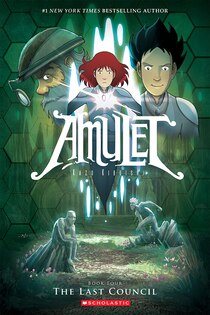
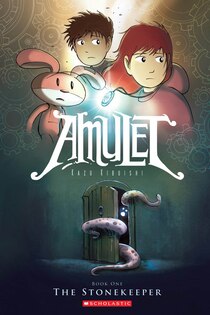
 This one I wrapped up with my son's name on it, because he's read the first three of Kazu Kibuishi's Amulet books, and was devastated by the cliffhanger ending of book three. I'm now rereading the first three, so I haven't cracked Book 4, The Last Council, but it looks every bit as gorgeous as the others. These are beautiful graphic novels with a compelling storyline and a stunning alternate world. I was pulled right in from the opening sequence of Book One: The Stonekeeper. (I deliberately didn't link you to Amazon or Goodreads or anywhere with a blurb about Book 1, because they all give away what happens at the beginning (I know it doesn't count as a spoiler if the book opens with it, but it still spoils the opening scene, I think. Consider yourself warned!)).
 After the really good opening scene which I will not ruin for you, Emily and Navin move out to their great-grandfather's old, spooky house, and Emily finds an amulet in the attic. It's when they venture into the basement that the real adventure begins, with a spectacular two-page spread of the staircase winding down, down, down. I love the beautiful and terrifying world they discover. I love Emily and her struggle to do right by her family even when she's being pulled in heroic directions; I love Navin who wants to prove himself and then gets way more of an opportunity than he was expecting. I'm excited to see what new magical places and people we'll get to see in the fourth book. Because so much of the appeal is visual for me, I can't seem to come up with a food metaphor; music is better. (Am I being slightly synesthesic about this?). The Amulet books are like the classical composer Saint Saens (and this).
 I have to interrupt this blog post, because while I was on Goodreads I came across a link to Hyperbole and a Half, and I've now spent two hours laughing out loud reading her posts. She's a little twisted and very perceptive and has this way of describing things, and these hilarious kid-drawing pictures. My mom probably won't like her (she does swear a lot)(the blog author, not my mom!), but if you like your humour dark and offbeat, check it out. The first post I read was a rather brilliant summary of clinical depression. Then I tried How A Fish Almost Destroyed My Childhood. Also be sure to read A Better Pain Scale and The Alot. (The picture comes from Am Adult, also hilarious.)
We now return to this blog post, which is now too long, so I'll have to make it To Be Continued . . .

The Last Dragonslayer is trademark Fforde, but with a simpler plot: it isn't as completely brilliant and subversive as The Eyre Affair, but it's a lot of fun. Quirky characters with silly names, magic that gets flummoxed by the idiocy of modern life, a practical orphan who takes care of everyone and then finds out she has to save the world (and appear on talk shows). And a Quarkbeast. And a dragon. Whose immanent death causes a crazy real-estate rush. It's excellent fun, and maybe just a little bit satirical (a teensy wee bit!). Like a really good chocolate chip cookie with Smarties in it. (Not that Smarties are very satirical. But they're fun.)
 I have to interrupt this blog post, because while I was on Goodreads I came across a link to Hyperbole and a Half, and I've now spent two hours laughing out loud reading her posts. She's a little twisted and very perceptive and has this way of describing things, and these hilarious kid-drawing pictures. My mom probably won't like her (she does swear a lot)(the blog author, not my mom!), but if you like your humour dark and offbeat, check it out. The first post I read was a rather brilliant summary of clinical depression. Then I tried How A Fish Almost Destroyed My Childhood. Also be sure to read A Better Pain Scale and The Alot. (The picture comes from Am Adult, also hilarious.)
We now return to this blog post, which is now too long, so I'll have to make it To Be Continued . . .
Saturday, December 17, 2011
Sharon Shinn, The Safe-Keeper's Secret
I picked this book up in a random library browse. Sharon Shinn's name rang a bell with me, but at the time I couldn't place why. The cover wasn't striking, but the concept seemed interesting, so I took the book home. (Have I mentioned that I love libraries?)
It turns out that I've read some of Sharon Shinn's adult books and really enjoyed them. Her Samaria novels read like fantasy but have a sci fi explanation in the end (which I won't give away): it's a non-technological society with angels to rule over and protect them. In Archangel, Rachel is chosen to be the bride of Gabriel the archangel, but she's not happy about it. There's reluctant romance, dangerous politics, Old-Testament-like mythology (in case the names didn't give it away), singing, and magic that's really science but everyone's forgotten. A good read, and now I want to go back and read the Samaria novels I missed.
 The Safe-Keeper's Secret isn't anything like the Samaria books. Set in a small English-like village in some non-modern time period, it's a quiet story about people with the gifts of keeping secrets, telling the truth, and granting dreams. I love that secret-keeping and truth-telling are magical powers. The story opens with a child being delivered to the village Safe-keeper, the woman who will keep whatever secret she is told, and the child's identity is a secret she keeps for most of the novel. She raises the child with her own as if they were siblings. The story follows Fiona and Reed's coming of age and discovery of who they really are.
I loved this book, and I'm still not sure exactly why. It's not exciting, there's no great peril, no important quest, not a lot of action of any kind, really. For a while I couldn't figure out who the antagonist was. Almost every character is caring and nice, and just about everyone loves Reed and Fiona. I think I liked the book so much because I cared so much about the characters. They were all individuals with their own sorrows and dreams, however small, and I wanted them all to find their place in the world and I cheered when they did. I think, in the end, the antagonist is the secret: the truth about who Fiona and Reed really are that changes everything when it's revealed. But the story is subtle--there isn't burning suspense all the way through. Fiona and Reed don't particularly care that they don't know who their parents are. Except that they do, of course, and that niggling question really does propel the plot as they each struggle to fit where they think they belong.
I feel like I'm not selling this book as strongly as I want to. It's deftly written and a pleasure to read and it deals with all the important parts of life: who we love and what we want to be and telling the truth when the right time comes. There are lovely bits of symbolism woven all through, and it just, well, it just made me happy. It's a little jewel, well worth an afternoon of your time.
It turns out that I've read some of Sharon Shinn's adult books and really enjoyed them. Her Samaria novels read like fantasy but have a sci fi explanation in the end (which I won't give away): it's a non-technological society with angels to rule over and protect them. In Archangel, Rachel is chosen to be the bride of Gabriel the archangel, but she's not happy about it. There's reluctant romance, dangerous politics, Old-Testament-like mythology (in case the names didn't give it away), singing, and magic that's really science but everyone's forgotten. A good read, and now I want to go back and read the Samaria novels I missed.

I loved this book, and I'm still not sure exactly why. It's not exciting, there's no great peril, no important quest, not a lot of action of any kind, really. For a while I couldn't figure out who the antagonist was. Almost every character is caring and nice, and just about everyone loves Reed and Fiona. I think I liked the book so much because I cared so much about the characters. They were all individuals with their own sorrows and dreams, however small, and I wanted them all to find their place in the world and I cheered when they did. I think, in the end, the antagonist is the secret: the truth about who Fiona and Reed really are that changes everything when it's revealed. But the story is subtle--there isn't burning suspense all the way through. Fiona and Reed don't particularly care that they don't know who their parents are. Except that they do, of course, and that niggling question really does propel the plot as they each struggle to fit where they think they belong.
I feel like I'm not selling this book as strongly as I want to. It's deftly written and a pleasure to read and it deals with all the important parts of life: who we love and what we want to be and telling the truth when the right time comes. There are lovely bits of symbolism woven all through, and it just, well, it just made me happy. It's a little jewel, well worth an afternoon of your time.
Sunday, November 13, 2011
Octavia Butler and Daughter of Smoke and Bone
It occurred to me that I might blog more often if I didn't spend three hours writing a blog entry. That last one could have been three posts, couldn't it? Hmm. In the meantime, the writing is still happening, slowly. It feels rather like getting ketchup out of the bottle. I'm hoping for the sudden blurp when way too much ketchup ends up on your hamburger, but I'm still waiting. Like in the Heinz commercials. (It doesn't help that I checked on my geography today and discovered that a key plot point is impossible. (And this is geography I'm intimately familiar with, so I don't know why I came up with that plot idea in the first place.) The story is set in the future, though, so maybe I'm going to have to give Vancouver that earthquake that we're all waiting for and alter the geography so my plot still works. I love fiction.)
I know I mentioned Laini Taylor's newest a few weeks ago, and I've been meaning to blog about it, but I want to do it justice and I haven't felt like I could devote the time required. Which is stupid, because it means I'm not blogging about it at all.
 But first I have to mention an adult science fiction writer I just discovered: Octavia Butler. I borrowed her novel Fledgling from a friend of mine. What a great title. (And I love the cover.) What an interesting, interesting book. This is a novel about vampires that you should not read if you generally like vampire novels. Intellectual is not quite the right word, but it's close. What if vampires didn't kill people; what if they entered into symbiotic relationships with them, relationships of love and trust in which the humans get whatever they want, but the vampires have all the control. Would that be okay? I found it fascinating how Butler kept my sympathy with the narrator: the young vampire does things that would be reprehensible if a human were to do them, but she does them within her own moral and ethical code, so they feel right. And the fact that they feel right feels seriously creepy. Fledgling has a plot with its own suspense, but to me the page-turning aspect wasn't what was going to happen next, it was what will I agree with next. Deliciously interesting. Like sushi.

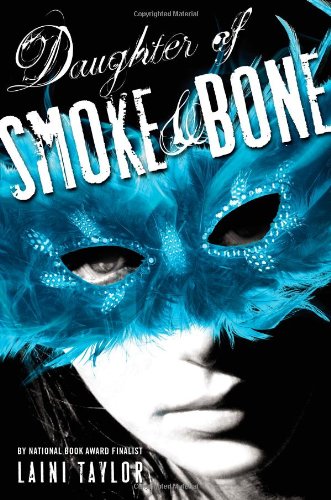
Okay, Daughter of Smoke and Bone, by Laini Taylor. It hardly needs my endorsement, since it's made all kinds of Best Books lists and everyone is raving about it, but I'll continue my Laini Taylor fandom and say you have to go read this book. It has everything I like about Taylor's writing: lush prose, dense with colorful detail, incredibly imaginative world-building, traditional mythologies mined for their deepest gems and then turned into something entirely new (angels and devils, yes, but these are not the angels and devils anyone else is writing about). My favorite thing about this novel? It's set in Prague, the most beautiful, evocative, artistic city I've ever visited. I also loved Karou's best friend the puppeteer. And the shop with doors that open in places around the world. Best use of teeth in a fantasy. I could go on, but I don't need to. I was thinking I'd compare it to a Czech dish, something desserty you'd eat with coffee in the afternoon: maybe apple strudel or blueberry dumplings. I only hope that the success of this series (yeah, cliffhanger ending: there'd better be another book coming!) allows her to get back to the Dreamdark books.
I know I mentioned Laini Taylor's newest a few weeks ago, and I've been meaning to blog about it, but I want to do it justice and I haven't felt like I could devote the time required. Which is stupid, because it means I'm not blogging about it at all.

Okay, Daughter of Smoke and Bone, by Laini Taylor. It hardly needs my endorsement, since it's made all kinds of Best Books lists and everyone is raving about it, but I'll continue my Laini Taylor fandom and say you have to go read this book. It has everything I like about Taylor's writing: lush prose, dense with colorful detail, incredibly imaginative world-building, traditional mythologies mined for their deepest gems and then turned into something entirely new (angels and devils, yes, but these are not the angels and devils anyone else is writing about). My favorite thing about this novel? It's set in Prague, the most beautiful, evocative, artistic city I've ever visited. I also loved Karou's best friend the puppeteer. And the shop with doors that open in places around the world. Best use of teeth in a fantasy. I could go on, but I don't need to. I was thinking I'd compare it to a Czech dish, something desserty you'd eat with coffee in the afternoon: maybe apple strudel or blueberry dumplings. I only hope that the success of this series (yeah, cliffhanger ending: there'd better be another book coming!) allows her to get back to the Dreamdark books.
Thursday, November 10, 2011
Books I'm Grateful for
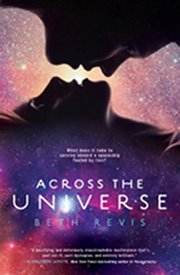 I just finished Beth Revis' book Across the Universe, and as I usually do when I finish a good book and don't want to let go, I went to her website. Good news: the next book is coming out in January! Also good news: Beth Revis has a terrific blog. She has a contest going that I thought was a great idea (even though the Canadian Thanksgiving is over!): Give Thanks for Good Books.
 What books should I give thanks for? Beth already used Narnia, so ditto. I have to mention everything by Madeleine L'Engle, particularly A Ring of Endless Light, for getting me through an awkward adolescence. Jane Eyre and Pride and Prejudice, of course. Oh, I can't leave out M.M. Kaye's Far Pavilions (I reread it a few years ago, and I have to admit I liked the Far Pavilions in my head better: it was still epic and sweeping and tragic and romantic and exotic, just not quite as much as I remembered it. But I was fourteen when I read it, so that explains a lot.)
But before I go on and on nostalgically, I think I'd like this post to be about books being written now. I'm grateful that people are writing books that are unique, quirky, crazy weird, or just thoughtful. Books that take you out of your head and then put you back in at a slightly different angle. Here are a few I've read recently:
 There is No Dog, by Meg Rosoff. This is an author who definitely does her own thing; I dare anyone to try to categorize her books. They're not even like each other, except insofar as they are all brilliantly written and make you laugh and cry and go "huh." (Her titles are all great, too.) This one starts with the intriguing (and potentially blasphemous) premise that God is really a sex-crazed teenaged boy named Bob. If it was only about Bob and his attempts to make it with Lucy, the latest human he's fallen in love with, it might have become tiresome. But it's also about Lucy, the assistant zookeeper who loses a capybara, and about Lucy's mother, and Lucy's mother's priest, and it's about Mr. B, Bob's longsuffering assistant, who tries to keep up with all the prayers and mitigate Bob's various disasters, and Bob's floozy of a mother, who won Earth for him in a poker game, and the last Eck, Bob's pet, who is in danger of getting eaten and is rather sad about it. Normally I don't like novels that jump around between every character's point of view, but I liked all of these characters, with their flaws and needs and worries. I liked the way everything fell apart only to come together in unexpected ways. I loved the whales. (Fairly certain they're a nod to Douglas Adams, whose worthy successor Meg Rosoff could be (except not quite, because she isn't like him either).)This is not a blasphemous book: it's a funny, honest, touching and surreal exploration of what a God might be, and how one might still have faith despite how messed up everything is. This book was dense and sweet and full of flavours both familiar and unusual, rather like the sweet potato cake I made last week.
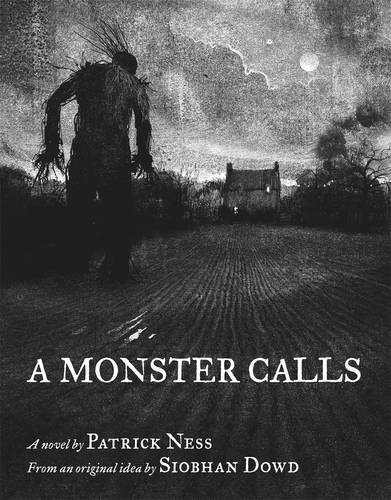 A Monster Calls, by Patrick Ness, inspired by Siobhan Dowd. You remember Patrick Ness, from Chaos Walking? I don't really need to say anything more, (and this blog post is getting too long, and I couldn't possibly do it justice anyway). Just go find this book. The illustrations are stunning, the story is strange, funny, powerful, and beautiful. You will cry. It will be cathartic. The concept is unique and yet feels inevitable, like a folk tale. The monster that shows up outside Conor's window is terrifying, but Conor isn't afraid of it because the monster from his nightmares is far more frightening. This is a fantasy book that's so realistic it tears your heart out. I'm going to compare this to the yak steak I had at a fancy restaurant once: beefy and tender with a sauce that hits all the ancient receptors in the brain.
Guess I should give a writing update: day 10, and I've written 9 1/2 pages. Not a whole lot, but I've done a bit every day, so I'm meeting my goal.
Thursday, November 3, 2011
Canadian Book Week: Kenneth Oppel
It's day three of Novel Writing Month, and so far so good: I have written something every day. Not much (I'm at about 4 pages longhand), but I'm getting to know my characters and setting and getting closer to figuring out my plot. (I think.)
This blog post has been sitting half-finished for weeks, now, so I figured I could procrastinate today's writing and finish it.
I have not forgotten my promise to focus on a Canadian author once a month, and this month it just has to be Kenneth Oppel, because his latest book has just come out, and it's awesome!
 That is an amazing cover, is it not? It gives you setting, mood, character; it reaches out and sucks you in; it promises you will be transported into the world beyond the keyhole. But really, all you have to read is the subtitle and you know you have to read this book. I mean, "The Apprentiship of Victor Frankenstein": how audacious is that?
But if anyone can tell a convincing story about fiction's most famous monster-maker, it's Kenneth Oppel. He's a versatile writer with a sure sense of story. He's written picture books, early readers, middle-grade and YA novels, all with strong characters and lots of action but also thematic depth and real emotion.
Does This Dark Endeavor live up to its cover? Yes. I had my reservations, because I wasn't sure I would like the character of Victor, but by the end of the novel I was convinced. If you have any interest in the Frankenstein story, if you love secret libraries and alchemy and finding impossible ingredients for the elixir of life, (and who doesn't?) then you have to read this book.


The Airborn series is for slightly older readers, and the airships and goggles on the covers do not lie: this is classic steampunk: an alternative history in which zepplins become the transportation of choice. (To be perfectly correct, I'm not sure it is steampunk, because I think the airships are powered with combustion engines, but I don't really care.) This is great fun: adventure, romance, pirates, young man proving himself, hitherto undiscovered flying creatures, ghost ships, a ladder into space. All that good stuff. Fast-paced and imaginative with characters you really care about. Highly recommended.
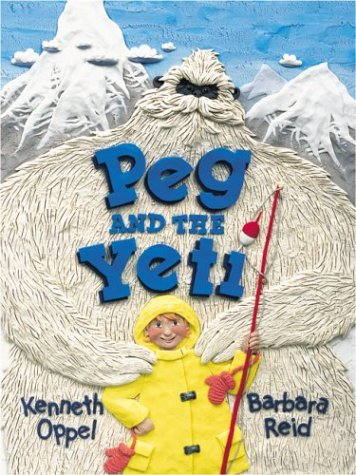
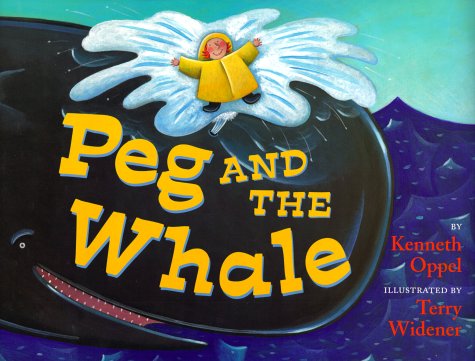 I also have to mention Oppel's two picture books about Peg. Peg and the Whale and Peg and the Yeti are so cute and upbeat and Peg is such an awesome heroine. Every young girl should have these books on her shelf. (And note the illustrations for Peg and the Yeti: Barbara Reid is so cool!)
This blog post has been sitting half-finished for weeks, now, so I figured I could procrastinate today's writing and finish it.
I have not forgotten my promise to focus on a Canadian author once a month, and this month it just has to be Kenneth Oppel, because his latest book has just come out, and it's awesome!

But if anyone can tell a convincing story about fiction's most famous monster-maker, it's Kenneth Oppel. He's a versatile writer with a sure sense of story. He's written picture books, early readers, middle-grade and YA novels, all with strong characters and lots of action but also thematic depth and real emotion.
Does This Dark Endeavor live up to its cover? Yes. I had my reservations, because I wasn't sure I would like the character of Victor, but by the end of the novel I was convinced. If you have any interest in the Frankenstein story, if you love secret libraries and alchemy and finding impossible ingredients for the elixir of life, (and who doesn't?) then you have to read this book.

The Silverwing trilogy could be thought of as a middle-grade Watership Down, starring bats. It has animals that behave like animals, a mythology that makes sense and resonates with the story (Camazotz, the vampire bat-god, and an underworld, and possible apocalypse), and a very cool bat super-power that allows Shade to save the day more than once. I'm making it sound more like fantasy than it is: most of the adventures are real-world/real-bat encounters with owls and humans and big nasty bats and suchlike. But the fantasy elements add that extra zing. I haven't read them in a while, but these are books I reread happily because there's so much to them. A good choice for boy readers. I haven't read Guardians of Ga'hoole, but I'm betting if you liked those books you'll like these.

The Airborn series is for slightly older readers, and the airships and goggles on the covers do not lie: this is classic steampunk: an alternative history in which zepplins become the transportation of choice. (To be perfectly correct, I'm not sure it is steampunk, because I think the airships are powered with combustion engines, but I don't really care.) This is great fun: adventure, romance, pirates, young man proving himself, hitherto undiscovered flying creatures, ghost ships, a ladder into space. All that good stuff. Fast-paced and imaginative with characters you really care about. Highly recommended.
Subscribe to:
Posts (Atom)