Tuesday, April 17, 2012

Poetry, toilets, and other fun stuff (with footnotes)

I think in some past life our family must have done something to offend the god of plumbing*. Did we tip over too many outhouses? Blow up a Roman bath? Six weeks ago the upstairs bathroom toilet overflowed its tank and water leaked into an adjacent bedroom and through the ceiling into the living room below. We rented a blower to dry the carpet and tore out some drywall to let the ceiling dry. We redrywalled and were just about to repaint the ceiling when . . . the same toilet overflowed its bowl and water leaked into the adjacent bedroom and through the ceiling to drip through the brand new drywall. I mean, seriously?**

I was on a roll there with blog posts, but we all knew it wouldn't last. I don't have a book review for you*** so I thought I'd share a few cool things I've encountered.

April is Poetry Month, and there are lots of fun poetry challenges going on around the blogosphere. I particularly like the Progressive Poem started by Irene Latham at Live Your Poem. What a fun idea, and what a cool poem is being created.

Sarah Lewis Holmes at Read Write Believe is doing one haiku a day for the whole month. What better way to start the day than with 17 syllables of wonderful imagery. And I really liked the longer poem she wrote on Poetry Friday: Poetry Forgives. Lovely imagery, and a lovely concept. I decided it was fair to extend the idea to writing in general, and hope it's true that my writing forgives me for my faithlessness and neglect (and my "insecure, pretentious stabs" when I do get around to it).

Not related to poetry, but it brought a bit of a tear to my eye and it's worth watching the 9-minute video: Kiersten White points out that Some People Are Gay.

And to return to the original topic (sort of), there is a very cool thing called an anaerobic digester (the link has a cute little video showing how it works) that turns poop and other organic garbage into methane gas for cooking stoves and lighting. (Word for the day: putrescibility. If something can rot, it can go in the digester. The more rotten it can get, the better!) You can install one of these digesters your backyard, connect your toilet to it, throw in all your kitchen waste, and presto changeo, you've got both fuel for your stove and fertilizer for your garden. It's brilliant ideas like this that give me hope for the human race.**** They didn't say anything about powering time machines with it, though.  :-( *****


* Didn't know there was a god of plumbing, did you? Called Hudor by the Greeks, Hugh by the Norse (who didn't have plumbing as far as I know, so they worshipped him as the god of cesspits)(did the Greeks have plumbing? Hmm. I'm going to have to do more research and get back to you before further explicating this little-known deity.)

** Humans have a hard time believing that coincidences like this are actually random, hence the invention of plumbing deities. A more likely but less amusing explanation is that God noticed how well things were going in our lives and decided we needed to learn some patience and humility. Plumbing incidents are good vehicles for those kinds of lessons. Just saying.

*** I have been doing brief book reviews on Goodreads. Recent reading includes a couple of Eva Ibbotson's romance novels, which I enjoyed highly, and which led me to the idea of a blog post on how authors convey their characters' emotions. I'm still working on that post, but it requires me to reread all my favourite books looking for useful quotations to use, so it may take me a while! Other recent reading is more non-fiction about various potential disasters our shaky, non-sustainable civilization is headed towards (doing research for a post-apocalyptic novel. There are just so many apocalypses to choose from!). Apparently we're going to run out of oil, food, and water within our lifetimes, so you might want to get started on that year's supply of food! And maybe learn a useful skill, like blacksmithing.

****You may want to consider installing one as part of your preparations for the apocalypse. Just saying.

***** If you're too young to get the reference, it's from Back To The Future II, where Doc fuels his time-travelling Delorean by throwing garbage into it. Unfortunately for verisimilitude purposes, the amount of biogas generated from a banana peel and a soda can (which isn't terribly putrescent) would not be equivalent to a lightning strike, and thus would probably not be sufficient for time travel. But it's an idea worth working on!

Monday, March 26, 2012

Marvelous Middle-Grade Monday: Breadcrumbs, by Anne Ursu

Here's one more Marvelous Middle-Grade Monday entry. I actually had this ready for last Monday, but I was flat on my back with the flu, so I didn't get it posted. Clearly, having this external deadline for posting is good for my post regularity. (Rather like high-fibre cereal.)(Never mind, not going there.) This will be my last consecutive (relatively) MMGM--I will do more in future, but I'll mix it up a bit in the meantime. Though obviously I like middle-grade fiction! (Really, it's just a boring, categorizing name for Children's Literature, right?)


I was excited to read Breadcrumbs because I liked Anne Ursu's Chronus Chronicles so much. Well, The Chronus Chronicles were good*. But Breadcrumbs is really, really good! It's poetry and folklore and true, true story, and it feels just like an ice shard being drawn out of your heart.

It"s a retelling of the Snow Queen, which I've always found a beautifully uncomfortable tale, and Breadcrumbs nails it. It's one of those stories about stories, but it's nowhere near as simple as that. It reminds me of The Life of Pi, in the way that fantasy could actually just be all in your head but is no less real because of it. Breadcrumbs is a fairy tale, several, in fact, but it is also a problem novel about friendship and family and fitting in. Hazel's relationship with Jack is exquisitely drawn. Her loneliness at school is a character in itself. And the overlap between the real world and the magical wood is painfully realistic. The story of the matchgirl brought me to tears.

I'm going to have to reread my Hans Christian Anderson. His stories have always bothered me: even the ones with happy endings are still so sad. Anne Ursu gets Hans Christian Anderson. Someone (not me!) is going to write a thesis on what she does with his characters and themes. I'll just say that Ursu gets why someone would go with the White Witch into the wood, and she gets the price to set him free.

Beautiful writing, beautiful story. And if there were Academy Awards for authors, Ursu would get the one for best use of allusions to favourite kids' books!

Breadcrumbs is the taste of fresh snow when you've been cross-country skiing through the woods and you're hot and thirsty and the snow is so white and fluffy and it tastes cleaner than anything and it's so cold it hurts your heart when you swallow.

Be sure to check out the origin of MMGM: Shannon Messenger's blog, where she links to all the other MMGMers with their excellent recommendations.

*And I just discovered a weird sort of symmetry: Kate Coombs liked the Chronus Chronicles so much that she commented on my review of them, which led me to discover her blog, which led to me reading her book The Runaway Princess, which I just reviewed last week. (The blogosphere is a strange, spiraling galaxy of a virtual place!)

Monday, March 12, 2012

Marvelous Middle-Grade Monday: The Runaway Princess, by Kate Coombs


The blogging fates are conspiring to get me writing more posts. Just when I decided I was going to try participating in MMGM, thinking maybe I'd manage once a month (I'm sorry, the alliteration just happens, I have nothing to do with it!), I read a whole slew of really good middle-grade books that need blog posts. So, two MMGMs in a row. Don't get used to it, folks, it won't last!


The Runaway Princess is much more than I thought it would be from the title and the cover. It's clever, cute and funny and has a hilariously complicated plot. I was hooked from the first page of the Prologue, when Princess Meg's mother tries to tell her a bedtime story but keeps getting interrupted:
"The princess stood at her window," the queen said . . . "longing for someone to come and save her, for the evil enchanter had bound her by his magic."
"Why didn't she break the spell?"
"She couldn't," Queen Istilda said gently. "Margaret, don't pick your nose."
Meg dropped her hand to the lap of her white satin nightgown. "Then what happened?"
"A handsome prince rode up to the castle gates."
"What did his horse look like?" 
(I love that last line!) Six year old Meg doesn't get why princesses can't rescue themselves. When she grows up and her father decides to have a contest for her hand in marriage, Meg decides she wants no part of it. In fact:
"Don't you see?" Meg asked, suddenly inspired. "We must save them."
"Save who?"
"The dragon. The witch. The bandits. We must save them from the evil princes." 

So we're set up for the ever-popular fairy-tale turned upside-down. But again, Runaway Princess is more than it appears. I loved irrepressible Meg and her loyal friends, Cam the gardener's boy and Dilly the maid. I loved reluctant Nort. In fact, I loved all the characters in this book, villains and parents and bumblers and schemers all. They are all real people who pick their noses and whine and keep secrets and make unwise decisions. That's what I liked so much about this book: it's a fairy-tale send-up, but it's got the gritty texture of reality. And it isn't the least bit predictable. Plus it's really, really funny, in both overt, slapstick-y ways and subtle, might-miss-it-if-you-blink ways (like the line about the horse). You get a lot of bang for your buck with this one. I want to get my hands on the sequel now, The Runaway Dragon.

The Runaway Princess reminds me of the breakfast sandwich I had at this little place in Seattle: it looked like your typical ham 'n egg 'n cheese sandwich, but when I bit into it I had never tasted anything so entirely delicious, each flavour deep and authentic and all the components mingling to create something greater than the sum of the parts. (I need to go back to Seattle and have another one!)

Oh, and don't forget to go to Shannon Messenger's blog (every Monday) to find lots of other marvelous middle-grade books!

Monday, March 5, 2012

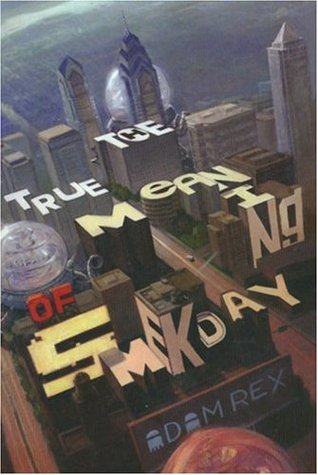
Marvelous Middle-Grade Monday: The True Meaning of Smekday, by Adam Rex

I think a day dedicated to celebrating Middle-Grade fiction is a wonderful idea, and I've been meaning to contribute to Shannon Messenger's MMGM* for a while, but the logistical challenge of having a post ready for a specific day is apparently beyond me** (and Marvelous Middle-Grade Random Day of the Week just doesn't have the same ring to it). Then I read this truly marvelous book and I was motivated! So, for my inaugural Marvelous Middle-Grade Monday post I proudly present:


This book is screamingly brilliant from beginning to end. It was so funny it hurt my brain. It's a road trip in a flying car with an 11-year-old driver, an alien and a cat named Pig, and it is a wicked, wicked social satire. It has flaky layers of irony as delicious as a Napoleon. Oh, yes, we're definitely going with a Napoleon as the food metaphor. Not only is the writing oozing with multiple layers of humor, from slapstick action to aliens massacring English grammar to ridiculous names like Gratuity Tucci; but also the structure is perfect: layer upon layer of narrative and plot development that doubles back on itself in yummy satisfying ways.

Okay, I'm done with the pastry metaphor. Think Terry Pratchett meets Carl Hiassen. I should really just quote from it so you see what I mean:
Mom went on to explain that the aliens, a lot of them now, had brought her aboard their ship to fold some laundry. They related, not with words but with complicated hand gestures, that they were really impressed with her laundry folding skills. She was guided to a table piled with bright, rubbery suits with tiny sleeves and too many legs. So she got to work. As she folded, she happened to notice another human, a Hispanic man, she said, far off at the other end of the room. They had him opening pickle jars.
This is the low-level background absurdity that underlies the entire narrative. Then we get Gratuity's sarcastic comments on everything:
There are companies that claim to make a greeting card for every occasion. If any of them are reading this, I couldn't find a "Sorry all your friends deserted you after your alien abduction" card when I needed one.
Gratuity's mother is abducted again right before the alien Boov turn Florida into a Human Preserve and make everyone move there.  Gratuity sets off on her own to find her mother, and encounters one of the Boov at a convenience store.
For you time-capsule types, MoPo was something called a convenience store, as in, "The soda is conveniently located right next to the doughnuts and lottery tickets." People who want to understand better how the human race was conquered so easily need to study those stores. Almost everything inside was filled with sugar, cheese, or weight-loss tips.
Adam Rex skewers us repeatedly with these throwaway lines.

And then there's the plot, which involves the alien (who looks absurdly like the aliens from an old video game) souping up Gratuity's car with pieces of his own broken vehicle so that it flies (on cloned gasoline). Oh, and the alien calls himself J.Lo, and the car's name (after part of a slushy machine has been grafted onto it) is Slushious. Girl, alien and cat make their way to Florida, where they discover the Boov have decided the humans can't have Florida after all because oranges taste so good. Now they have to go to Arizona. Gratuity stops to visit Happy Mouse Kingdom first. Then they crash into Roswell (literally)(ha, ha) and find out what really happened there (it has something to do with a long-eared koobish and a water tower). The plot continues being ridiculous and convoluted but making perfect sense in a hilarious, human-skewering way.

Every once in a while Adam Rex breaks out into comic book format to give useful information, like the history of the Boov, or "8 Things You Have Always Wanted to Know About the Gorg But Were Afraid to Ask the Gorg Because the Gorg Might Punch You In The Face." (The Gorg are different aliens that come invading after the Boov. They're worser.)

I need to stop talking now so you can run out and go get this book, and I can sit down and reread it. (Keep your eyes open for the scene with the squishable gaputty: I tried to read it to my daughter and I couldn't finish I was laughing so hard.) Adam Rex is very much like Terry Pratchett in his ability to deal with serious themes like racism and imperialism and all the really stupid things humans do and have you crying with laughter while he does it.


Mmmm. Flakcy.
*  If you follow the link, you'll see Shannon Messenger's MMGM post and links to everyone else who participates: lots of great books to read about!

** It's still beyond me, though this time it's not my fault: I was going to post this first thing Monday morning so that MMGM people could link to it, but I didn't get home from a weekend trip until 3pm. Sigh.

Monday, February 20, 2012

Canadian Book Week: Philip Roy's Submarine Outlaw series

I haven't forgotten about Canadian books! I review them regularly for CM Magazine (a very useful reference if you're looking for Canadian children's books), and occasionally the books they send me get me very excited. That's the case with the Submarine Outlaw books. I was first sent River Odyssey, the third book in the series, and I just finished Ghosts of the Pacific, the fourth book, and now I want to get the first two books, because these are great stories! They might be difficult to find; I'm not even sure they're available in the States, but they're worth searching out, particularly if you're looking for books for boys.


The Submarine Outlaw series has an original and appealing central concept: young Alfred pilots his unregistered submarine wherever he likes, with a seagull for a first mate and a dog for a second. He gets into trouble because he can’t resist rescuing people (and animals) and so is always barely evading capture by the authorities, who will take his submarine away from him. Thus Alfred is firmly a good guy and yet still an outlaw—an irresistible combination!

In River Odyssey, the third book of the series, Alfred is given a quest by his spiritual mentor: he needs to find the father who abandoned him as a baby. Unwillingly he puts off his planned journey to the Pacific and instead journeys from Newfoundland up the St Lawrence River to Montreal. Along the way he finds people to rescue and dangers (including police) to evade.


In Ghosts of the Pacific, Alfred sails from Newfoundland through the Northwest Passage to the Pacific Ocean. He encounters polar bears and gets trapped in the ice. In the Pacific he gets shot at by a shrimp trawler when he cuts their net to release trapped turtles and dolphins. He rides out a storm, meets a floating circus and sails into a sea of plastic garbage the size of Texas. He visits the Bikini Atoll and dives to see the ships sunk by nuclear testing. Then he ends up on the island of Saipan, where he hides in an underwater cave during a typhoon and discovers the skeletons of Japanese soldiers. Alfred considers an offer to join the circus, but decides he’s not finished sailing alone yet. There will be a sequel!


I think these would be great books for reluctant readers. The language is clear and simple, the plot is full of exciting episodes--and come on: submarines! I usually veer towards fantasy (you may have noticed!), but I found these books completely engaging. Plus I learned stuff!

Thursday, February 9, 2012

Debate on Piracy and Copyright is more than 100 years old

David Malki, author of the webcomic Wondermark, has been reading old newspapers and discovering that issues of intellectual property rights have been thorny and contentious from the beginning. He's doing a series of blog entries presenting arguments from newspapers of the late 1800s and comparing them to current arguments. Turns out the internet hasn't really changed the name of the game! It's worth a read; I find it fascinating.

He makes a point that I think is the most pertinent in all the discussions:

So, in a world where piracy exists, my task as an author is to make the legitimate consumption of my work the path of least resistance.

Hear, hear! (Creators of Leverage and White Collar, are you listening? Please allow me to purchase your latest seasons in Canada!)

(Note that this is the second time a tweet may have been more appropriate than a blog entry. I'm keeping track. Maybe if it happens again I'll consider using my Twitter account.)

Wednesday, February 8, 2012

Compulsive Re-Reading, or why I never get around to blogging

Book Aunt had a post around Christmas time asking if people had books they liked to reread over holidays, and that post inspired this one.  I don't limit re-reading to holidays curled up by the fire. I re-read books all the time.

When I started to think about the books I choose to read over and over again, I thought I'd try to analyze what made me want to experience them multiple times. The word "experience" is the key: what sort of experiences do books offer that can be enjoyed even when you already know what happens? Here are a few of my thoughts, with examples from the books that I love to re-read (I've linked to descriptions of the books, in case my vague references don't make them immediately obvious!)


Coniston Water, Lake District
(could be Narnia, couldn't it!)
The experience of place: otherwise known as the Narnia effect. I must have read the Chronicles of Narnia at least once a year for most of my childhood and adolescence. I so badly wanted to go to Narnia, and reading the books was the only way to get there. (Okay, I still want to go! When I read them now, it amazes me how few words Lewis needs to create such a compelling world.) There are a number of fantasy worlds that I enjoy spending time in: Lyra's world; Earthsea; Ancelstierre; Damar, or any of Robin McKinley's other worlds; Discworld; Hogwarts. But I also love to go to Arthur Ransome's Lake District (I finally did a few years ago; it was just as he had described it), or to the nostalgic England of E. Nesbit's children, or to The Secret Garden. I do love places with cool magical systems and creatures, but even if a place is perfectly realistic, if the author loves it then I want to keep coming back to it.


Please tell me you know this
is Anne of Green Gables
The experience of people: there are some characters I wish were my real friends, and some that I'm glad aren't real but they're a lot of fun to hang around with! Elisabeth Bennett, Anne of Green Gables, Jane Eyre, Sara Crewe, Vicky Austen, Meg and Charles Wallace, Tiffany Aching, Sophie and Wizard Howl, Ender Wiggins, Vidanrik Renselaeus, Marquis of Shevraeth (I haven't re-read him yet since I just discovered him, but I will!), Miles Vorkosigan, Thursday Next . . . I've got another bookshelf upstairs I could check, but this is a pretty good list! These characters are not like me: they are clever and brave and spunky, and these qualities get them into as much trouble as they get them out of. I wish I could be them, but I'd settle for being their sidekick!


The experience of drama: once you know how it ends you don't get to feel the suspense again (unless you have as bad a memory as I do, in which case sometimes you can!), but those dramatic moments are worth reliving. Sometimes I skip through books just to get to the good parts.
Elizabeth rejecting Darcy's proposal;
Jane choosing to leave Rochester;
Eugenides noticing Attolia's earrings;
Edward kissing Bella for the first time (not the 247th time; it does get old!);
Lyra finding Roger clutching the dead fish because his daemon is gone;
Katsa throwing that knife at the end;
If you don't mind reliving the best
use of a swear word in literature,
this is quite funny
Harry returning to Corlath after disobeying a direct order and riding off to save the kingdom;
Molly Weasley facing Bellatrix.
Scenes that twist your heart, scenes that make you jump up and yell "Yes!" Little guys facing down big guys; difficult truths being spoken; noble sacrifices being made. Like the taste of homemade bread or the smell of roses, the emotional intensity of these moments is necessary to my well-being. I love drama more than I love sleep, which is saying a lot!


The experience of voice: I will read anything written by my favourite authors, because I love listening to them talk. They could be talking about walking their dog and picking up the dry-cleaning; it's not the content, it's the way the words are strung together. Part of it is facility with language: I opened up I Shall Wear Midnight at random and here's a sentence:
It was a nervous statement with a wiry little question clinging to the end of it, waiting to burst into tears.
Here's a random Laini Taylor sentence:
They laughed alike and moved alike, and they thought the same thoughts as completely as if a butterfly traveled back and forth between their minds, bearing ideas on its legs like pollen.
Sentences like these make me happy. With some authors it's not so much individual sentences as the way sentences and paragraphs all build on each other, layer upon layer of meaning: Connie Willis is brilliant at this; so is Patricia McKillip. Nothing extraneous, everything necessary. Craft, is what it is, using words as tools.

But voice is more than just excellent writing; it's also the mind behind the writing. I can enjoy a book with an exciting plot and interesting characters and competent prose, but if there isn't some fundamental idea behind it all that resonates with me, I won't read it again. Authors I re-read have a strong world view, a sense of right and wrong, an appreciation of what is beautiful and just. They may be lyrical, they may be funny, but they all have a certain fierceness: they have written the truth and they know it.  (I don't mean that the author is opinionated or, heaven forbid, preachy; in fact often the authors don't know that they've written truth, or what truth they've written. But their voice knows.) I don't have to agree with their world view, but they have to believe in it, and then it comes through in their voice and then I have confidence in their story and want to be carried along in it.

I also only re-read books with happy endings, so I guarantee that in all the books linked to in this post the girl will get the guy, the evil whatsits will be defeated, the loner/outcast with no talent will have found his/her place in the world and  humanity will have proved itself redeemable, if only just. (Is that why most of my re-reading happens to be fantasy? No! I firmly believe happy endings happen in real life too! I do.)