Sunday, October 28, 2012

Sherwood Smith's amazing fantasy world

Whew! I'm finally finished all four of Sherwood Smith's Inda books. (When you download ebooks, you don't get a sense of how long they are: you don't get that satisfying heft of a thick book.) Now I can finally be productive again. (I've done pretty much nothing else but read for a week and a half, because they were so compelling.)

Sherwood Smith's name isn't as well-known as Robin McKinlay, Megan Whalen Turner, Orson Scott Card--but it should be. She has the ability of all the best fantasists: to make a world and a set of characters leap off the page and take residence in your brain, until you're quite certain you could buy a ticket and go visit, if only you could find the right train platform. What's unique about Sherwood Smith is that she has been working on the world of Sartorias-Deles since she was eight years old. I think she's actually been there. (My pet theory is that Smith is really a Norsundrian mage, and that's how she can skip through Sartorias-Deles's history observing everything and everyone.)

That's the strength and the weakness of Smith's Sartorias-Deles books: they read as if they were real history. The characters behave like real people, with all their contradictions and infuriating motivations; and the plots fit into a larger scope, so there are things that may not make sense in the current story, but that's what actually happened, historically. She has essentially an entire planet worked out, with political, magical, cultural and linguistic histories of probably 20 different countries. (Just go here and look at the map she's developed, and understand that for every country on that map she knows what their language sounds like, what their architecture and fashion looks like, what their food tastes like, not to mention the strengths and weaknesses of their political and military systems.)

So where should you start? So far I've only read the Inda books and Crown Duel/A Stranger to Command. I loved both sets of stories equally, but they do appeal to different readerships.

If you read my blog because you like all the YA and MG books I tend to like, then you should definitely read Crown Duel. (Make sure you get the version that includes Court Duel: they used to be published separately but the latest version of Crown Duel has both. Also, there's some awesome extra material at the end of my ebook that I don't know is there in the print version, so there's a good reason to get an e-copy. (Besides the fact that there aren't a lot of real books around.))

Meliara is one of the original kick-ass heroines (along with Harry and Aerin from Robin McKinley's Damar books, and Tamora Pierce's Alanna). The great thing about Meliara is that she's real. Sure, she's taken swordfighting, but she's not actually that good at it. She's idealistic and determined to right the wrongs in her country, but she's a little ignorant about politics and maybe doesn't make the best choices. She's got spunk--which gets her into more trouble than it gets her out of. And she's stubborn--which can be a good thing, but not always. But she has enough humility to recognize when she's wrong, and she wins everyone's hearts because of her honesty and courage.

The first half of the book (the original Crown Duel) is fighting and getting captured and escaping and being chased; the second half (Court Duel) is set at court (duh) with intrigue and plots and secrets and stuff. I'm not even going to mention the second main character, because you have to discover him for yourself. (Let's just say this is the best kind of romance: where the characters don't even know it's a romance until it's almost too late!) And when you do discover him, you'll be as anxious as I was to read A Stranger to Command, which is his coming-of-age story. (I'm not giving you a link, because I don't want you to go find out who he is before you read Crown Duel.) Then once you've read that, you'll want to read more about Sartorias-Deles, and find out about those mysterious Norsundrians.

I haven't read all the Sartorias-Deles stories Smith wrote when she was younger. They're not as polished, so I think I'll have to be in the right mood for them. (I will read them, because there are so many unanswered questions!) I decided to try the "historical" novels, which are set 400 years before Crown Duel.

If you're an adult* who likes really epic (ie: long and complicated) military fantasy, if you can handle lots of shifts of point of view, and if you don't mind being confused at the beginning as an entire social/military/political system with its own jargon is gradually revealed to you, then you'll like Inda and its sequels. The story begins with a ten-year old boy being sent to military academy. There's an Ender's Game-like section at the academy (which will be familiar to you if you read A Stranger To Command). Then Inda gets exiled and we enter the pirate phase of the story (I know: pirates!) Inda is very much an Ender-type of character, a brilliant strategist and a born leader who endures incredible suffering and remains good (kind, loyal, fair, unarrogant). He's the hero who doesn't recognize his own heroism. He and his group of loyal friends have all kinds of adventures culminating in great battles (both land and sea) against the invading Venn. The plot is epic, vast, with threads and characters going all over the place, but you care about all the characters. You care about Inda--oh, he breaks your heart! He's now up there with Miles Vorkosigan, Horatio Hornblower, Harry Dresden, Eugenides--as my current favourite noble, scarred heroes.

So far everything of Sherwood Smith that I've read is going to stay in my iPod for future escape-out-of-the-universe, fall-in-love-with-the-characters, can't-put-the-story-down comfort reading. And she's got a whole whack of other books I haven't even looked at yet. (But I have to pace myself: one must occasionally be productive.)

Since I can smell it now (I just took it out of the oven) and it is the best thing ever, I'm going to compare Sherwood Smith's books to Upside-down Buttermilk Pear Cake (which is also supremely scrumptious with plums instead of pears). To die for. I'm going to go have a piece right now. Then I think I'm going to download The Trouble With Kings. Or maybe The Spy Princess. Oops, I mean, I'm going to go be productive. Seriously.

*There's quite a bit of violence in the Inda books, though no gratituous gore, and definitely lots of sex--not graphic, but you know what's going on behind the bedroom door, and it's often pretty interesting. (Let's just say that there's probably no Marlovan word for "monogamy.")

Tuesday, October 16, 2012

The Scorpio Races and Grave Mercy

Carnivorous horses and assassin nuns: what's not to like! (I'm actually very mild-mannered and I hate conflict. Really, truly.)

I have to start by confessing that I'm not a huge Maggie Stiefvater fan. At least, I wasn't until now. The Scorpio Races grabbed me with its sharp teeth and carried me out to drown into a stormy sea. Everything about this book was vivid and compelling. The island, with its scent and its storms and its modern mask over an ancient culture revolving around the water horses. The capaill uisce themselves, terrifying, unpredictable, horse-like but so not horses. (They were so convincingly frightening that I had trouble believing that Puck would actually race them--my one quibble about the plot.) I loved the two characters who alternate telling the story: mysterious, skilled, respected-but-not-liked Sean, and fierce, desperate, angry Puck. I loved the romance, nicely understated and full of conflict, because they both really need to win.

The Scorpio Races is about carnivorous horses who come ashore only on this island and are captured for the annual race, which has mythic significance beyond what the tourists recognize. But really it's about the people, their relationship to the horses, to the island, and to each other. No, that sounds boring. It's about  dreaming, longing for something that is denied. It's about taking huge risks and making huge sacrifices. No, that doesn't adequately convey it. I can't really explain what it's about. It just oozes with atmosphere and intensity. Maggie Stiefvater writes beautifully. Her previous novels (about werewolves and fairies) just weren't that interesting to me, but this one was meaty and satisfying. Steak and mushroom pie.

Assassin nuns. I have to say it again, because, really. Why has no one else come up with this concept? (Maybe they have and I just don't know about it: if so you have to tell me what I've been missing!) Grave Mercy is Robin LaFevers first book about girls from the convent of St. Mortain, otherwise known as Death. They are trained to be His Fair Assassins and carry out his will, which appears to be saving Bretony from those treacherous French, so once Ismae is trained in all the cool ways there are to kill people she gets to dress all pretty and sneak around court looking for spies to assassinate. I liked the idea of Mortain. I liked the spying, the girl kicking the butt of arrogant men, the romantic tension between Ismae and the guy she doesn't know if she can trust. Grave Mercy was entertaining--not as good as Sherwood Smith or Megan Whalen Turner, but along the same lines. I think there is a lot of potential in the premise that LaFevers can still explore, so I'm going to read the next book in hopes that she does more with the depths that Grave Mercy hints at. This book was a mocha cream puff.

In the meantime, I had to go and reread Sherwood Smith's Crown Duel, because she does such a good job of the romance between people who don't trust each other. And because it's just so good. And then I had to read more Sherwood Smith, so I downloaded the Inda books. When I emerge, gasping, into the real world again, I'm going to devote a whole post to Sartorias-delas.

Thursday, October 11, 2012

Legend, by Marie Lu

Yikes. How is it halfway through October already? I've got a backlog of books to blog about, so let's get right to it.

Characters. It's all about the characters, people. You can create the most fascinating fantasy world or the most devastating dystopia. I won't give a rat's eyeball about it if I don't care about the characters.

Marie Lu could give a master class on creating compelling characters. (Sorry, I think I'm coming down with the alliteration virus. I'll try to hold it in check.) Here's how Legend opens:
My mother thinks I'm dead.
Well, that catches my attention. Not only that, but "it's safer for her to think so." Why? Day is a notorious wanted criminal, "wanted for assault, arson, theft, destruction of military property, and hindering the war effort." I like him already! Then we find out he's hiding in an abandoned building that overlooks his home, waiting until the soldiers are finished going through the neighborhood so he can sneak down and leave a gift of food and useful items he's stolen, because it's his older brother's birthday. Oh! Wrench my heart and make me completely love the guy!

Then we meet the second main character. June is waiting to see the dean because she's in trouble again: she snuck out of school to "scale the side of a nineteen-story building with a XM-621 gun strapped to [her] back." This puts her in a class above your typical spunky heroine. Why did she do this? "My afternoon drills aren't teaching me enough about how to climb walls while carrying weapons." Yeah, mine neither. "Rumor has it that Day once scaled five stories in less than eight seconds." Oh ho. June is training to be the best possible soldier for the Republic, and she would love nothing better than to be the one to capture Day.

Do we have conflict? Two compelling characters set on a collision course in a pretty scarey world of tromping soldiers, crumbling cityscape, and plague. You're not going to tear this book out of my hands.

You may be getting a little tired of dystopian YA. It can be horribly grim, and a lot of the books out there are less interesting than they think they are. But Legend is an example of why the genre became so popular in the first place. Okay, I'll say it: a worthy successor to The Hunger Games. There's a sequel, but it's not a horrible cliffhanger ending. There's just lots more story to tell.

Legend is a big, juicy burger with all the fixings. Meaty and flavorful. (It's told from alternating points of view; that's what made me think layers, therefore burger. It makes sense, trust me.)

Monday, September 10, 2012

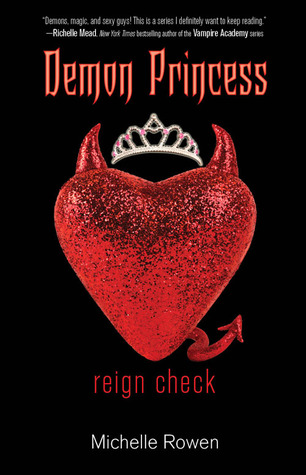
Demon Princess, by Michelle Rowen

The covers tell you everything you need to know about these books: cute, funny, light, romantic paranormal. In the same vein as Paranormalcy and Hex Hall.

Nikki Donovan's completely absent father suddenly appears in her life to tell her that A: he's a demon, B: she's a Darkling, a demon/human hybrid, and C: he's dying, so she's going to have to take over as ruler of the Shadowlands. Not what she wanted to hear just when she's been invited to Winter Formal by high school heartthrob Chris. But her father's emissary is really cute, and her father is a pretty nice guy, all things considered. Plus, when she turns into a Darkling she can really kick ass.
"Everything was going to be okay, though. I could feel it. And if it wasn't, then I'd have to do something to make it okay because no one better mess with me or anyone I loved. After all, mess with the demon and you get the horns. Cut horns. But still, horns."
 The plot is fairly predictable, but it's got some fun twists in it. The second book adds a third hottie to the mix: the king of the fairies, who comes undercover to Nikki's high school to find out whether she's evil and needs to be killed.

The third book, Reign Fall,  is out, but my library doesn't have it yet. I've requested it.

If you like Meg Cabot, or if you're looking for a fast, undemanding read with some romance and the odd demon dimension to complicate things, Reign or Shine and Reign Check will fit the bill.

The Demon Princess series is like a palate cleanser: a fruity sorbet perfect if you've had a really heavy meal and you're not quite ready to dive into a rich dessert.

These are books 5 and 6 of my Canadian Book Challenge. Find out what other great Canadian books people are reading at The Book Mine Set.


Monday, September 3, 2012

MMGM: The Big Splash, by Jack D. Ferraiolo

This was a really fun read. It's up there with The True Meaning of Smekday: I wasn't peeing my pants laughing, but I had a goofy grin on my face the whole time.

Take the plot and characters of a hard-boiled detective novel--mob boss and hitmen, pretty females who might not be so innocent, bad-ass cops, and honest but hapless newspaper reporter--and plunk it all down in a middle school. Vinny Biggs runs a nice little racket in forged hall passes and stolen exams. Anyone who gets in Vinny's way is targeted by his squirt gun assassins, and the most feared hit kid is Nikky Fingers. Matt Stevens has his own side business as a private eye. Last year he brought down Peter Kuhn, who was stealing cameras to support his Pixy Stix habit. Now Vinny has a case for Matt: who took out Nikky Fingers? The money is too good to turn down. "I sat there cursing myself for breaking one of my longest-standing rules: Don't ever work for Vinny Biggs, especially on deals that were too good to be true. Nothing that paid well was ever easy."

I think the best way to convince you to read this book is to quote from it. Ferraiolo nails the tone: just over-the-top enough, but not so much that it gets tired. The absurdity stays at a low simmer all the way through.

His name was Joey Renoni, a.k.a. "The Hyena," and I knew who he worked for. [. . .] Joey wasn't a big kid, but he was crazy, and crazy trumped size. Size could be negotiated with. Nobody knows what to do with crazy.

"Let me clue you into something, kid . . . Justice is a snack," I said. "You get justice, and five minutes later you realize you're still hungry. Revenge, on the other hand, is a full meal."

He was off of the sofa and in my face. "And you don't know me very well. I'll get to him regardless, with or without you. My way, you'll have a little money to show for it."
"Go home, Kev. Vengeance isn't good for your complexion." 

Mac was honest, and at the Frank, that was as rare as a decent lunch from the cafeteria. 

Katie Kondo was the first seventh grader in the history of Franklin Middle School to ever make hall monitor chief, and she didn't get there by being sweet. 

"No thanks, Jimmy. I've got to do this alone." He looked relieved, as if his brain was angry with his mouth for making the suggestion. I started walking away. "See you around, guys."
"Hey Matt," Kevin said. I stopped. "Be careful."
"I always am. It hasn't made a difference yet." 
I love the combination of noir talk with middle-school setting. It's almost parody, but it's seasoned with real feeling. Matt's interactions with his mother are both funny and poignant. The squirt-gun assassination is a brilliant analogy for social ostracism. This tale of kid mafia intimidation may do a better job of addressing issues of bullying, friendship, and staying true to yourself than most problem novels that take them seriously.

Not everything is tied up neatly in a bow at the end; there is definitely room for more Matt Stevens, Private Eye.* (Ferraiolo's next book is about a superhero's sidekick who has a significant issue with his tights. I'm quite anxious to read it!)

The Big Splash is sweet corn basil soup, the one they serve on the ferry from Horseshoe Bay to Langdale: sweet corn, spicy, savoury basil, all blended together in creamy goodness. I could eat it all day.

Be sure to head over to Shannon Messenger's blog, where all the other MMGM-ers hang out with all their marvelous middle-grade selections.


*Oh, according to Goodreads, The Quick Fix will be out in October. Yay!

Monday, August 20, 2012

MMGM: Two Young Sherlocks

I have a confession to make: I have not actually read Sir Arthur Conan Doyle. (Well, I read the first part of A Study in Scarlet, and then got completely bored when the scene suddenly shifted to America, so put it down and never went back.)

 But I love Sherlock Holmes! At least, I love all his various incarnations, interpreted by various writers, directors and actors. (Yes, I'm talking about Benedict Cumberbatch again, don't shoot me!)

 You would think my enthusiasm for all things Holmesian would send me back to the originals, and I'm sure I will eventually get over my mental block and pick up The Sign of Four. But I happened to be browsing the kids' section of the library for books with maple leaves on the spines (since I haven't yet done my Canadian book for August), and look what I found:


Not one, but two different series about Sherlock Holmes as a boy.


Who was the young man who turned into the brilliant, enigmatic detective? Was he always that clever and observant (and obnoxious)? How did he become an excellent boxer and violinist? Why is he so friendly with street urchins? Well, Andrew Lane and Shane Peacock set their imaginations to answering all these questions, and came up with two very different but equally plausible young versions of the sleuth.

Death Cloud, the first of Andrew Lane's Young Sherlock Holmes mysteries, has a Sherlock from an upper class, though not terribly wealthy family. His father is away in the military, and his mother is unwell, so older brother Mycroft, already working for the British Government, arranges for Sherlock to spend summer vacation with an aunt and uncle in the small town of Farnham. Mycroft also engages an American tutor with unconventional teaching methods. A couple of bizarre deaths in Farnham lead Sherlock to discover a criminal conspiracy endangering the entire country. He has some help from the tutor and his pretty daughter, and more help from Matt, an orphan living on his own. His investigations put him in danger of his life, repeatedly--curiosity and fearlessness are this Sherlock's primary traits, and he uses the logic and observational skills he has learned from Mycroft and his tutor to put the pieces of the conspiracy together and single-handedly defeat it.

Eye of the Crow is the 1st Case of Shane Peacock's The Boy Sherlock Holmes. This is the book with the maple leaf on the spine, since Peacock is a Canadian. His Sherlock is a more complex character from a much bleaker background. His mother is a gentlewoman who fell in love with a poor Jew and was disowned for marrying him. The family lives in extreme poverty in a terrible neighborhood in London, and Sherlock resents it greatly. He plays truant regularly, preferring to observe humanity in Trafalger Square and read the sensational happenings in the Illustrated Police News. Sherlock is regularly harassed by a young thief who calls himself Malefactor and his gang of street kids called the Irregulars. The case that gets Sherlock's sleuthing attention is a woman knifed to death in an alleyway, and he is driven to find out what happened when the police arrest a young Arab man who claims to be innocent. But Sherlock's investigations lead Lestrade (the elder: his son who wants to be a detective has a brief appearance) to arrest him on suspicion of working with the Arab. Sherlock escapes the Bow Street jail with the help of a beautiful girl named Irene Doyle, and has to find the real killer to prove his own innocence as well as the Arab's. He enters an uneasy partnership with Malefactor, and learns how to disguise himself and ask the right people the right questions. But the murderer will do anything to prevent Sherlock from collecting the evidence he needs.

Both novels are full of excitment: escapes, fights, spying, mysterious figures in the shadows. Both mysteries are interesting and require lots of observation and deduction to solve. Readers familiar with the Sherlock stories will recognize certain elements in each novel, which is fun. Eye of the Crow is the darker of the two books, and probably the one closer to the canon in terms of setting, psychology, and characters who will appear later. But both books are great reads and will satisfy the Holmes afficionado--or will ignite afficion in readers who haven't yet caught the Baker St. bug.

This post is a two-for-one in multiple dimensions: it's my Marvelous Middle Grade Monday offering, and my Canadian Book Challenge book for August. Find marvelous middle-grade books every Monday on Shannon Messenger's great site, and find great Canadian books to read on John Mutford's awesome blog.


Tuesday, August 7, 2012

The False Prince, by Jennifer A. Nielsen

I haven't ranted about Megan Whalen Turner on my blog yet, have I? She's pretty well-known, so maybe I don't have to. If you haven't read The Thief, The Queen of Attolia, The King of Attolia, and A Conspiracy of Kings, then drop everything else and go read them. Then you can continue with this blog entry.

So. Are you in love with Eugenides? If not, then I despair of you. I really do. But if the Attolia books are your kind of thing, then you should definitely read The False Prince. Sage is a worthy successor to Eugenides, and there isn't much else I need to say.

I love the premise of The False Prince: nobleman with questionable motives, plot to impersonate a prince, competition between orphans with life and death stakes. It reads like an epic fantasy, even though there are no fantastical elements. If conflict is the heart of story, this one's got oodles! But it's Sage's voice that raises this book into must-read status.
"I'd never attempted roast thievery before, and I was already regretting it."
Sage is funny and clever and mouthy, and excellent at getting himself into trouble. He also has hidden depths: he's not as callous as he makes himself out to be. You're constantly rooting for him and exasperated with him at the same time. The rest of the characters are all equally rounded: no cardboard villains; everyone has believable motivations, and right and wrong aren't exactly clear-cut.

This would be a great read for guys: there's fighting and plotting and sneaking around and more plotting, and hardly any romance. Girls will love Sage, and will be happy that the few female characters have "voices of their own, goals of their own, and brains. Yay!" as Sherwood Smith says in her review.

I'm excited to know this is the first book in a trilogy: more Sage to come!

The False Prince is pain au chocolat: buttery, flaky croissant wrapped around rich dark chocolate. Mmmm!

On another topic entirely, can anyone recommend a good medieval-setting YA fantasy about a witch? I'm drawing a complete blank, even though I'm sure I've read a bunch. (I can almost see their titles in the corner of my brain, but when I turn to look they're gone!)