Tuesday, December 18, 2012

54 hours of reading time

The planet Earth is really big. It took 27 hours of travel time to get from Vancouver to Buenos Aires, and another 27 hours to get back. Bleagh!

I didn't actually spend the entire time reading: I doped myself with Gravol and managed to get some very uncomfortable sleep on the plane. (Why do we do this to ourselves? Travel by Zepplin would be way more comfortable!) But I got through a few books on my TBR:

First I reread Pathfinder, since it's been a while, and then I read the second book, Ruins. The story idea is pretty interesting, like all Card's ideas: (spoiler for Pathfinder in yellow). Imagine a planet colonized by eleven versions of the same colonists, who are kept separate from each other for 11,000 years as an experiment to see what sort of social and biological evolution will happen.

The plot was mostly idea-based--the entire story is really one big thought experiment. I enjoyed seeing where Card took it, but I have to say that by the end of Ruins, I couldn't stand any of the characters. They spend most of the book sniping at each other in really annoying snarky dialog. They're all completely arrogant and self-absorbed, and it's hard to see why they stay together. But I'm curious enough to know what's going to happen next that I'll probably read the next book.

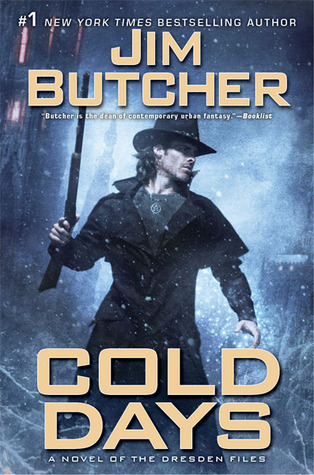
Cold Days is the latest (as in #14) Harry Dresden novel. You could probably start reading the series here, but you'd miss out on 13 books of  character and world-development. I guess it's a bit like a soap opera I'm addicted to, but I have to say that if a series drops off in quality then I don't keep reading it, and this one just keeps getting better. Butcher takes the typical paranormal elements--vampires, faeries, gods, magic, etc. etc.--and recreates them in fun, original ways in an internally consistent world that I find impressively believable. What's really impressive is that he manages to add more depth to the world in every book: both good guys and bad guys get more complex and more interesting. I love Harry, the wise-ass underdog wizard whose greatest strength turns out to be his bloody-minded stubbornness. He's just trying to do the right thing, dammit. And it just keeps getting harder. So, yeah, two thumbs up to this one. (There's a big twist at the end that worries me: how's Butcher going to make this turn out okay?!)

I think I'll sign off now and get another post out of my vacation reading!

Friday, November 23, 2012

Code Name Verity, by Elizabeth Wein

I swear, I was going to do a middle-grade book next. I went to the library and got several out that have been on my TBR for a while. But I also got out Code Name Verity, and I read the first page, because I always read first pages along with book flaps to see what I'm in for, and I was so impressed and compelled that I had to keep reading. And now I have to do a review, because YOU HAVE TO READ THIS BOOK!

Deep breaths. I'm calm now. But seriously, this is the most amazing, brilliant, wonderful, beautiful, suspenseful book I've read in a long time. I had to read some pages with a bookmark below the line I was on so my eyes wouldn't skip ahead to the end of the page and ruin the scene for me. Maggie Stiefvater calls it a "three gasp" book, and there were at least that many gasps for me. More, I think. (But read her review, and then you probably don't have to read mine.)

Other reviewers have commented that it's a very difficult book to review, because you can hardly say anything about it without giving away spoilers. I can't even tell you the main characters' names! But it's about a female pilot and her best friend a female spy, during WWII, and if that doesn't make you want to read it already. . . even if you don't like historical fiction, you've got to admit that spies and the French Resistance and Gestapo torture sound pretty exciting, right?

The people who didn't like the book complain that it's too slow, that they were actually bored for the first hundred pages. Come on: the narrator is writing her story with her feet tied to the chair and a guard jabbing his cigarette into her neck. How is that boring???!! Okay, so maybe it takes a while to get to the --never mind, I can't tell you what it takes a while to get to--but aren't you dying to know what happens to her from the very first page?

The story she tells is a story of friendship--supposedly she's revealing all the secrets of the British War Effort (that's not a spoiler, you find that out on the first page), but really she's telling us about two incredible personalities who meet because of the war and become the unlikeliest of friends. And the personalities just shine out. The narrative voice is so vivid and funny and unexpected you want to read on just to see what she'll say next. Which is why the Hauptsturmfurer (sp??) keeps giving her more paper, and more days alive to write. Scheharazade, he calls her.

Oh, the allusions. And the metaphors, and the symbolism. This book is so rich, so interwoven with plot and meaning and connections. Everything is connected. EVERYTHING is significant. I can't tell you any of the significant things, but PAY ATTENTION TO EVERYTHING. It will make you gasp, the way some little thing will keep coming back and gain new significance every time.

MMmmmgahlslflargllmpgl. That's me not saying all the things I want to say about this book because I don't want to give away ANYTHING. The way it reveals itself to you is so brilliant and I would hate to ruin it for you. I've said too much already. Careless talk costs lives.

I thought I recognized the name Elizabeth Wein, and then I discovered that she wrote the Lion Hunters series, which I read a long time ago and really liked. The five books, starting with The Winter Prince, are a very, very different take on the King Arthur story, with really, really interesting characters. I don't remember them well enough to say more, but I'm going to go back and reread them.

Code Name Verity is the full-meal-deal: your grandmother's best meatloaf, with garlic mashed potatoes and creamed corn, all washed down with a pint of something bitter and British (for me it will be malted chocolate milk, but you could have Guinness if you like).

PS: I won't be doing any blogging for a couple of weeks, because I'm off to Buenos Aires to tango! Perhaps I'll post some pics when I get back. Now I have to load up my iPod with books for the long, long plane ride.


Friday, November 9, 2012

A Surplus of Sequels

I know I'm behind on my Canadian reviews, and I want to do another Marvelous Middle-Grade Monday, but on Tuesday two books came out that I've been waiting forever for, so I had to drop everything and read them! (So I may as well get a blog post out of them.)

Captain Vorpatril's Alliance is book 14 of Lois McMaster Bujold's Vorkosigan series (more accurately, Vorkosiverse, since not all of them star a Vorkosigan. Like this one, for example.) I've raved about Bujold already, so I'll just say that if you've read the other books you won't be disappointed in this one. But if you haven't read any don't start with this one--a lot of the humor and enjoyment comes from in-jokes and from finding out more about characters we already care about. Oh, Ivan! Have to say, the climax scene was incredibly funny.

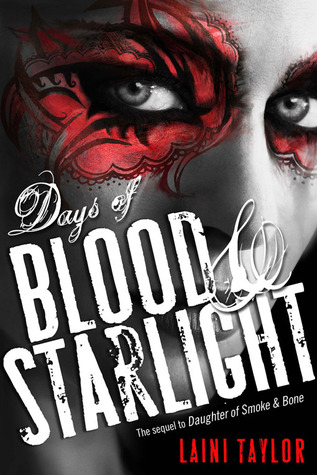
Days of Blood and Starlight is the insanely amazing sequel to Laini Taylor's Daughter of Smoke and Bone, and I can't begin to say enough about this author or this series. Except, Aauuuggghhh! It's a trilogy! (At least it wasn't as horrifically cliffhanger an ending as the first one was.) This book is brutal and bloody* and bleak, but it's so, so beautiful**. Morocco this time, and an abandoned kasbah. And lots more of Eretz. Seriously evil angels. Painfully good monsters. (And scary monsters and good angels, and conflicted both.) The first book was about love. This one is about war, vengeance, retribution. But Karou still means hope. Laini Taylor is a craftswoman of consummate skill, and her stories are both exquisitely written and grippingly page-turning. (Sigh. I will never, ever write as well as she does.) If you loved Daughter of Smoke and Bone you won't be disappointed in this one, though you may wish she hadn't taken it to such a dark place. Just be aware that it's much more violent than the first book. (Think Hunger Games and Chaos Walking, and it's a bit worse.)

There are a few other sequels coming up to sabotage my attempts to be productive. Jim Butcher's latest Harry Dresden book is due on Nov 27: I'm eagerly awaiting what Dresden will do as the Winter Knight in service to Mab. I already have Orson Scott Card's Ruins, the sequel to Pathfinder, on my iPod, but I have to reread Pathfinder first, so I'm saving them both for a long plane trip I'm taking in a few weeks. And I have Terry Pratchett's latest, which I don't think is a Discworld novel, so doesn't count as a sequel, but I've been looking forward to it as well.


*Literally, in my case: I sliced my finger while chopping vegetables (a fairly regular occurrance, since we have sharp knives and I'm a klutz), and some blood was leaking out of the bandage, and I kept forgetting and putting that finger on the page. So there are authentic bloodstains in various places in my book.

**I really thought I'd gotten over that alliteration virus, sorry.

Sunday, November 4, 2012

The Next Big Thing

I haven't yet mentioned my writing on this blog, because that wasn't the purpose I had in mind for it. But my friend tagged me in her blog, and if I don't carry forward the tag (pay it forward?) I imagine the consequences will be as calamitous as if I didn't pass on a chain letter. (Remember chain letters? Did you know they used to be actual letters that you sent in the mail?)

I'll answer the 10 Questions about my Work In Progress that I'm supposed to, but the most important thing to take away from this post is the link to my friend's site, where she talks about her WIP (and it sounds way cool and I wish she'd hurry up and write it), and the links to the writers I'm going to tag, because they'll have way cool WIPs to talk about, too.

So, first go to Kim Neville's blog. Was I right? Isn't that the greatest idea for a story?

And now, here are

10 Interview Questions for the Next Big Thing


1. What is the title of your Work In Progress?


I don't know yet. I call it Arin, because that's my main character's name. (I may or may not have named her after Aerin from The Hero and the Crown.)

2. Where did the idea come from for your book?


A half-page scene I wrote in a notebook several years ago, in which a boy is listening to his grandfather telling stories about the days when people lived in shining towers and flew through the air in giant metal birds. The boy doesn't believe his grandfather. He has to go take care of the rabbits, that keep trying to escape. I had the image of a farm in the Fraser River valley, inland from Vancouver, at a time when the climate is dry and almost desert--a great contrast to what it is now. Eventually the only thing I kept from this scene was the climate. And the rabbits.

3. What genre does your book fall under?


Post-apocalyptic YA. But NOT dystopian. I'm trying to imagine a very real future scenario, when oceans have risen, temperate climates have gotten warmer and drier, weather has gotten more extreme--and I threw in some earthquakes and volcanic eruptions just to make sure society would completely crumble. But it's not going to be depressing or bleak. People are resourceful and will come up with all sorts of interesting ways to adapt. Think steampunk except with eco-tech. Eco-punk!

4. What actors do you imagine playing your characters?


Um. Hadn't really thought about this. It's a good exercise in character development! Arin's best friend, Chelse, is a young version of Karen Gillian crossed with Julia Sawalha in her role as Lydia in Pride and Prejudice--gorgeous, fearless, impulsive, and completely selfish. Kennan could be Matthew Lewis as the older Neville Longbottom--lanky, a bit awkward, but very nice, and good in a crisis. He's hopelessly attracted to Chelse. Arin is harder. A young Sissy Spacek, but with brown hair. (That just shows how old I am!) Okay, more contemporary: Caitlin Stasey, from Tomorrow When The War Began (which is based on a wonderful book of the same name, which anyone who liked The Hunger Games should go find right now). But without the Australian accent. Naive but practical, fragile-seeming but with a core of steel.

And Arin has a younger brother who could easily be played by a young Macaulay Culkin.

5. What is a one-sentence synopsis of your book?


That would require me to know what's going to happen! I reserve the right to completely change this, but so far:

A girl caught stealing water is forced to spy on (or maybe for) a group of saboteurs determined to start a war over the Pipe that carries the Fraser River south to Seattle.

6. Will your book be self-published or represented by an agency?


Um. I have to finish writing it first.

7. How long did it take you to finish the first draft of your manuscript?


See answer to 6. My last novel took me five years. I'm hoping to cut down on that somewhat.

8. What other books would you compare this story to in your genre?


I'm thinking Little House on the Prairie meets Kenneth Oppel's Airborn. Not sure about the airships, though. (I'd like airships, but where will they get the helium?)

9. Who or what inspired you to write this book?


As soon as I started thinking about what Vancouver might look like in 100 years or so--assuming the worst climate change predictions come true, and we run out of oil, and the whole fragile structure of our society comes tumbling down--I came up with a whole cascade of political, economic, and social ramifications that are a lot of fun to play with. Essentially I've been reading all the dire warning books and deciding, gee, this is probably going to happen at some point in the near future. What will that look like? But I have faith in the human race: I don't think it will be dystopian. I think it might be kind of cool!

10. What else about your book might pique your readers' interest?


I think I've come up with a (reasonably) plausible explanation for why there won't be electricity in my future world, but people will still have technology, so it will be fun to come up with non-electric ways to do all the things we currently need electricity for. (Did you know that London used to have a network of high-pressure water mains all through the city to supply hydraulic power to factories, workshops, building sites, etc?)(Does that not give you all kinds of steampunky ideas?)('Cause, it was actually steam powered. Unlike airships.) (Which are just too inherently cool not to include, whatever the genre is called.)(But I don't think there are any helium repositories anywhere near Vancouver, darn it all.)(I wonder if they could pipe it from somewhere?)(There may end up being a lot of pipes in my novel. Would Pipe make a good title?)


That's it for my WIP. Now it's time for my taggees to answer these questions and post on their blogs. Give them a week or so, and then go check out

The purple-haired KT Wagner, at Northern Lights Gothic

The blue-haired Aheila, at The Writeaholic's Blog

(I should totally dye my hair.)

Sunday, October 28, 2012

Sherwood Smith's amazing fantasy world

Whew! I'm finally finished all four of Sherwood Smith's Inda books. (When you download ebooks, you don't get a sense of how long they are: you don't get that satisfying heft of a thick book.) Now I can finally be productive again. (I've done pretty much nothing else but read for a week and a half, because they were so compelling.)

Sherwood Smith's name isn't as well-known as Robin McKinlay, Megan Whalen Turner, Orson Scott Card--but it should be. She has the ability of all the best fantasists: to make a world and a set of characters leap off the page and take residence in your brain, until you're quite certain you could buy a ticket and go visit, if only you could find the right train platform. What's unique about Sherwood Smith is that she has been working on the world of Sartorias-Deles since she was eight years old. I think she's actually been there. (My pet theory is that Smith is really a Norsundrian mage, and that's how she can skip through Sartorias-Deles's history observing everything and everyone.)

That's the strength and the weakness of Smith's Sartorias-Deles books: they read as if they were real history. The characters behave like real people, with all their contradictions and infuriating motivations; and the plots fit into a larger scope, so there are things that may not make sense in the current story, but that's what actually happened, historically. She has essentially an entire planet worked out, with political, magical, cultural and linguistic histories of probably 20 different countries. (Just go here and look at the map she's developed, and understand that for every country on that map she knows what their language sounds like, what their architecture and fashion looks like, what their food tastes like, not to mention the strengths and weaknesses of their political and military systems.)

So where should you start? So far I've only read the Inda books and Crown Duel/A Stranger to Command. I loved both sets of stories equally, but they do appeal to different readerships.

If you read my blog because you like all the YA and MG books I tend to like, then you should definitely read Crown Duel. (Make sure you get the version that includes Court Duel: they used to be published separately but the latest version of Crown Duel has both. Also, there's some awesome extra material at the end of my ebook that I don't know is there in the print version, so there's a good reason to get an e-copy. (Besides the fact that there aren't a lot of real books around.))

Meliara is one of the original kick-ass heroines (along with Harry and Aerin from Robin McKinley's Damar books, and Tamora Pierce's Alanna). The great thing about Meliara is that she's real. Sure, she's taken swordfighting, but she's not actually that good at it. She's idealistic and determined to right the wrongs in her country, but she's a little ignorant about politics and maybe doesn't make the best choices. She's got spunk--which gets her into more trouble than it gets her out of. And she's stubborn--which can be a good thing, but not always. But she has enough humility to recognize when she's wrong, and she wins everyone's hearts because of her honesty and courage.

The first half of the book (the original Crown Duel) is fighting and getting captured and escaping and being chased; the second half (Court Duel) is set at court (duh) with intrigue and plots and secrets and stuff. I'm not even going to mention the second main character, because you have to discover him for yourself. (Let's just say this is the best kind of romance: where the characters don't even know it's a romance until it's almost too late!) And when you do discover him, you'll be as anxious as I was to read A Stranger to Command, which is his coming-of-age story. (I'm not giving you a link, because I don't want you to go find out who he is before you read Crown Duel.) Then once you've read that, you'll want to read more about Sartorias-Deles, and find out about those mysterious Norsundrians.

I haven't read all the Sartorias-Deles stories Smith wrote when she was younger. They're not as polished, so I think I'll have to be in the right mood for them. (I will read them, because there are so many unanswered questions!) I decided to try the "historical" novels, which are set 400 years before Crown Duel.

If you're an adult* who likes really epic (ie: long and complicated) military fantasy, if you can handle lots of shifts of point of view, and if you don't mind being confused at the beginning as an entire social/military/political system with its own jargon is gradually revealed to you, then you'll like Inda and its sequels. The story begins with a ten-year old boy being sent to military academy. There's an Ender's Game-like section at the academy (which will be familiar to you if you read A Stranger To Command). Then Inda gets exiled and we enter the pirate phase of the story (I know: pirates!) Inda is very much an Ender-type of character, a brilliant strategist and a born leader who endures incredible suffering and remains good (kind, loyal, fair, unarrogant). He's the hero who doesn't recognize his own heroism. He and his group of loyal friends have all kinds of adventures culminating in great battles (both land and sea) against the invading Venn. The plot is epic, vast, with threads and characters going all over the place, but you care about all the characters. You care about Inda--oh, he breaks your heart! He's now up there with Miles Vorkosigan, Horatio Hornblower, Harry Dresden, Eugenides--as my current favourite noble, scarred heroes.

So far everything of Sherwood Smith that I've read is going to stay in my iPod for future escape-out-of-the-universe, fall-in-love-with-the-characters, can't-put-the-story-down comfort reading. And she's got a whole whack of other books I haven't even looked at yet. (But I have to pace myself: one must occasionally be productive.)

Since I can smell it now (I just took it out of the oven) and it is the best thing ever, I'm going to compare Sherwood Smith's books to Upside-down Buttermilk Pear Cake (which is also supremely scrumptious with plums instead of pears). To die for. I'm going to go have a piece right now. Then I think I'm going to download The Trouble With Kings. Or maybe The Spy Princess. Oops, I mean, I'm going to go be productive. Seriously.

*There's quite a bit of violence in the Inda books, though no gratituous gore, and definitely lots of sex--not graphic, but you know what's going on behind the bedroom door, and it's often pretty interesting. (Let's just say that there's probably no Marlovan word for "monogamy.")

Tuesday, October 16, 2012

The Scorpio Races and Grave Mercy

Carnivorous horses and assassin nuns: what's not to like! (I'm actually very mild-mannered and I hate conflict. Really, truly.)

I have to start by confessing that I'm not a huge Maggie Stiefvater fan. At least, I wasn't until now. The Scorpio Races grabbed me with its sharp teeth and carried me out to drown into a stormy sea. Everything about this book was vivid and compelling. The island, with its scent and its storms and its modern mask over an ancient culture revolving around the water horses. The capaill uisce themselves, terrifying, unpredictable, horse-like but so not horses. (They were so convincingly frightening that I had trouble believing that Puck would actually race them--my one quibble about the plot.) I loved the two characters who alternate telling the story: mysterious, skilled, respected-but-not-liked Sean, and fierce, desperate, angry Puck. I loved the romance, nicely understated and full of conflict, because they both really need to win.

The Scorpio Races is about carnivorous horses who come ashore only on this island and are captured for the annual race, which has mythic significance beyond what the tourists recognize. But really it's about the people, their relationship to the horses, to the island, and to each other. No, that sounds boring. It's about  dreaming, longing for something that is denied. It's about taking huge risks and making huge sacrifices. No, that doesn't adequately convey it. I can't really explain what it's about. It just oozes with atmosphere and intensity. Maggie Stiefvater writes beautifully. Her previous novels (about werewolves and fairies) just weren't that interesting to me, but this one was meaty and satisfying. Steak and mushroom pie.

Assassin nuns. I have to say it again, because, really. Why has no one else come up with this concept? (Maybe they have and I just don't know about it: if so you have to tell me what I've been missing!) Grave Mercy is Robin LaFevers first book about girls from the convent of St. Mortain, otherwise known as Death. They are trained to be His Fair Assassins and carry out his will, which appears to be saving Bretony from those treacherous French, so once Ismae is trained in all the cool ways there are to kill people she gets to dress all pretty and sneak around court looking for spies to assassinate. I liked the idea of Mortain. I liked the spying, the girl kicking the butt of arrogant men, the romantic tension between Ismae and the guy she doesn't know if she can trust. Grave Mercy was entertaining--not as good as Sherwood Smith or Megan Whalen Turner, but along the same lines. I think there is a lot of potential in the premise that LaFevers can still explore, so I'm going to read the next book in hopes that she does more with the depths that Grave Mercy hints at. This book was a mocha cream puff.

In the meantime, I had to go and reread Sherwood Smith's Crown Duel, because she does such a good job of the romance between people who don't trust each other. And because it's just so good. And then I had to read more Sherwood Smith, so I downloaded the Inda books. When I emerge, gasping, into the real world again, I'm going to devote a whole post to Sartorias-delas.

Thursday, October 11, 2012

Legend, by Marie Lu

Yikes. How is it halfway through October already? I've got a backlog of books to blog about, so let's get right to it.

Characters. It's all about the characters, people. You can create the most fascinating fantasy world or the most devastating dystopia. I won't give a rat's eyeball about it if I don't care about the characters.

Marie Lu could give a master class on creating compelling characters. (Sorry, I think I'm coming down with the alliteration virus. I'll try to hold it in check.) Here's how Legend opens:
My mother thinks I'm dead.
Well, that catches my attention. Not only that, but "it's safer for her to think so." Why? Day is a notorious wanted criminal, "wanted for assault, arson, theft, destruction of military property, and hindering the war effort." I like him already! Then we find out he's hiding in an abandoned building that overlooks his home, waiting until the soldiers are finished going through the neighborhood so he can sneak down and leave a gift of food and useful items he's stolen, because it's his older brother's birthday. Oh! Wrench my heart and make me completely love the guy!

Then we meet the second main character. June is waiting to see the dean because she's in trouble again: she snuck out of school to "scale the side of a nineteen-story building with a XM-621 gun strapped to [her] back." This puts her in a class above your typical spunky heroine. Why did she do this? "My afternoon drills aren't teaching me enough about how to climb walls while carrying weapons." Yeah, mine neither. "Rumor has it that Day once scaled five stories in less than eight seconds." Oh ho. June is training to be the best possible soldier for the Republic, and she would love nothing better than to be the one to capture Day.

Do we have conflict? Two compelling characters set on a collision course in a pretty scarey world of tromping soldiers, crumbling cityscape, and plague. You're not going to tear this book out of my hands.

You may be getting a little tired of dystopian YA. It can be horribly grim, and a lot of the books out there are less interesting than they think they are. But Legend is an example of why the genre became so popular in the first place. Okay, I'll say it: a worthy successor to The Hunger Games. There's a sequel, but it's not a horrible cliffhanger ending. There's just lots more story to tell.

Legend is a big, juicy burger with all the fixings. Meaty and flavorful. (It's told from alternating points of view; that's what made me think layers, therefore burger. It makes sense, trust me.)