Tuesday, January 21, 2014

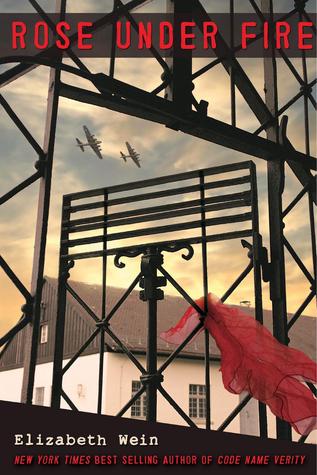
Rose Under Fire, by Elizabeth Wein

Alrighty! Here's the first of my long overdue reviews. This is one of the best books I read in 2013.

When I heard there was a companion book to Code Name Verity, I was both excited and a little worried. How could Elizabeth Wein write another book that powerful, that moving, that brilliant? And did I want to read another book that powerful and moving? So many terrible, terrible things happened during WWII: did I really want to read about more of them?

The answer is yes. Most resoundingly.

Because we still need to know what happened during WWII. We still haven't learned what we need to learn about the terrible things humans do to other humans.

And because Wein's books are full of hope and courage and poetry and strength.

From Wein's Afterword:
What I'd really like to pound into the reader's head, if there's any lesson to be learned here, is that I didn't make up Ravensbruck. I didn't make up anything about Ravensbruck. Often, I have had to fill in the blanks--when the toilets stopped working, how thick the mattresses were, how you might improvise a sanitary pad. The little things. The terrible and the unbelievable, the gas chambers and the medical experiments and the twenty-five lashes, propping up the dead to make the roll call count come out right, the filth and the dog bites and the curl hunts and the administration and politics of bowls, I did not make up. It was real. It really happened to 150, 000 women. And that is just one camp.
But if you think you don't want to read a book about a concentration camp, because it will be depressing and you just don't want to know about such horrible things, trust me: you have to read Rose Under Fire. Hope. Courage. Poetry. (The best use of Edna St. Vincent Millay's poetry I've ever seen.) Strength.

Character. The characters in this novel shout off the page: we are people! We are PEOPLE! And the thing is, however tragic it was, there is something fiercely joyful about that brazen assertion in the face of all evidence to the contrary. Wein captures that joy, that ferocity.

I finished the book a little breathless, with tears in my eyes, wanting to do that fist pump of victory the sports players do as they come off the field. Yes! Humanity wins again. We do have it in us.

Beautiful book. She's such a brilliant writer. My food analogy is strudel (there's a recipe a few pages into the linked article): not the flaky fruit-filled kind; this is a wartime German dish--suitable for nourishing a whole family with only potatoes, flour and oil, and so delicious that my kids asked their grandmother to make it for Christmas Eve dinner this year.

Monday, January 20, 2014

Elephant and Piggie, by Mo Willems

I am seriously behind on my reviews, have a ton of stuff I read over the holidays to post about, but I'm going to procrastinate a little longer because I have to post about the new books I just bought at Kidsbooks' annual sale (every year in January, like a little extra dose of Christmas, just when you thought it was all over!)


I was familiar with Mo Willem from the Pigeon and the Knuffle Bunny picture books, classics all, but my sister introduced me to his Elephant and Piggie early reader books. They are so funny! Funny up there with Captain Underpants, which if you know me you'll know means they are sidesplittingly hilarious in all kinds of brilliant ways. Just look at the facial expressions on Gerald the elephant and his friend Piggie: such simple line drawings convey so much emotion. And I bet you can't look at these pages without your lips starting to twitch:


 Willems plays with absurdity, with character, with the fourth wall (the one between the audience and the stage), with convention, with imagination, with moral choices (Should I Share My Ice Cream? The answer is yes, but not for the reasons you might expect). And he respects children. Kids get irony, probably better than us stultified adults. These books are quintessentially silly, but they're the farthest thing from dumb.

Elephant and Piggie are refreshing to the soul. I restrained myself and only got three this time, but I think I may end up collecting the whole pack.

Neil Gaiman was my other purchase, but I'm going to save him for next week's Marvelous Middle-Grade Monday. (This post would have been an MMGM if I had gotten my URL to Shannon Messenger in time! Go see her blog today for other great middle-grade reads.)

Monday, December 16, 2013

MMGM: A trip to Wales

Entering read-a-thons is probably not a good idea for me. It's not like I need any more encouragement to spend all my waking hours with my nose in a book!

I've now finished the five books of Susan Cooper's The Dark is Rising sequence (for the umpteenth time, I might add), and I can confidently recommend them to anyone with an interest in High Magic and the ancient battle between Light and Dark. If you like C. S. Lewis, Tolkien, Philip Pullman, Madeleine L'Engle, Ursula K. LeGuin--Susan Cooper stands right up there with them, weaving bits of Welsh and Arthurian myth with her own version of the eternal struggle, all planted firmly in real landscapes of the British Isles. (My last post has more descriptions of the five books of the series.)

I had the additional fun on this read-through of using Google Earth to trace the protagonists' journeys through Wales. Search for Aberdovey, Wales, when you're reading Silver on the Tree, for example, and you can find the Bearded Lake on the hillside above it (follow Panorama Walk). You can even use Streetview to see the view of Happy Valley that Jane, Simon and Barnaby saw, and get some images of the estuary at the mouth of the river, where Will and Bran come back from the Lost Land.

I also have some pictures from my own trip to Wales several years ago (which unfortunately wasn't long enough for me to visit all the places Cooper mentions). There are three pics in my previous post, and here are two more. This is Llyn Mwyngil, the 'pleasant lake' where the Sleepers lie in The Grey King. The first picture is looking across the lake at the slopes of Cader Idris; Will Stanton stood somewhere up there to play the harp that woke the Sleepers. The second picture is looking down the lake toward Tal-y-Lyn pass (green slopes of Cader Idris on the left)(and I'm sure that's one of the Light's swans):


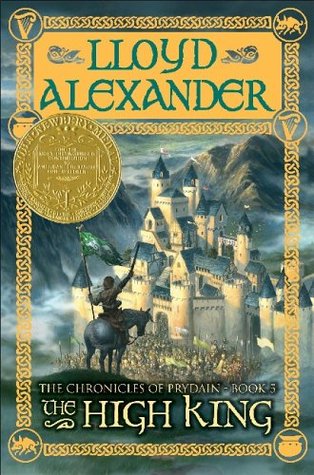
If you're enamoured of all things Welsh, you can round out your reading experience with another classic kids' fantasy series: Lloyd Alexander's Chronicles of Prydain. Based on the tales of the Mabinogion, the five short novels tell the story of Taran, Assistant Pig-Keeper, and his motley group of friends who must fight against Arawn, Lord of Death. I adored these books when I was a kid. Taran is one of the most accessible epic heroes: he tries so hard and falls flat on his face so often! (I think I found him a true kindred spirit.) I haven't reread these in a while; think they might be my next readathon.

If the Hobbit movie has got you in an epic fantasy mood, Cooper and Alexander are some of the originals of the genre. (I find it funny that people say Alexander was ripping off Tolkien: truth is they were both ripping off mythology!)

For more great Middle-grade picks, check out Shannon Messenger's slate of marvelous bloggers.

Wednesday, December 11, 2013

The Dark Is Rising 40th Anniversary Readathon

Well, this one is a no-brainer for me! Thanks to Kristen over at We Be Reading for pointing me toward Danny Whittaker's Readathon. Susan Cooper's The Dark Is Rising sequence is an old favourite. I've reread it multiple times, but it's been a few years. (40th anniversary, huh? I'm not going to say that I'm starting to feel old, but . . .)

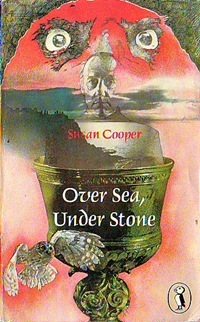
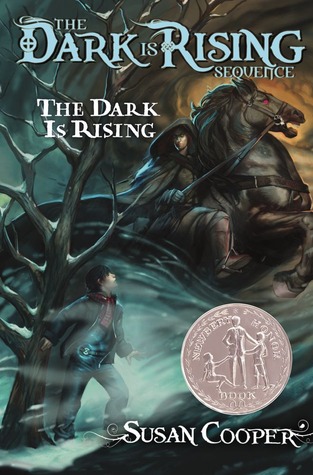
I'm a few days late for the start, but I'm sure I can catch up! If any of you have missed out on this seminal fantasy series, now's a great time to amend that distressing gap in your reading history. (There are a number of different editions, and I can't say I love any of the covers, but I have a particular fondness for the Penguin Over Sea, Under Stone and the Collier Greenwich, illustrated below. I think they captured Merriman and the Greenwitch particularly well.)

First, you'll meet Simon, Jane, and Barnaby Drew, children on vacation in a Cornwall village with their Great Uncle Merriman Lyon. They discover an old map in the attic, and it soon becomes apparent that this map leads to something of great importance, if they can only decipher it . . . That's Over Sea, Under Stone.


Then in The Dark is Rising you'll meet Will Stanton, the seventh son of a seventh son. And you'll find out who Merriman Lyon really is.


Don't worry, the Drew children come back in the third book, Greenwitch, and show up for the climax of the battle between Light and Dark in Silver on the Tree, along with the mysterious boy Bran, whom Will meets in The Grey King. There may or may not be references to King Arthur, here and there about the series, and lots of real places in Britain and Wales with real historical or mythical associations.

Here, for example, is Cader Idris, home of the Grey King:

And nestled at its feet (you can sort of see the lake in the picture above, if you look closely) is Llyn Cau:


And this is the breath of the Grey King: a sudden fog rushing up the mountainside. She did not make this up:


When I found out these were real places, I rearranged my trip to Wales so that I could hike up and take these photos. Just for you!

Now you have to go read the books!

(Okay, I hadn't actually started blogging when I went to Wales. So maybe I didn't take the pictures just for you. But now you have them! So you still have to read the books.)

Monday, December 9, 2013

Northward to the Moon, by Polly Horvath

I've been a Polly Horvath fan since I picked up Everything on a Waffle purely for its title and fell in love with her quirky characters, deadpan humour and off-the-wall philosophy. Northward to the Moon is a sequel to My One Hundred Adventures (my review here).  Adventures is a complete story unto itself, but now we get to find out what happened next to Jane and her unusual family.

Jane's dreamy poet of a mother has never identified the fathers of her four children; she may not even know who they are; but Ned is a definite possibility for at least one of them, and at the end of My One Hundred Adventures he has decided to take responsibility for the family. They move to Saskatchewan where Ned takes up a position teaching French. At the beginning of Northward to the Moon we learn:
Our family lasted almost one year in Saskatchewan. It took the town that long to figure out that Ned didn't speak any French.
Jane is thrilled to be on the road again seeking adventures. Ned takes her and her mother and siblings along a trail of clues from Ned's past to northern BC, Las Vegas and a horse ranch in Nevada.
It occurs to me how Ned and I wanted to be outlaws and here we are, in the American West, in the high desert. We are escaping who knows what with a bunch of money from who knows where. Do things happen because you want them to? Can you create your life and adventures by imagining them?
Ned ends up with a bag of possibly ill-gotten cash from his brother that he doesn't know what to do with. He is reunited with his mother and sisters and gets stuck caring for his mother when she gets injured. Jane is tangled up in these adult affairs and yet powerless to affect them. She gets a crush on a ranch hand and tries to figure out why her sister is so depressed. She thinks adventure and excitement are everything she wants from life, but maybe it would be nice just to go home.

Jane as the innocent narrator has a hilariously accurate perception of the adults around her. I found myself laughing with Jane at the same time as I felt horrified by how irresponsible everyone was. Northward to the Moon is more bittersweet than One Hundred Adventures: it's an elegy about families and how they fail. It's also about how they succeed despite all the ways they fail. Jane has a resilient spirit, and people do come through for each other. I found this book less funny and more troubling than the first one, but I never wanted to put it down. And I really, really hope there is a sequel.

For fans of Sharon Creech, Katherine Paterson and Kit Pearson. Cornbread with maple syrup. Or with baked beans. Or both.

For more Middle-Grade reads, check out Shannon Messenger's great weekly meme, Marvelous Middle-Grade Monday. And for more Canadian books, head over to John Mutford's blog.

Friday, November 29, 2013

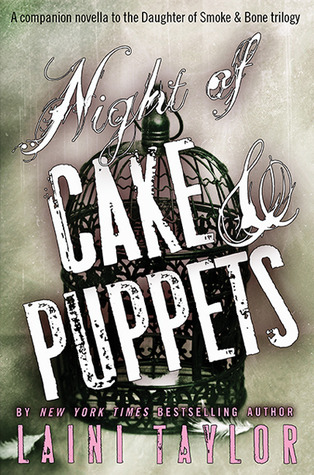
Night of Cake and Puppets, by Laini Taylor

Laini Taylor wrote a novella called Night of Cake and Puppets. Best. Title. Ever. I am so stoked!

It's about Zuzana and Mik. I'm jumping up and down squealing. (For those of you not already Laini Taylor fans (and why aren't you? huh? really?), these are characters from her Daughter of Smoke and Bone series. This novella takes place in the middle of the first book.)

I can download it right now. I love the internet. I'll be back.


"I am a rabid fairy. I am a carnivorous plant. I am Zuzana."

"I eat vengeance with a spoon like it's honey."

"Life doesn't need magic to be magical."


I can't quote anymore because I just want to quote the whole thing and that would be spoilery.


Aieeeeeeee! Okay. All love stories ever written are now lame and boring and passionless as blanc mange. No romance will ever, ever, ever measure up to Night of Cake and Puppets. And wow, does this woman know how to ki . . . nope, spoilers!

I think the long short story/short novella is Laini Taylor's best medium. Don't get me wrong: her novels are great. But there's all that plot and stuff to distract you from her sentences, and her sentences are exquisite. And epic action and adventure are fine, but what she's best at is moments. Pure, magical, intense, perfect moments of discovery, encounter, twist of heart. She distills the revelations we all long for into poetry of scene and dialog that leave you breathless with anticipation and delight. You didn't know the world could be like that but she creates it for you before your eyes.

I want to go to Prague, right now.

I'm going to reread the story.

"A small, whole Sacher torte, its chocolate so dark it looks black."

Mmmmm.

Friday, November 22, 2013

Shadows, by Robin McKinley

A new Robin McKinley! Break out the chocolate and get comfy!

If you're familiar with Robin McKinley from her earlier books, like Beauty, or The Blue Sword, and think of her as the queen of YA fairy-tale/high fantasy, you may not know what to make of her more recent work. There's Sunshine: awesomely scary vampires and an unusually talented coffeehouse baker (gives Death by Chocolate a whole other meaning), in a world that's sort of like ours but not. So, kind of urban fantasy/paranormal, but not really. Then there's Dragonhaven, with dragons, but real ones, in a reserve, where park rangers collect dragon poop and orphaned baby dragons are a bit of a problem to care for. So, not your typical dragon story at all. Pegasus is closer to vintage McKinley, with a princess and a flying horse and a world reminiscent of Damar. (Still waiting eagerly for Pegasus II, which is coming.)

The only thing you can definitively say about McKinley is that she's incredibly imaginative and original, and whatever world she creates she drags you into it and makes you never want to leave.

Which brings us to Shadows. I'm not sure this is a world I'd like to visit, because it's pretty scary. It's most similar to Sunshine (Sunshine's world is scary too: it's the coffeehouse I wish were real): it looks a lot like our modern world, but with weird stuff. Like cohesion breaks: rips in reality that pop up occasionally and if you get too close you disappear forever. But it's okay, the army has cobey units with all sorts of scientific devices to deal with them. Move along now, folks, nothing to see here. In Newworld science can deal with everything; it's not like Oldworld with all those suspicious, creepy magic-users; there's gene-splicing to make sure no one in Newworld has magic anymore.  And if anyone wants to immigrate, they'd better have left their magic behind. There are monitoring devices at the border to make sure.

So when Maggie's mom remarries a guy with an Oldworld accent, and there's something weird about Val (and it's not just his fashion sense), Maggie is seriously freaked out. Val's shadow has too many legs. In fact, he has too many shadows. With legs. Or possibly tentacles. "Have you ever thought about the darkness between a row of books and the top of the shelf? Of course not. You don't, until it goes all loopy, and little things like legs or tails or tongues hang down over the spines."

Shadows is the spookiest book McKinley has written, and she's just as good at creating spooky as she is at heroic and magical. The version of magic in Shadows is completely different from any other kind of magic I've ever read about--it's so interesting. I love that origami is magic. And algebra (or, at least, algebra books). And animals: more than anything else I think Shadows is a paeon of praise for dogs and other loyal animals who take care of their humans no matter the cost to themselves. The gruuaa are wonderful. (Not going to tell you what they are!)

There are also a couple of seriously hot guys and a great best friend with a Mammothmobile (the better to fit all the dogs). Quite a bit of humour, a lot of it dog-related (which you'll be familiar with if you read McKinley's blog). And a lot of possibilities for sequels, not that it will do any good to hint about it. (McKinley's quite insistent she can't write the stories she wants to write, only the ones she's given. And she hasn't yet been given any Damar sequels, despite all of our begging.)

If your reality could use a little warping, I highly recommend the particular warped version of it in Shadows.

This one has to be caterpillar rolls from your favourite sushi place (it's okay if you don't like raw fish: caterpillar rolls have cooked crabmeat. And avocado. But if you really don't like sushi, then you can have the beef teriyaki. So long as it's really good, and comes on one of those sizzling hot cast iron trays.)