Monday, December 7, 2015

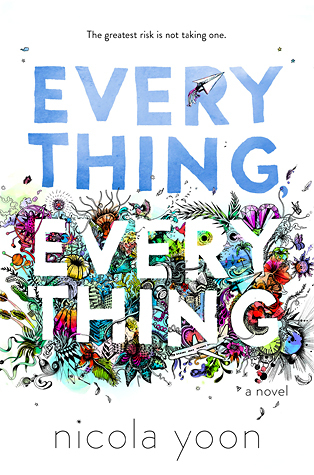
Everything, Everything, by Nicola Yoon

This book. This book, people.

This book is perfect.

This book has everything (ha, ha, get it?). All the feels. Stunning command of language. Brilliant use of structure. Living, breathing, flesh-and-blood characters. Deep, honest themes. Really cute kids who fall in love. (That's in the blurb, so it doesn't count as a spoiler.)

And that cover! I keep touching it to see if it's real. Plus there are awesome illustrations and graphic designs inside the book that add a wonderful immediacy to Madeleine's narration.

I want to quote the whole thing, but it's hard to find any quotes that aren't spoilery. Here's a good one:

"Love can't kill me," I say.
"That's not true," she says. "Whoever told you that?"
I adored Madeleine from the moment I met her, with her colourful books in her white room with the white walls and white bookshelves, and her heartbreaking "Reward if Found" ideas that she writes in each book. Trapped in her house by a rare disease, she is patient and funny and self-aware and so, so sad.

Then Ollie and his family move in next door, and Ollie dresses in black and is athletic and sardonic and does hilarious things with a bundt cake. Madeleine is terrified of getting to know him because it can only end sadly. They can't even meet! But how can she resist?

It's almost certainly going to be a disaster.

There is so much going on in this book, and I can't tell you about any of it! Just know that it's utterly compelling (I sat in a chair, opened it up, and didn't get up from the chair until I was finished). It's also very funny. Olly and Madeleine have intelligent witty banter that actually sounds realistic. Their developing relationship is delightfully, exquisitely drawn.

And the ending is the best kind of ending: the one you never saw coming, but when it happens you realize you should have known all along.

YA romance isn't really my genre, but when it's done like this one I can't help but like it.

My mom's melt-in-your mouth shortbread (which I'm about to make, because Christmas baking!).

Tuesday, December 1, 2015

Orleans, by Sherri L. Smith

Taking a break from Cybils nominees today: I was browsing in the library and I happened to see this cover and I had to bring this book home. And wow. This is quite the book.


Orleans came out a couple of years ago, and I'm surprised it didn't get more notice, either in the blogosphere or on the awards circuit. This is a significant book. It's also not a very typical YA novel; in particular it's not a typical YA dystopian, and that's part of why I loved it (and maybe why some readers were left a little stranded by it).

The cover is perfect. I can't stop looking at it, it's so beautiful. Plus, it perfectly represents the vivid, gorgeous, fascinating, terrifying—and terrifyingly plausible—world Smith has created. Orleans is what New Orleans becomes after multiple hurricanes have devastated it, after a terrible plague sweeps through it and after the rest of the States wall it off to prevent the plague from spreading. Those who didn't die of Delta Fever band together in tribes based on blood type as a way to prevent the worst effects of the disease. Cut off from the rest of the world except for whatever smugglers can bring in, a strange, dangerous society evolves.

I can't say enough about the world-building in Orleans. Unlike almost all YA dystopias, this one has an entirely believable premise—the only thing that seemed a little contrived was the fever affecting different blood-types differently, and I don't know enough biochemistry to know how plausible that is. And, given the premise, this is how people would actually behave. I love that there are selfish, manipulative evil people making the most of the lawlessness and chaos, but there are also good people trying to take care of others, and there are regular folk just trying to survive. There's an economy that works; there's no central authority, but there are rules everyone obeys because it's to everyone's benefit to obey them.

Orleans reminded me of Olivia Butler's Parable of the Sower with its incisively accurate portrayal of humanity reacting to crisis. Both at the societal level and the individual, I was completely convinced by Smith's version of post-apocalyptic New Orleans.

And the environment: decaying, toxic, flooded, lush with swampy jungle. Never mind my description, just gaze at that cover and know that the narrative draws you right into that world.

But, however immersive the setting, if I don't like the protagonist I won't be able to read the book. I loved Fen de la Guerre. Fierce, intelligent, loyal, pragmatic, deeply scarred—physically and emotionally—by terrible things that have happened to her, she pursues her goal come hell or high water (quite literally) using whatever means she must. And her goal? I have not seen this yet in YA sci fi: she has to smuggle a newborn baby (not her own) across the wall to safety before the baby gets infected with the fever. Utterly compelling.

Fen's voice . . . let me give you a sample:
The second rule of escape: Assess your assets.
I got two legs and two arms that work, so that be something. They took the chains off when they threw us in here. I got a half-empty bottle of baby formula. I got a shirt tied into a sling, and a baby. I got some hay, and that about it. Not a lot to go on. 
Then a cough come from the other side of the room and I remember I got one other thing. I got the leper. 
The rhythm of the dialect worked for me; I could hear Fen in my head and it brought her to life. It's also another example of Smith's detailed realism, because there are actually several dialects and languages in the book, and Fen speaks more than one, depending on the circumstances.

I could go on and on about this book, but I'll finish by telling you two things that this YA dystopian does not have:
1. a teenager with special powers who saves the world
2. romance
So you've been warned! Unless you think those are two essential elements, you need to go find this book. It's that good.

Monday, November 23, 2015

MMGM: A bunch of fun books

Guaranteed to get you out of a November slump (the sun sets so early this time of year, it can be really depressing!) Here are a bunch of books from the Middle-Grade Cybils nominees that I found at my library and greatly enjoyed:

Diary of a Mad Brownie, by Bruce Coville—Angus was a hilarious narrator, and I loved his difficult relationship with his new—very messy—human, Alex. The curse was delightful and the plot resolution was very satisfying. Lots of chuckle-out-loud moments. Yummy like Cherry Blasters (those sour candies in the shape of cherries, like Fuzzy Peaches but better)

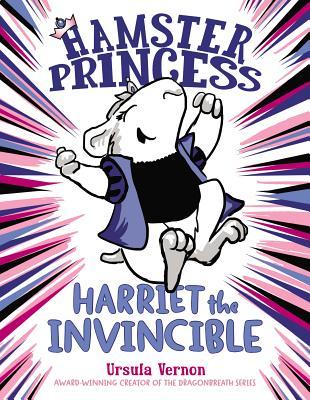
Harriet the Invincible, by Ursula Vernon—funny and brilliant on so many levels. I never liked the Sleeping Beauty story until I met Harriet, the Hamster Princess, who realizes the incredible upside of the evil fairy's curse: if she's going to get pricked by a hamster wheel when she's twelve, then obviously until then she can't die. So off she goes to jump off cliffs, rescue princesses from dragons (and dragons from princesses) and deal with those nasty Ogrecats. Really cute illustrations and really clever jokes. (An example: "Princesses do not go cliff-diving." "I bet lemming princesses do.") I just hope it reaches its audience, because the cover makes it look like a very easy reader, and I think it's for the same readership as Captain Underpants, or Diary of a Wimpy Kid. (Every bit as funny as Captain Underpants, which is my benchmark for awesome humour.) Salted caramel chocolate chip cookies—my brother makes them; they're to die for.

Pip Bartlett's Guide to Magical Creatures, by Jackson Pearce and Maggie Stiefvater—what if the Tribbles spontaneously caught fire when they got excited? That's the chaos-inciting premise of this fluffy adventure. Fuzzles are smaller than Tribbles: small enough to hide in your underwear drawer, which is a problem when the town is overrun with them, and whenever people find them in their underwear drawers the people tend to shriek a lot, which gets the fuzzles excited, and then . . . lots of slapstick humour in this one. I loved the other hilarious magical creatures, like the paranoid unicorn and the toxically smelly hobgrackle. I also liked that the adults both helped and hindered in realistic ways. Peanut butter and jelly sandwich.

These two aren't actually on this year's Cybils list, but their sequels are (and the sequels weren't in the library yet, so I read these ones in the meantime!)

The Penderwicks on Gardam Street, by Jeanne Birdsall—I adore this family of clever, loyal, proactive sisters who get into the most ridiculous situations just by being themselves. Birdsall captures families perfectly, in all their chaotic, messy, hilarious, fierce and tender reality. I love books with characters so leap-off-the-page fully-drawn that you have to smile just thinking about them. This one (Gardam Street) is the second in the series, and the one that came out this year (Penderwicks in Spring) is the fourth. I'm so happy I still have two more to read (and it looks like there will be a fifth one, too).

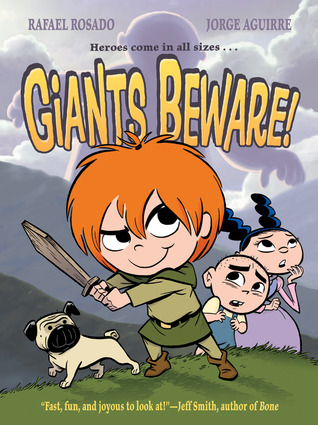
Giants Beware! by Rafael Rosado and Jorge Aguirre—what's not to love about this band of friends who march off to slay a giant and only survive their adventures because of the surprising talents they each turn out to have. Clean, bright artwork and a full cast of interesting characters, including the adults (I loved Claudette's father.) This is book one, and the sequel, Dragons Beware!, came out this year.

Sunday, November 15, 2015

The Rest of Us Just Live Here and Bone Gap

I have to face the facts: I am never going to be able to read all of this year's Cybils nominees. And even if I could, I'd never have time to review them all! So you'll just have to follow the Cybils blog and all the other Cybils judges* to get highlights about all the awesome books I'll never get around to. I'll just review as many as I can, sometimes with shorter reviews so I can fit them all in. Here are a couple from the YA Spec Fic list that I was thrilled to find at my library.

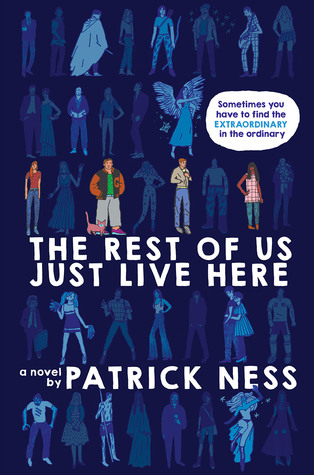
I was so excited to read this new one by Patrick Ness, that I almost forgot what Patrick Ness books are like: they're devastating.

I got sucked into reading The Rest of Us Just Live Here by the fun premise and the engaging characters and . . . fortunately for my state of mind this one isn't quite as soul-wrenching and brain-exploding as some of his past books have been. *cough*Chaos Walking*cough*

But, The Rest of Us Just Live Here has its share of deep insights into relationships, human choices/free will/destiny, self-knowledge, trust. You know, all the big stuff. The reasons we read YA.

Plus awesome characters: Mikey and his sisters who take care of each other because their parents are so messed up; Mikey's best friend Jared (Jared is so awesome I love Jared but no spoilers so I can't tell you why!); Henna, the girl Mikey loves who thinks she loves someone else but isn't sure. And they're all just trying to navigate the last year of high school and figure out what to do with their lives, while in the background the indie kids battle the latest supernatural menace.

I love the chapter headings ("Chapter the Fifth, in which indie kid Kerouac opens the Gate of the Immortals, allowing the Royal Family and its Court a fissure through which to temporarily enter this world; then Kerouac discovers that the Messenger lied to him; he dies, alone"), and the way the indie kids' story starts out seeming completely irrelevant, but then gradually starts to impact Mikey and his friends, but the real drama and excitement is still friendship and love and saying what you feel and trusting your friends. It's spoofy and funny and heartwarming and just very, very real. (And a tiny bit devastating, but in a good way.)

Apple cake, moist and dense, the kind your grandma used to make, but with a bit of ginger and cardamom along with the cinnamon in the streusel topping. (Your grandma didn't use a streusel topping? Everything should have a streusel topping. Especially apple cake.)

Bone Gap, by Laura Ruby, is a weird, wonderful book. Seriously weird. It's not a book you can come into with any expectations, particularly genre expectations, because it isn't like anything else. People are calling it magic realism, but it's not quite that. There's mythology of different kinds woven through it, (what is it about cornfields??) but it's not exactly retelling a myth. Except that it's about myths, and how the stories we tell ourselves and each other matter; the stories that we believe matter and we can change them.

I loved the writing and the characters, but about halfway through I was starting to get worried. There were some disturbing stories being told, and I was afraid that maybe Laura Ruby has a big chip on her shoulder about the way men and women interact with one another and this book is her way of disturbing us into realizing how wrong things are. Yes, men can be nasty and ignorant and treat women as objects, and people do judge and label women in unfair, hurtful ways. I was afraid that was going to be the message of the book, and I wasn't sure I wanted to keep reading.

I should have trusted Ruby. She knows what she's doing. Bone Gap is a story about stories, and you can't change the stories other people tell but you can change your own story. And you can save yourself, and you can save other people, too.  I loved Finn and Rosa and Petey, each with their strengths and hurts and different kinds of courage.

There were some seriously creepy scenes, and some wonderfully magical ones, and the most magical scenes were maybe the most realistic ones, because what is more magical than people choosing to trust each other?

I don't know if I would have tried this one just based on its blurb: just read it, it's the only way to know if you'll like it!

Sweet potato pie. (Unless sweet potato pie is your familiar comfort food, in which case choose a pie that isn't familiar but if you tried it you'd probably like it.)

*I hope this link takes you to the right page of the blog, but if not, the judges are announced in blog entries in late September, so just keep navigating through to find them.
Monday, November 9, 2015

MMGM: settings that are like characters

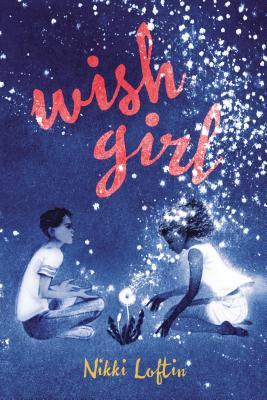
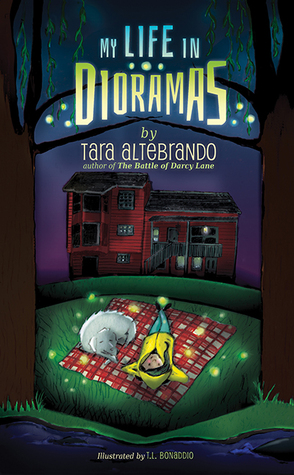
Two books this time that have a little more in common than my last pair: My Life in Dioramas is realistic, Wish Girl is sort of magic realism, but both have settings that are so vivid and so important in their impact on the characters that they are like characters themselves. (Also, they're both nominated for Cybils. I'm trying to make my way through the lists!)

Wish Girl is about a boy who is bullied so badly his family has to move, and who meets a girl dying of cancer. Yet it's not at all bleak, depressing, or even very sad. Peter's humorously fatalistic narration helps:
I got tired of my family saying, "What's wrong with Peter?"
There was a lot wrong with me. But at the moment the most serious thing was the rattlesnake on my feet.
Peter runs away from home and discovers a beautiful, wild, magical valley, a place that only reveals its secrets to someone who knows how to be quiet. I loved the descriptions of this valley, and the way magic and art in the valley are synonymous. I enjoyed how the valley's magic accepts Peter and Annie (and rejects the loud, violent, mean neighbor boys).

I did find those boys—and every other character besides Peter and Annie, actually—to be rather stereotyped, cardboard characters. And I thought the ending was too pat and easy, especially considering the themes of choice and acceptance I thought she was developing.

But that valley! I never thought of Texas as a beautiful place, but apparently I was wrong.


My Life in Dioramas is as quirky as it sounds. It's a quietly funny book about a family that has to leave their beloved house because they can't afford it anymore, and the lengths daughter Kate goes to try to prevent their house from selling. 

I enjoyed Kate's relationships with her best friends Stella and Naveen and the subtle changes in those relationships as they approach adolescence. I thought the family dynamics were well done; Kate's parents are fully developed characters who have their own reactions to selling the house. 

The house itself was wonderful: one of those old houses that gets added on to through the years so it has strange corners and odd rooms and little quirks, set out in the country so there's an old barn and a creek and lots of room for special places. The dioramas in the title are Kate's way of processing her grief and coming to terms with change: she makes dioramas of each room of the house that encapsulate her favourite memories. I loved how the dioramas became metaphors that worked in different layers, both for the reader and for Kate. 

Letting go of something you love is part of growing up, and Kate's journey is sweet, funny and satisfying. (Though I was disappointed the stinkbugs never played a major role in the plot!)

Friday, November 6, 2015

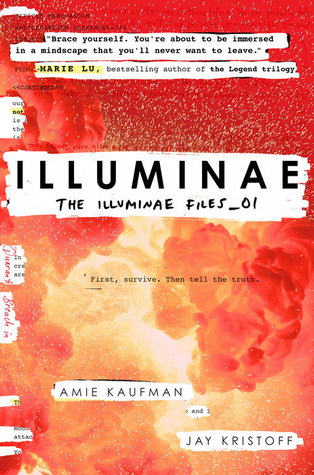
Illuminae, by Amie Kaufman and Jay Kristoff

Well, that was a fun ride!

**Note that this review is more spoilery than my usual reviews.**

Illuminae is getting a lot of hype that it doesn't even need, because it has all the stuff. I mean, think about any stuff that might make a bestselling YA sci fi novel, and this book has all of it. In fact, think about anything from any successful sci fi movie of the last 20 years, and this book probably has it.

(Except light sabers. There aren't any of those.)(Or aliens. Guess that's a pretty big one.)

I wasn't going to be spoilery about it, but then I saw Jay Kristof's Goodreads review, and it pretty much summarizes the whole plot (which, frankly, is pretty easy to do), so I guess it doesn't matter. If you think zombies on spaceships sounds like an awesome premise, then this is the book for you.

(There aren't any clones, either. Maybe there should have been clones. (I bet there are clones in the second book.))(Maybe there will be aliens in the second book!)

I have no doubt the movie will be coming out within the next year.

Am I sounding a little cynical about this book? Don't get me wrong, it was a highly entertaining read. Lots of action right from the get go, and the different formats were kind of fun and only sometimes annoying. It was entirely predictable, to the point that I could skip some sections and skim through others, because I knew what they were going to say. I lost a lot of interest once the zombies got on board, because I think zombies are incredibly boring. But I was invested enough to keep reading.

The crazy AI character was pretty good. The romance was formulaic, but I enjoyed the snarky banter.

Worth reading in the same way blockbuster action films are worth seeing and cheezies are worth eating. Great cover.

Monday, November 2, 2015

MMGM: a scary book and a not scary book

What do these books have in common? They've both been nominated for a Cybils award, and they're both written by Canadian authors! (And I've read them both in the last week. So they have tons in common. Despite being completely opposite in nearly every way.)

The not scary book first:

Clover's Luck is the first book in a series called Magical Animal Adoption Agency, and can you think of a more brilliant idea for an early chapter book series? because I can't! This book is as cute and sweet as it looks, but it's also funny and clever.

Clover earnestly attempts to match up various magical people with the most appropriate magical pet, even though she herself has been terribly unlucky when it comes to pets. The animals are delightful, and the details of their care and feeding are a lot of fun (eg: Clover deduces that hot peppers are the best food for the fire salamanders). To complicate matters there's a witch with increasingly ridiculous disguises and a fiendish (but not at all scary) plan.

Clover's combination of diffidence about her own skills but genuine care for the animals makes her a truly engaging protagonist. Young readers will be charmed by the magic and will be rooting for Clover. I know I can't wait to read the next one and see what will hatch out of the egg that arrived at the end! The illustrations, by the way, are perfect: soft sketches that just capture the personality of each animal.

Full disclosure: I know Kallie, and I'm beyond thrilled for her that this series is coming out. I wouldn't have reviewed the book if I didn't like it, though, so it's honest praise!


And, two days too late for Halloween, a very creepy book that rivals Coraline for scariest story I've ever read:

First of all, you have to go find The Nest in a bookstore and pick it up. It has the coolest cover ever! So effective! You can't get the 3-D aspect of it from a picture, and I imagine that a library copy is all taped up so you can't see the under-cover, so do go to your closest (local independant) bookstore. And then, if you're like me, once you pick it up you'll notice the utterly gorgeous, perfectly moody illustrations by Jon Klassen, and you'll just want to own the book anyway. It's a work of art.

So, wasps. The cover makes that obvious so I'm not spoiling anything. There are wasps in this story. Wasps are inherently terrifying—bees are cute and benevolent; wasps are not; I'm sorry, I know that's speciesist, but I can't help it—especially if you're allergic to them, which our protagonist Steve is. That inherent dread runs through the whole story. But what Kenneth Oppel does with wasps is brilliant and mind-blowing and so much more terrifying because mmmbbblefarg! I can't say anything useful without completely spoiling it, so I won't. Let's just say that this is not a book about people being chased by wasps, oh, isn't that scary, the end.

Steve is a heartbreakingly courageous protagonist. He suffers a lot of anxiety just dealing with normal life, and there's a new stress in the family: "There was something wrong with the baby, but no one knew what." This book rises above other scary* books and approaches the catharsis of A Monster Calls because of the nuanced psychology of this family dealing with the unimaginable and yet so very real terror of a child with "a kind of sickness that never got better."

There's the fear of one's helplessness to fix it; then there's the child's fear that something they do or don't do might actually change things. Oppel deals with this brilliantly. What if Steve could fix the baby? Think about the terror of that possibility—that responsibility.

All the comparisons to Coraline are apt not just because of the beautiful writing and the quiet, gradual, creeping horror, but also because they both touch sensitively on a very real childhood fear: what if, out of fear or anger or desperation or love, I wished things were different, and what if that wish actually came true?

The ending is truly beautiful—there's family love, and acceptance, hope and transformation—and have I mentioned the illustrations? There's just so much in this book to like! Kenneth Oppel is at the top of his form; he's one of the best middle-grade writers out there right now.

For more marvellous middle-grade books, go see what the rest of the MMGM crew are raving about this week on Shannon Messenger's blog.


For more great Canadian authors, see what John Mutford's guests are all reading this month for the Canadian Book Challenge.


*I'm carefully not using the word "horror" because I don't think it's quite right. "Gothic," maybe.