Saturday, August 10, 2013

The Lost Code, by Kevin Emerson

A quickie review I did for Goodreads, of a book I read on vacation:


I picked up The Lost Code on a random library browse, because I was intrigued by "Atlanteans." I was immediately drawn in by the narrator, Owen, who is drowning when we first meet him. He's not snarky and self-confident, like so many of the heroes we love, but he's self-aware, and his awkwardness is so familiar to those of us who weren't snarky and self-confident when we were teenagers. He's not particularly heroic at the beginning, which makes his journey to heroism more believable, in my opinion.

This is a fun read in the Percy Jackson vein, a summer-camp-turns-sci-fi/magical adventure. I liked the slow build-up of things-are-not-what-they-seem, what's-really-going-on-here, isn't-that-super-nice-camp-director-kindof-creepy. I liked the swimming scenes. I liked the Atlantean technology and the futuristic dome technology. There were a few things I would like to have been more developed, and this isn't one of those jump-up-and-down amazing books I'll reread a dozen times, but it was page-turning and engaging and I'll look for the next one.

Tuesday, July 16, 2013

A Face Like Glass, by Frances Hardinge

A new Frances Hardinge novel! I had to drop everything and go find it as soon as I heard. This woman just keeps getting better and better. I'm going to go out on a limb here and call her the next Diana Wynne Jones, and I do not do that lightly. A Hardinge novel makes me turn every page with a frisson of excitement to find out what wonders await me in the next paragraph.


I don't know where to begin.  I can't really tell you what this book is like, because it isn't like anything else. Hardinge is one of the most original and imaginative authors out there. Her awesome website calls A Face Like Glass "a stand-alone tale of deception, cheese-making, betrayal and strategic amnesia." That pretty much sums it up!

You want to know more? A Face Like Glass is set in the underground city of Caverna, where master Craftsmen create magical luxuries (the Cheeses were my hands-down favourites). In this world of corridors and caves, the only light comes from luminescent carnivorous plants. (Coolest light fixtures ever!) The ruler is so paranoid only half his brain sleeps at a time. And children born in Caverna have to be taught how to make expressions on their faces; servants might only be taught a few, like "keen alertness" or "respectful attentiveness," while rich courtiers might have a range from "World Weary, with a Hint of Sadness and a Core of Basic Integrity" to "Amused Shrewdness, with a Well of Deeper Wisdom." So interesting! Original in an entirely different way than Catherine Fisher's Incarceron is original. (Even though they're both cave worlds, they're nothing alike. Except for the twisted, dangerous politics, maybe.)

Hardinge doesn't just have a bunch of clever ideas that she sprinkles through the story like pictures on the wall: everything is thought out; she knows how the cheeses and the wines are made and what happens if they aren't watched carefully; she knows what goes on behind the scenes to make everything work, so I completely believed in Caverna. Plus, everything ends up being crucial to the plot, from the biology of trap-lanterns to the psychology of Cartographers. It all fits together in ways you never would have guessed.

Yes, the plot.
"The problem with Caverna is that it isn't flat. It goes up and down and slants and narrows and spirals round itself and bursts into huge caverns and meets itself going the other way. So—you know the crinkly edible bit inside a walnut? Well, suppose you had to draw a flat picture of the surface of that." . . .
"And now . . . imagine that you are trying to map the biggest, crinkliest, most complicated walnut in the world—that's Caverna. Cartographers have to twist their brains a certain way to understand even part of it, and afterwards their brains don't untwist.
That's what the plot is like. Five-dimensional. Intensely satisfying.

Then there's her language: inventive, textured, surprising, precise, evocative. "She felt the Facesmith's smile tickle over her as gently and irridescently as the headdress feathers had touched the ceiling." When I reviewed The Lost Conspiracy, I compared Hardinge to Laini Taylor in her poetic richness, but Hardinge is less flowery and more colorful and bumpy. Reading her sentences I feel like a kid in a toy shop where the words are the toys. Several times I laughed out loud in delight at her choice of words.

But other books have inventive settings and crazy plots and great language, and I don't love, love, love them the way I love this book. For me it always comes down to the characters, and I adore Neverfell. (She's named after a cheese.) "Despite her best efforts she was a skinny, long-boned tangle of fidget and frisk, with feet that would not stay still, and elbows made to knock things off shelves." Neverfell has such a good heart, and she lives in a terribly dangerous world, and it's heartbreaking and thrilling to watch the world be transformed by her naive, stubborn goodness. And ... but I don't want to give anything more away. I'll just say that Hardinge really understands people and their motivations. Loved Master Grandible the Cheesemaker. And the Kleptomancer. And ... Oh just go read it now!

Because I just spent all day making it, and it turned out delicious, I'm going to compare A Face Like Glass to chicken corn chowder, made with cream and fresh herbs from the garden (thyme, basil, tarragon, green onion, cilantro), and baked in the oven with herb biscuits on top. Rich, complex, textured, layers of flavours, sweet and savoury. (Might just go have another bowl right now.)

Saturday, June 29, 2013

Quick! Three more Canadian Books!

The Canadian Book Challenge, hosted over at The Book Mine Set, is coming to a close tomorrow, and I'm supposed to have read and reviewed 13 Canadian books over the past year. As of yesterday I've only done 10!

I decided at the beginning of the challenge that I would only count books I reviewed on my blog—books I chose and decided to recommend. If I counted books I reviewed for CM Magazine I would be way over my quota—but I'm not changing the rules on myself just because I'm down to the wire. What I can do is add a few more books to my blog that I reviewed for CM over the past year and liked. These are books I can heartily recommend as excellent reads, even if they're not books I would otherwise have chosen for myself.

Old Man, by David A. Poulsen, is  the story of a father-son trip to Vietnam. An estranged father tries to come to terms with what he did during the Vietnam war, and share with his son the experiences that, for good or bad, have made him what he is. Sounds heavy and dramatic and potentially didactic, not my kind of thing at all. But Poulsen narrates it from the point of view of sixteen-year-old Nick, and he is likeable, flippant, self-depreciating. The plot is fast-paced and tense, and the difficulties of two non-communicative guys trying to get to know each other are heartbreaking and hilarious. Poulsen conveys the complexities of a terrible war by describing one man's experiences and how they haunt him, all told from the point of view of the son who is trying to understand him. Quite masterfully done. Definitely a book for guys, but also for anyone interested in war stories and history, and anyone who just likes good writing.

Objects in Mirror, by Tudor Robins, is a horse book. I went through my phase as a teenager, devouring every book about horses I could get my hands on. Objects in Mirror is also about a girl with anorexia, and when I discovered this in chapter two I thought to myself, "oh, no, a horse book that's also an issue book." But then I stayed up until past midnight reading it because it's so good!

Main character and narrator Grace's voice is completely authentic. Her compulsion to lose weight is compellingly believable, and it conflicts heartbreakingly with her love and concern for the horses. According the the author interview at the back of the book, Robins is an avid horsewoman, and she has suffered from eating disorders herself. Her understanding and love of horses shines through in her writing: the horses are all individual characters, and she really makes us care about them. Robins also does a great job with the romance in the story: I swooned a bit over "Matt the horse god," who proves to be so understanding about Grace's disease. (And Robins writes one of the better kissing scenes I've ever read!)(I kind of harp on that in all the reviews I wrote of this book, but really, a good kissing scene is a rare thing to find and should be appreciated.) So don't pass this one by because it has a picture of a horse on the cover. It's worth a read whether you're horse mad or not.

Submarine Outlaw, by Philip Roy, is the first book of a series. I reviewed books 3, 4 and 5 for CM Magazine last year, (here are books 3 and 4 on my blog) and then I went on my own to find the first two, because I enjoyed the others so much. I just can't get over how clever Roy's concept is: a teenager builds his own submarine and then travels around the world having adventures. Who wouldn't want to read about that?

This first book describes how Alfred comes to build the submarine in the first place. Alfred lives in Newfoundland with his grandparents, but doesn't want to be a fisherman. He comes across an old oil tank in the local junk yard and dreams of turning it into a one-man submarine. Turns out the crusty owner of the junk yard knows everything about submarines, and the two of them spend the first part of the book building a sea-worthy vessel. The description is detailed enough to make you believe this is actually possible without being boring. Then off Alfred goes. He rescues a dog and adopts a seagull, he has to avoid getting caught because he has no license, but when people need help he doesn't hesitate. In each story in the series, Alfred learns about a different part of the world and learns a little more about himself and responsibility. A coming of age story set in a submarine. Too awesome. Good for boys, good for middle-grade and above, good for everyone who likes adventures.

There! 13 Canadian books read and reviewed between July 1 2012 and June 30 2013! Maybe a bit rushed here at the end, but I squeaked by. Next year I won't leave so many to the last minute. I promise. Really.

Thursday, June 27, 2013

Strands of Bronze and Gold, by Jane Nickerson

Holy flying time, Batman! What happened to May and June??

I've been busy, and I haven't had much time to read in the last two months. But the truth is I haven't been inspired to blog because nothing I've read lately has really grabbed me and made me want to force you all to read it too because it's so amazing. Sad to say, I've taken a great number of books back to the library unfinished. I just don't have the time or the attention span to put up with contrived plots, boring characters and laboured writing.

I read this book several months ago, and reviewed it for CM Magazine (note that my CM review contains spoilers) and Goodreads, but I never got around to blogging about it. I'm going to blog about it now because it's a Canadian book, and I've only got three more days to make my Canadian Book Challenge quota (and I think I still need at least three books, yikes!). And because it was neither contrived, boring nor laboured!


Strands of Bronze and Gold is a retelling of the Bluebeard story, one of the more disturbing fairy tales out there. Set in the American South before the Civil War, Nickerson's version revisits Bluebeard as M. Bernard de Cressac, a wealthy Frenchman who transported an ancient abbey stone-by-stone from Europe to Mississippi. The story takes place in his huge castle-like house with rambling rooms and mysterious ruins in the garden; the setting is vivid enough to be a character itself.

The main character is de Cressac's goddaughter, Sophie. He invites her to live with him as his ward after her parents die and her family becomes destitute. At first it's a dream come true of luxury and beauty, but Sophie gradually realizes that the house is haunted by the ghosts of de Cressac's former wives. What exactly happened to them? Then de Cressac asks Sophie to marry him.

Creepy, lush, gothic, suspenseful and atmospheric, Strands of Bronze and Gold plays with the original fairy tale, making it possibly even more disturbing. Not action-packed: it's about the slow dawning of horror as Sophia realizes what her godfather really wants from her, and discovers what he has done.

Grilled peaches with bacon and maple syrup on cornbread.

I wouldn't recommend it for younger readers; nothing explicit, but mature themes.

This is my 9th Canadian book reviewed this year. Check out The Book Mine Set for lots of great Canadian books to read.

Friday, May 3, 2013

Half World and Darkest Light, by Hiromi Goto

This is the other book & sequel that I read on my Spring Break holiday, and Hiromi is Canadian, so they count as two more toward my Canadian Book Challenge! (I think I'm up to 10 now.)

Do you remember Monty Python's famous quotation, "And now for something completely different . . ."?


That's how I feel about Hiromi Goto's two YA fantasies: completely different from anything else out there.

Have you ever seen Hieronymus Bosch's famous painting The Garden of Earthly Delights? I'm fairly certain that some of the inspiration for Half World comes from this bizarre painting (these are just two small sections of the whole thing):


If all that gorgeous and weird art hasn't piqued your interest enough, Goto has created a fantasy world built on Eastern philosophy, not Judeo-Christian Good vs Evil. It has a very different feel. Disconcerting, sometimes, if you're not used to it, but interesting.

Of the two books, Half World has the more conventional plot: Melanie's mother goes missing and Melanie has to travel to the alternate realm of Half World in order to get her back. There is the creepiest villain you've ever met and Melanie has to defeat him. Or does she? The ending is quite unexpected and makes you rethink all the other stories you've read that had typical Good Guy Wins endings. (Don't worry, I'm not spoiling it for you. You still have no idea what happens!)

Darkest Light was harder for me to read. Gee is the most fascinating protagonist I've ever encountered, and his development was compelling to follow. (Anything I tell you about him would be spoilery, so I shall say no more!)(Don't read any Goodread reviews either, at least not until you've read Half World!) His story delves more deeply into Half World, which is an uncomfortable place for a Judeo-Christian reader to be: this is not an after life in which the good are rewarded and the wicked punished. Innocent people have to suffer in Half World until the trauma of their life is worked through. As much as I enjoyed the creepy, imaginative ways Goto represents suffering souls, I did not want them to have to suffer! So I had a hard time wrapping my head around some of the things that happened. But it was thought-provoking and very cool.

Maybe the most unusual thing about these two books is that there are only two of them: they aren't the first two books of a trilogy. How original!

The best comparison for the Half World books is the mango roll at our local sushi place: raw pacific salmon and albacore tuna wrapped up with mango. Raw fish takes some getting used to if you've never had it before. But it's so delicious!

Disclaimer: I didn't know Hiromi Goto when I first read Half World, but I have since met her and worked with her, and she's a very nice, funny, intelligent, thoughtful person. So I'm not likely to say anything negative about her books! But if I didn't like them I wouldn't mention them here at all, so you can be reassured that this isn't false praise.

For more great Canadian reads, check out John Mutford's The Book Mine Set, with a monthly round-up of reviews of Canadian books. Also go here to vote on John's weekly book question:  What has been the best small or big screen adaptation of a Canadian book?

(My vote is for Anne of Green Gables) :)

Friday, April 26, 2013

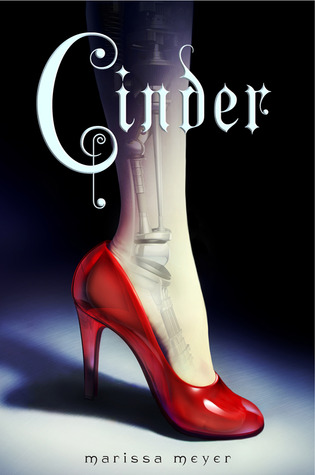
I promised you sequels: Cinder and Scarlet

What on earth happened to April? Yikes! Almost an entire month ago I said I'd get to the sequels I read over Spring Break soon. I guess three weeks counts as soon in Dead Houseplant Land. I'd better quickly get caught up!

I didn't read everything I said I was going to, and I read some things I wasn't planning to, but I did re-read Cinder and then read Scarlet, by Marissa Meyer.

Here's my Goodread's review of Cinder, just to bring you up to speed if you haven't read it yet:

A steampunk Cinderella? With a believably-realized world of human cyborgs and plagues and moon people? Too fun! I was willing to buy the book for the joke of Cinderella losing her foot rather than her shoe, but I was completely won over by the characters, the romance, the suspense, the fascinating world. Eagerly awaiting the second book.

I enjoyed Cinder just as much on rereading. It's not one of the books I'll go back to again and again, but it's certainly entertaining. And I found Scarlet a very satisfying second book. We still get to see quite a bit of Cinder (not too much of Prince Kai, unfortunately), and I loved the new characters: feisty Scarlet, mysterious Wolf, and disreputable Thorne. There's plenty of action, and we learn a bit more about those strange Lunar people and their scary queen. Apparently the next book will have Rapunzel in it. Light, fun, intriguing--and with awesome covers: I'll probably buy Cress in hardcover too.

Milk chocolate-covered nuts, or pretzels, or little fruit nuggets, whatever you like covered in chocolate: tasty and a little bit addictive.

Keeping it short: I'll save my Canadian sequel for the next post (which won't take me another month, I promise!)

Wednesday, April 3, 2013

Beholder's Eye, by Julie Czerneda

I didn't get all the vacation reading done that I said I would. I did get to a few of those sequels, and I'll do a post about them shortly. I also discovered a couple of new authors I want to read more of. Since one of them is Canadian, and I'm sorely behind on my Canadian Book Challenge (I need 12 by July and I've got 7 so far), today's post is about sci fi writer Julie Czerneda.

I bought Beholder's Eye right before I left, because it was a paperback, my friend said it was good, and Czerneda is Canadian. (Always like to support fellow countrymen.) It turned out to be a perfect beach read: fun, interesting with cool ideas but not mind-bendingly challenging, fair bit of action but not too intense.

Beholder's Eye felt more fantasy-like to me than science fiction. (Just to be clear, this isn't a bad thing in my view.) Yes, there are space ships and space ports, but the story didn't depend on technology in any way. Esen-Alit-Quar is a being who can shift shapes into any species she has "acquired." Faced with a threat to her own existence and to all the life she has encountered, Esen has to decide whether to keep the rules about not exposing her identity, or to risk her own species in helping the others. It's really a coming-of-age story set in a number of fun alien worlds, and a story of friendship and loyalty, using two species as metaphors for the things that keep us from trusting one another. I wouldn't hesitate to recommend it to YA readers, and to fantasy readers who want to try out science fiction.

This book is a stand-alone, but there are two more books about Esen-Alit-Quar. I'm curious to see how her relationship with the human Ragem develops in the next two books. But my library has the three books in her Stratification cycle, which looks promising, and her latest, which is fantasy and also looks very good (there are giant toads: I think it's a must-read!). So I'm not sure which one I'll try next.

Beholder's Eye is like the tostadas we had in Mexico: lots of different flavours layered on top of crunchy goodness.

For more Canadian books to try, in all genres, check out John Mutford's blog, The Book Mine Set.