Monday, March 28, 2016

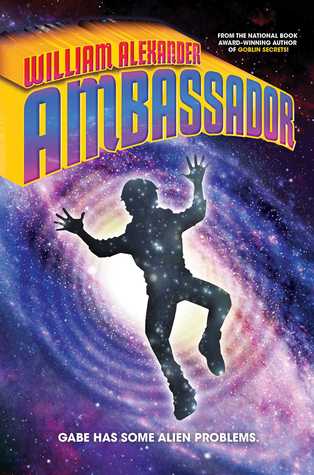
MMGM: Ambassador and Nomad by William Alexander

What do you want from your science fiction? Cool ideas, right? Technological, biological, philosophical—doesn't matter, so long as its stuff you've never thought of before, or never thought of in quite that way. Because otherwise you may just as well read realism.

But the best science fiction uses these cool ideas to say important things about who we are: what makes us human; what we get right sometimes; what we're getting very, very wrong.

William Alexander has written the best kind of science fiction in this duology. I hope they end up getting lots of attention, because they deserve to become well-loved classics.

When I finished Ambassador, my first thought was, "this is a lovely, lovely book," and that's not an adjective I expected to use on a book with that kind of cover, about aliens shooting laser guns from scorpion-like spaceships. The spaceships are pretty awesome, but—true to the title—the book is actually about diplomacy—about the possibility for people completely alien to one another to communicate and find common ground.

Cool idea #1:  Ambassadors are all children, because the young of any species are most flexible and willing to adapt to new circumstances, and interacting with aliens takes a lot of flexibility. (I knew this when I was a kid: I was quite certain that if aliens landed in my backyard, I'd be the perfect person to deal with them!)

Awesome quote: "Juveniles have not yet fixed the boundaries of their social world. They haven't drawn a circle around those worth talking to."

Cool idea #2:  It would be pretty hard for aliens to communicate with each other over the fast distances in the galaxy if there wasn't such a thing as entanglement—which I won't try to explain, but if you've read a sci fi book with an ansible in it, you know the principle. In this book's universe it's possible to entangle your perceptions so you can perceive two locations at the same time, even if you're not physically present.

Awesome quote:
"Did that make sense to you?" the Envoy asked.
"It sounded like it make sense," Gabe said carefully. "I'd like to just pretend that it did and move on. Maybe it'll sink in later." 

Cool idea #3:  The Envoy (awesome character!) builds an entangling device out of the washer and dryer in Gabe's basement.

Awesome quote:
"You can make a black hole in the dryer?"
"Yes," said the Envoy. "Please do not stand too close to it."
 "Can I throw something at it and watch what happens?" Gabe asked.
"No," said the Envoy. "It will be very precisely calibrated."
"Not even little scraps of paper or balls of dryer lint or something like that?"
I could fill several blog posts will cool ideas and awesome quotes, but you should just go read the book. I hope you noticed that it's also a very funny book, mostly because of Gabe.

I love Gabe, love the way he perceives the world, love his interactions with his family, love the way he handles all the sudden things thrown at him. I love all the characters: Alexander has a way of conveying everyone's essence in a very few interactions so that you instantly understand and therefore care about them.

Alexander is just a really really good writer. I savoured his sentences, his characters, his metaphors, his plot.

And Nomad is even better. (I don't have to tell you to read Nomad, because as soon as you get to the end of Ambassador you'll be clamouring for it. It's one of the better cliff-hanger endings out there.)(In fact, make sure Nomad is available before you finish Ambassador!) The plot gets even more fraught and perilous; there are more awesome characters and new cool ideas;  it's just as funny and profound, often at the same time. (I think those are my favourite kinds of books: funny and profound. Truth that makes you smile in recognition.)

Have I mentioned that these are really, really good books? For a food metaphor I should go with something Mexican, for Gabe . . . I don't know how authentic it is, but sweet potato black bean soup is pretty nummy and hearty and nourishing, with a bit of heat but a nice sweetness. Just like these books!


So many Marvelous Middle-Grade books out there, and every Monday you can read about more of them on Shannon Messenger's blog.


Tuesday, March 22, 2016

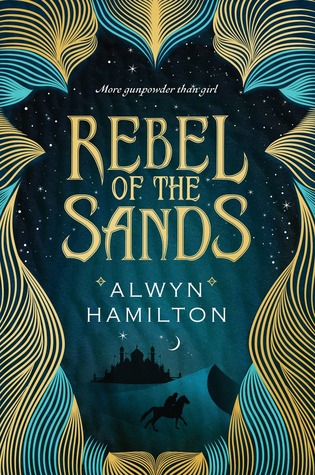
Rebel of the Sands, by Alwyn Hamilton

When I read the blurb for Rebel of the Sands, I confess I was a bit dubious: Hamilton takes the Wild West—a popular setting these days—and plops it down in the Middle-East, to come up with a fantasy land somewhere between Arabia and the American frontier. But she really makes it work. 

Miraji is mostly Arabian: a country ruled by a Sultan where Djinn still walk the earth (occasionally falling in love with mortal women, of course) and camel caravans cross shifting sands. But there are trains and mining towns that sound awfully Western, and some of the human-eating ghouls in the shadows are Skinwalkers. I think what I love about the setting is that Hamilton draws from all kinds of sources to come up with something that has familiar resonances but feels entirely original. 

The heroine, Amani, is a gun-toting hellion who leaves everything behind to gallop off on a magic horse with a rakish foreigner. She's impulsive, ruthless, not a little bit selfish—but I was rooting for her. She doesn't know it, but she's on a journey to find something larger than herself to believe in, and I was with her every step of the way.

It helped that I was entirely in love with Jin. I think Amani and Jin are going to be on top ten lists of great couples: the sparks certainly fly between them! Jin is mysterious, conflicted, has a hidden agenda, can't seem to keep away from Amani–plus he's got awesome cheekbones and a great smile, so, yeah. I'd follow him across a desert.

Not much happens with the magic at first—though there's plenty of action—, but once we meet the magical beings they're very cool. I loved the different powers and limitations everyone had; it was all very evocative and colorful. There's a Rebel Prince, a nasty army commander (who is actually the Rebel Prince's brother), plots and counter plots. Things really start getting interesting at the end, and I'm quite excited to see where the sequel goes.

Reminded me a bit of The Blue Sword and Graceling. Spicy lamb tagine served over couscous.

I was impressed with the writing in this debut novel. Alwyn Hamilton might live in London, but she was born in Toronto, so I'm claiming her as Canadian! I'm now over my goal of 13 Canadian books reviewed between July 1 and June 30: this makes number 14.

For more Canadian choices, you can always check out John Mutford's blog.


Tuesday, March 8, 2016

An Inheritance of Ashes, by Leah Bobet

This is one of the most original fantasies that I've read recently, with beautiful, compelling prose and a cast of fierce, wounded characters who will break your heart (in a good way).

Every time I sit down to write this review, I try to come up with coherent words to express my feelings about the book, and I can't find the right ones. Other reviewers have talked about it being intense, desolate, dark, eerie, bleak—and I can't deny those are appropriate words for An Inheritance of Ashes, but they're not sufficient. (And I would never have picked it up if I had read all those reviews first.)

Yes, it's a dark book, but it's also luminescent. You have to meet the characters to realize that all the fear and suspicion and despair only highlight the courage, hope, conviction and love that burn inside them. It reminds me very much of the Leonard Cohen song: "there's a crack, a crack in everything: that's how the light gets in." (Just had to go listen to it again. Really quite perfect for this book.)("Every heart to love will come, but like a refugee.")

But I'm not being a very helpful reviewer, here. What do you need to know to make you read this book? How about some of the cool, original things:

1.  It's about the aftermath of a war, about the people back home, waiting for the soldiers to return. It's not about fighting. At least, it's not about that kind of fighting. It's a very realistic setting—could be a farm just about anywhere, at just about any time. Except . . .

2.  The Wicked God was defeated. No one knows who or what the Wicked God was, that's just what everyone calls it. Eventually we do find out what the Wicked God was, and it's an explanation that doesn't draw on any mythology I've ever heard about; I found it entirely fascinating.

3.  But there are still Twisted Things appearing, and the Twisted Things are awesome: creepy, unexpected, poisonous, threatening, nothing like anything I've ever read about. And they shouldn't still be showing up, now that the Wicked God is dead.

4.  There's a lone soldier returning from the war with a secret. Does he know why the Twisted Things are coming? Does he know what to do about them?

5.  He's not the soldier Hallie and her sister Marthe are waiting for. And if Marthe's husband doesn't come back, they're not going to be able to hold the farm together, not two young women, one of them about to give birth, two sisters who rely completely on each other but can't seem to trust each other, or anyone else.

And number 5 is the burning, toxic heart of the story: Twisted Things may be poisoning the farm, but Marthe and Hallie are poisoning each other with their complete inability to understand each other*, and the psychological and physical threats are marvellously woven together in layers of metaphor and tension.

There are people who want to help, and people who hope they fail, and the community around Roadstead Farm is also a crucial part of the story. The war might be over, but there are so many things to fight for, to fight about. There are the battles we inherit from our families, the ones we think are over but are still festering into the next generation. And the people we think are the enemy might be the only people who can save us.

You just have to read it; I can't adequately explain how dense and nuanced and wise and surprising and real this fantasy is. Bobet is a writer into whose capable hands I will gladly entrust myself again.

Sweet potato black bean soup: hearty, rich, complex, with lots of heat and depth of flavour. (I might not put as much cumin into it next time, though!)

Leah Bobet is that rarest of wonderful people: a Canadian fantasy author! Which makes this my 13 out of 13 books in the 9th Canadian Book Challenge: and it's only March! (I have until June 30.) Yay Canadian books! Be sure to check out the other great Canadian books on John Mutford's blog.


*You know how in most fiction, the characters tend to say what they think to each other—things real people would never actually say because there are too many things holding them back? Hallie and Marthe are not capable of ever saying what they think, because the things holding them back are too painful and entrenched. It's possibly the most realistic relationship I've ever read in a fantasy novel.

Wednesday, March 2, 2016

Things Going On In March

Seems March is a month for themes, because there are all sorts of month-long things going on in various places around the blogosphere. Here are a few I'll be following along with:

We Be Reading has hosted DWJ March on every anniversary of Diana Wynne Jones' death, to celebrate her wonderful fantasy. This year she is adding Terry Pratchett to the celebration, entirely appropriately, and calling it #MarchMagics. She'll link up any posts you do about either author, and she's hosting readalongs of Pratchett's Equal Rites and DWJ's Dark Lord of Derkholm (a personal favourite of mine). If you have any love for these authors—or if you have yet to discover them (oh, what a treat you have in store!)—then you should check out her blog this month.

The YA/MG Book Battle is on again! This is the third year that Beth has chosen a slate of underappreciated YA and MG books and invited fellow book lovers to face them off against each other. The point being to get more people talking passionately about these great books. Here are the books in this year's battle: lots I haven't read, and I will do my best to read at least a few of them before their battles. (Go Crown Duel!!)

The Book Wars has a lot of cool-sounding reviews and discussions planned for Monster Girls Month. (Maybe this is the month I'll finally get around to reading Nimona!) Plus, they're doing a readalong of  Megan Whalen Turner's Thief series, which I will definitely be participating in (despite the fact that I've pretty much memorized all four books).

And if you really want to challenge yourself, you could sign up for Take Control of Your TBR Pile, in which you promise to spend March only reading books from your TBR pile released before March 1. (I'm not signing up for it, since I've already got two books on my Kindle that weren't on my TBR that I plan to read over Spring Break . . .)

Monday, February 29, 2016

MMGM: Oh, yeah, the Cybil's winners!

How is it already the end of February?? Happy Leap Year, by the way! What are you going to do with your extra day?


It's kind of old news by now, but in case you missed it, the Children's and Young Adult Bloggers' Literary Awards winners were announced a couple of weeks ago. I was on the panel that had to pick the Middle-Grade Spec Fic winner, and it was a difficult task, let me tell you! Just take a look at this shortlist! I'm going to highlight each of the books on the shortlist in coming posts, because I loved many of them and liked them all.

But to begin with, the book everyone on the panel agreed was a sure-fire hit, with lots of kid appeal, an original premise, great characters, and a fascinating speculative world that says a lot about our own world: The Fog Diver.


Imagine we came up with a way to get rid of all our pollution by building tiny self-replicating robots to eat it. (Nanites! They're going to solve everything! A great sci-fi trope that I haven't yet seen in children's fiction.) Of course, something goes wrong, and now there's a toxic nanite fog covering almost all of the earth's surface, and humans can only live clustered at the tops of mountains.

So, of course, they get around in airships. (Airships! Inherently awesome! Especially if they look just like pirate ships, because (physics aside) of course we would build airships that look like pirate ships.) Since there aren't too many resources available at the tops of mountains, people have to dive into the toxic fog to find food and other useful stuff down on the surface. But they can only do it for so long before they get sick and die. So, of course, it's poor orphans who do most of the diving, because they have no choice.

I love the socio-economic commentary that underlies the world-building here and ties in with the plot. We have a group of poor orphans—excellent protagonists for a middle-grade adventure—facing off against exploitative land-owners (poor people don't actually get to live on the mountaintops: the slums are floating rafts that collect all around the land. If people don't pay their rent, the slum landlords cut their balloons so their shack falls to the earth. A great metaphor for the precarious position of the poor.)

Then there's the hero, Chess, who doesn't get sick when he dives into the fog. What makes Chess different is one of the mysteries that propel the plot—protagonist with a secret, another excellent trope well-used here. And Chess's crew is a great team: the book blurb almost makes them sound like caricatures, but they are all well-developed characters whose interactions were fun and believable. (They reminded me of the Firefly crew, actually, and that's high praise.)

The action is fast-paced, the stakes are high and plausible, all the characters develop over the course of the book. One plot arc comes to a satisfying close, but there is more story to be told, and I for one am eagerly anticipating the second book coming out this year. It's a world and characters I want to return to.

For more Marvelous Middle-Grade selections, every Monday check out Shannon Messenger's magnificent blog.

Thursday, February 11, 2016

Waiting on Wednesday: Every Heart a Doorway

I know it's Thursday. But lots of you do the Waiting on Wednesday meme, and I just ran into a book that I am now desperate to read, and I couldn't wait until next Wednesday to tell you about it. (And Waiting on Thursday just doesn't sound the same.)


Look at that cover, that gorgeous, gorgeous cover. And the title! Squeezes my insides. But the premise is the kicker:

Children have always disappeared under the right conditions; slipping through the shadows under a bed or at the back of a wardrobe, tumbling down rabbit holes and into old wells, and emerging somewhere… else. But magical lands have little need for used-up miracle children.
Nancy tumbled once, but now she’s back. The things she’s experienced… they change a person. The children under Miss West’s care understand all too well. And each of them is seeking a way back to their own fantasy world. But Nancy’s arrival marks a change at the Home. There’s a darkness just around each corner, and when tragedy strikes, it’s up to Nancy and her new-found schoolmates to get to the heart of things.
I am a quivering mass of desperate need for this book. Why is it not April yet?

Oh, and Tor has an excerpt from it, in case you needed more convincing: Every Heart a Doorway. Here are a couple of my favourite lines:

There was still something unfinished around her eyes; she wasn’t done yet. She was a story, not an epilogue.

“Because hope is a knife that can cut through the foundations of the world,” said Sumi. Her voice was suddenly crystalline and clear, with none of her prior whimsy. She looked at Nancy with calm, steady eyes. “Hope hurts. That’s what you need to learn, and fast, if you don’t want it to cut you open from the inside out. Hope is bad. Hope means you keep on holding to things that won’t ever be so again, and so you bleed an inch at a time until there’s nothing left. Ely-Eleanor is always saying ‘don’t use this word’ and ‘don’t use that word,’ but she never bans the ones that are really bad. She never bans hope.” 

Thursday, February 4, 2016

Special Guest Danika Dinsmore! on her Narine of Noe Blog Tour

Today we get an author interview AND a book excerpt!

I am very excited to help promote the fourth book in Danika Dinsmore's Faerie Tales from the White Forest series. These are great middle-great adventures about a magical world full of fascinating creatures. Here are my reviews of Brigitta of the White Forest, The Ruins of Noe, and Ondelle of Grioth.

In Narine of Noe, Danika does one of my favourite things: she takes us back in time to to learn the truth about the Ancients and the devastating events that destroyed their world. Narine is a young fairy who thinks she knows her destiny, but when everything she knows is turned upside-down she is suddenly left on her own to figure out how to save the world.

Here's how Danika Dinsmore answered my questions about the book and about herself:


You’ve said that you have a six-book series planned out. Was a prequel always included in that plan? What made you decide to go back 1000 years and tell this story at this stage in Brigitta’s journey?


The prequel was not actually part of the original plan. The idea crept up on me as I was writing the first three books, because I had had to come up with so much back story for those books. As the back story became more and more vivid, I realized it, too, needed telling. 


I honestly can’t say why I decided to write it in the middle of the series. I just knew it was the right time, and I tend to trust my intuition. I think it provides a lot of answers that are important before Brigitta's journey continues. It also helps us realize what great sacrifice the Ancients made and what's at stake if Brigitta should fail in reuniting Faweh. 


Ruins are so cool and evocative. Brigitta visits the Ruins of Noe in book 2, and now in book 4 we get to see what Noe was like. Have you visited any real-life Earth ruins? If you had a time machine, is there a particular set of ruins you’d love to visit in the past to see what they were like?


Ruins are definitely evocative and I've seen my share. My first were the ruins of Ayutthaya in Thailand, which I absolutely loved. I've also visited Athens and Crete and the ruins there were mind-boggling, especially Knossos, Europe's oldest city (first settlement was 9,000 years ago). They made our North American concept of "old" appear so quaint. I also loved Tikal in Guatamala, and I've been to a few Anasazi ruins in Colorado and New Mexico. I'm sure there are more I'm forgetting. I'd love to travel back in time to Ayutthaya or another ancient South Asian culture.  


How do you conceive of the differences between Narine's world and Brigitta’s? Narine's world has different magic (I saw it almost like different technology), different social structures, different architecture and fashion—what did you use as inspiration to create this precursor society?


I can't point to anything specific as an inspiration for the precursor society, other than I knew it had to be more advanced and more connected to the rest of the world. The Ancient Faeries were the keepers of the elements, the caretakers of Faweh. The White Forest faeries were "lesser" faeries who had been rescued by the Ancients during the Great World Cry (which I now refer to as the "faerie apocalypse") and placed in a protected realm. White Forest faeries do not have the magical abilities of the Ancients and are by no means worldly. They are still a young civilization - much more primitive.
Narine lived before and during the "apocalypse," and Brigitta lives in the "post-apocalyptic" world. It would be like if our own world experienced an apocalypse and everyone had to start over in these isolated communities. Since the White Forest Faeries had been cut off, I knew their society would have grown its own way rather than imitating the Ancients' ways. The fun of Brigitta's story is reconnecting all these ancient cultures that existed together in Narine's time.


Your settings are always so detailed and real, despite being completely fantastical. Did you use real-Earth settings as the basis for any of the locations in Narine’s world?

I actually try not to, lol. I have lived among forests for so long that I fear the forests in my stories will "dull" if I use my earthly ones for inspiration. I have to keep re-imagining them so that they appear fantastic in my mind. I guess my "uul trees" were partially inspired by banyan trees. And Lake Indago possibly by Lake Louise in Alberta.


Did you love fairies as a child? Is there a book or movie or painting or anything you remember sparking your fascination? Or did that happen as an adult?


The funny thing is that I had absolutely no fascination with fairies / faeries as a child. I loved stories and I loved fantasy books. I devoured all the Wizard of Oz and Chronicles of Narnia books. And I had no interest in faeries when the idea of the story popped into my head. Brigitta and Himalette just asked to be written. I didn't even consider myself that interested in faeries as I was writing the story itself! I was just interested in the characters and their world. 


Have you tried to recreate any fairy food using Earth alternative ingredients?


I have! I've made two different versions of Pippet's pipberry juice and have also made batches of triple lyllium succlaid and gundlebean stew on occasion (I use lentils because gundlebeans are hard to come by)


Well I, for one, would love to see those recipes!

I've got an exciting look at Narine of Noe at the end of the post. (If you've read the other books, you will be intrigued by the character Narine meets in this scene!)

Anyone interested in writing a review for any of the White Forest books may contact Danika at danika.dinsmore@gmail.com for free ebook copies. Mention you saw this posted on Kim’s site. :-)

You can connect with Danika in the following realms:

Facebook Author Page: https://www.facebook.com/authordanikadinsmore
Facebook White Forest Series Page: https://www.facebook.com/whiteforestrealm
Website: danikadinsmore.com
Twitter: @danika_dinsmore


Meeting the Drutan Newling

As the two faeries dipped down toward the river, the newly sparkled forest dropped from sight. When they reached the valley proper, they pulled next to a cliff to stay out of the wind. Though Narine could no longer see the glowing section of forest, the sky shone brighter above it. Mesmerized by the peculiar light, Narine nearly missed the oddly-shaped silhouette standing at the top of one of the cliffs, but a howling from that direction caught her attention. She stopped and hovered in the air, watching the strange beast’s movements.
Shaped like a small gnarled tree, it shook in the moonslight, barky branch arms reaching out to the skies. At first Narine thought it was simply the wind shaking and howling behind it, but then she realized the keening came from the tree-like creature itself. It released one final low, haunting moan and pulled back into the forest.
In its place, a wee beast stood at the edge of the cliff, lurching in the wind. Far below it, the river cascaded over a series of slippery rocks. Narine gasped as the creature toppled toward the edge.
"Look out!" she cried, and Thorze turned around.
"On the cliff!" Narine called to her father, pointing to the top of the ridge where the small creature twisted and turned. "It’s going to fall!”
“Narine!" called Thorze, several wingbeats downriver, but she didn’t have time to stop and explain to him that the beast was in peril.
She sped up the cliffside until she reached the top and the strange creature snapped into view. She gasped as the little beast tumbled forward, and she extended her arms to catch it . . . but it didn’t fall.
Like a sapling rooted to the earth, even as it slumped forward it was anchored in place. Its two brown arms embraced its own body, limbs extending into fingers with protruding rootlets winding and tangling around its back. Within the twisted roots, its hard, ridged skin shone in the moonslight.
"There, there." She clasped its barky shoulders.
"No!" her father called to her from below. "Wait!"
But it was too late. As she straightened the beast up again, its eyes popped open. The little thing blinked several times into Narine’s face and then let out a cry. Its black eyes watered over, and Narine was pulled into their murky wetness. Something stirred inside them, and she drew forward . . .
. . . she was gazing down from a crumbling cliff, across a dark and choppy ocean . . . Under the water, a shadow headed toward her . . . No! Not a shadow . . . something solid, massive, and formidable . . .
“Narine!" a voice cut through the darkness, shaking her back to the present.
She swung her head around, not sure where she had just been.
"Are you all right?" Thorze pulled Narine’s face to his, examining her eyes.
"I… I… think so…" She looked back down. The creature was slumped sideways. "What happened?"
"I put her back to sleep," said Thorze gravely. "Come."
"But, what…why…" Narine tried to recall what had just transpired as her father turned her away.
"It’s a newling Drutan." He rubbed her arms. "We must leave her be.”
It took immense effort for Narine not to turn back around again; she felt such an ache for the beast. If she could only look into its eyes again. Maybe even hold it in her arms.
"What’s a Drutan?" she asked instead.
"A very rare creature." Thorze pulled his daughter closer and guided her back off the cliff. Her body, still stunned, let his sturdy one hold them both up. He gave her a squeeze. "Let us hope we have not disturbed her destiny."
"Her destiny!" Narine gasped, now fully awake.
She glanced down at her hands as if they had betrayed her all on their own. Some High Sage Mentee she was. How could she have just grasped the newling Drutan without even thinking?
Thorze stopped several wingbeats away and rotated his daughter around, holding her tightly across the shoulders. She didn’t know whether it was to comfort her or restrain her, but she accepted his warmth gratefully. They watched as a few of the creature’s roots unraveled and gathered themselves up again, twisting around and around and tucking themselves away inside her bound body.
“Drutan newlings soak in the moonslight energies to acquire a destiny," Thorze explained. "When a Drutan first opens its eyes to the moonslight, its initial tears transform to moonstones, which, over time, reveal its destiny."
"I disturbed her sleep!" Narine’s voice caught in her throat. "She opened her eyes!"
"You didn’t know," Thorze said.
She waited for her father to tell her everything would be fine, and her heart sank a little more when he did not.
"Where did her parents go? Maybe we can find them? Maybe they can help?”
He shook his head. "Both her father and mother have gone away. They are solitary beings. They will most likely never meet again."
"But what will happen to her?"
"She will live a very long time, and, as she grows older, her tree energy will emerge, and she will slowly transform, until one day, many season cycles from now, she will root into the earth, as tree-like as any in the forest before you.”
“But won’t she be lonely?" Narine asked. "Won’t she be scared?"
She could not imagine being born into a very long life without any parents or family or friends. What would the Drutan do by itself all day? Who would comfort her? Who would pass on Drutan knowledge and tell her Drutan stories?
"It is their way." Thorze gave her one last squeeze, but it was little solace. "Come, let us continue our journey to investigate this strange shimmering. I promise, Narine, there’s nothing else we can do. All she needs is her moonslight, and the rest will take care of itself. Drutans are born wise.”