Sunday, February 26, 2023

MMGM: Fenris and Mott, by Greg Van Eekhout, and Freddie vs the Family Curse, by Tracy Badua

Here are another couple of books from the Cybils Middle-grade Spec Fic shortlist that I can highly recommend. 

Fenris & Mott is a funny and thought-provoking take on the Norse idea of Ragnarok.

What if Fenris, the wolf in Norse mythology who will consume the world during Ragnarok, was discovered as a little starving wolf-pup in a back-alley in California?

Mott is the highly-engaging character who finds Fenris and really, really wants to adopt him, even though she knows she can't. She vows to keep him safe, despite the mundane and mythical obstacles that spring up at every turn. Various characters from Norse mythology show up, either wanting to kill Fenris to prevent Ragnarok, or set him free to begin it. But Mott cares about Fenris himself. Her single-minded devotion forges a path through the middle of all the prophecies: is it possible to save Fenris and save the world, too? The combination of Mott's compassion, integrity and wry humour with Fenris's adorable puppy nature is irresistible. And Van Eekhout throws in some pointed metaphors about climate change and human shortsightedness as the vehicles for the end of the world, with the empowering message that kids still have a choice and can make a difference.

Freddie vs the Family Curse is a very funny and relatable story about a boy whose notorious bad luck and clumsiness aren't his fault: he's been cursed!

If anything can go wrong for Freddie, it definitely will, leading to all sorts of slapstick and embarrassing scenarios. Freddie isn't a victim, however, and he has a staunch supporter in his cousin, who at least understands about the family curse. When Freddie discovers an amulet inhabited by the spirit of his great-uncle, he learns the origin of the curse and how to break it. This leads to more shenanigans, including a road-trip to a break-dancing competition—nothing could possibly go wrong with that!  All along Freddie is a character with a great deal of agency and cleverness in dealing with his problems.

The best part about this book is Freddie's family and the rich representation of Filipino culture. I loved that everyone in the family has a different attitude toward the idea of the curse, and toward religion and superstition in general. I loved how everyone cares deeply about each other but that doesn't prevent conflict and frustration. Freddie's great-grandmother is a wonderful character, and the glimpses we get into Filipino history are rewarding.

Monday, February 20, 2023

MMGM: Children of the Quicksands, by Efua Tratore

A Middle-Grade Spec Fic finalist for the Cybils, Children of the Quicksands was one of my top choices for winner. (Here is my review of The Mirrorwood, the one we picked.)

We begin in Lagos, Nigeria, with the common middle-grade trope of the city child being sent to stay with a relative in the country. And of course there's going to be something mysterious going on in the forest behind grandmother's cottage. But this isn't Kansas, and these are not the European folk tales we've seen so much of! 

Simi is such a likeable protagonist, and she drew me right into her voice and her world. I loved being immersed in modern-day Nigeria, and then I loved being taken with Simi into a country village, where we gradually learn about her grandmother's Yoruba religion and the mythic dangers hidden in the forest. 

The magical and the real are integrated seamlessly; I loved that this is a story set firmly in the "real" world, and the world under the quicksands that Simi falls into is just one more part of reality. I loved that this is a story about families, about relationships, healing and forgiveness, whether it's within mortal families or relationships between gods.

Every character is rich and rounded; there is convincing conflict without anyone being a villain. I loved how the interplay between religion and politics was represented—simply enough for a middle-grade audience, but nuanced. There are all sorts of interesting themes going on, but the story never bogged down, never faltered from its clear arc of Simi discovering her heritage and reuniting her family.

Have I mentioned how much I love Simi? And her grandmother, and Jay, the son of the chief, who insists on becoming Simi's friend. Lots of humour and very relatable situations.

The writing is excellent, the descriptions vivid, the dialog easy to hear—and I loved the incorporation of Yoruba language into the text (with a helpful glossary).

I can't claim to have eaten authentic Nigerian food, but I am now looking up Nigerian restaurants in Vancouver, and I shall correct that lack with all due haste. I do love peanut soup, which is at least West African in origin—maybe that's what I'll have for dinner tonight!


Marvelous Middle-Grade Monday is hosted by Greg Pattrige at Always in the Middle, and is always an excellent source of middle-grade recommendations.


Tuesday, February 14, 2023

Cybils Winners! The Mirrorwood, by Deva Fagan

Happy Valentine's Day! For those whose greatest love may be books, it is more than appropriate that the winners of the Children's and Young Adult Book Lovers Literary Awards are announced today! Time to update your TBRs!

I'm excited that I finally get to talk about the winner in the Elementary/Midde-grade Speculative Fiction category: The Mirrorwood, by Deva Fagan.

Every one of the judges was impressed by the compelling writing and the imaginative world-building in this one. It starts with a girl who has been cursed with a blight: she has no face of her own, and has to borrow faces from people she touches. What an interesting curse, full of metaphorical possibilities! Appearance, identity, how our relationships with others define us—all the deep stuff!

Our heroine, Fable, escapes from blight hunters through a wall of thorns into an enchanted kingdom caught in time with a sleeping prince in a tower in a castle. 

People, it's a gender-reversed spin on Sleeping Beauty!

This was just such a fun story. Whimsical, likeable characters, a vivid, colourful world with interesting magic, and a lot of examination of fairy tale tropes: fairy godmothers, curses, demons and monsters, quests. Before Fable can end the blight and save the kingdom, she has to figure out who the good guys are, and just what, exactly, the curse is.

Also there's a great talking cat, and the annoyingly loquacious skull of a bad poet! So much to enjoy!

If I were to pick a food analogy for The Mirrorwood, I think I would go with the amazing chocolate chunk salted caramel cookies my sister and brother make, with chunks of Belgian chocolate and homemade caramel in a meal-sized cookie. Sweet and salty deliciousness with hidden depths and a different combination of flavours in every bite.

I will post reviews of the rest of the short-listed books over the next few Mondays, for Marvelous Midde-Grade Monday. Some very cool stories, and I'm excited to share them with you!

Tuesday, January 31, 2023

Cybils Award Shortlists

This is a teaser post, letting you know that I will actually have some book reviews in two weeks, once the Cybils winners are announced. I've been busy reading all the Middle-grade Speculative Fiction shortlisted books, and they're all great, and I can't tell you anything about them until we come up with our winner! But in the meantime I can highly recommend all of them, and you can read all about them here.


And now that I'm done reading those, I can take a look at the YA Spec Fic list, which ... oooh, has some really interesting books on it!


Tuesday, September 27, 2022

It's Cybils time again!

That time of year when we look back at all the books for young people published in the last 12 months and pick our favourites for The Childrens and Young Adult Bloggers Literary Awards,.

Nominations open on Oct 1, and you have until Oct 15 to nominate a worthy book in each of ten categories. Anyone can nominate! That means you! If you've made your way to this blog, you probably read at least some YA or kids' lit, so be sure and nominate the ones you think should be considered by the judges.

And once again the Cybils is hosting a book recommendation padlet. You can only officially nominate one book in each category, but if you have more than one favourite, you can add them all here! Here's where to go for a ton of great book recommendations (and where to find books to nominate if you haven't read enough in a category.)


This year I'm excited to be a Round 2 Judge in the Elementary/Middle-Grade Speculative Fiction category. I love getting to know my fellow judges—the Cybils is such a great opportunity to find new books to read and new cool people to talk about books with!

So many ways to participate in the conversation about kids books! I hope to see you and your favourite books out there!

Tuesday, July 5, 2022

Kelly Barnhill, new Victoria Goddard, and a few other things I've been reading

It's been three months since my last post: I'm not sure if that's because I've lost interest in blogging, or I haven't read much that made me excited to talk about, or life has just gotten really busy with other interesting things to occupy my mind and time. Or a combination of all three. But I'm not ready to call it quits yet, so here are a few short reviews of a few things!

The Girl Who Drank the Moon was on everyone's blog for a while when it came out, and I finally read it, and it's as awesome as everyone said! Very original: lots of folk-tale elements and the narration has a fairy-tale feeling to it, but there's a modern sensibility behind everything—there are no unexamined tropes here. Very pointed critiques of human behaviour and society. Interesting, complex characters; unusual in that the adult characters are more prominent than the titular girl, and we get lots of different POVs, so I don't know how that will work for younger readers. Felt similar to some of T. Kingfisher's not-exactly-for-young-people novels, like A Wizard's Guide to Defensive Baking and Minor Mage. Whimsical and hopeful while unflinching about the damage people can do to each other. Beautiful writing.

The Troubled Girls of Dragomir Academy, by Anne Ursu, is another middle-grade novel that's been widely raved about that I finally got around to reading. I love Ursu's writing, and this one didn't disappoint. Similar themes to Girl Who Drank the Moon, actually: standing up against evil that persists because of false beliefs deliberately perpetuated by those in power to make sure they stay in power. (Hmm. That doesn't ever happen in the real world; I see no relevance to our current state of affairs. Ahem.) Girl power and friendship. Pretty dark story, actually—misogyny isn't fun to read about—but I promise it has a happy ending!

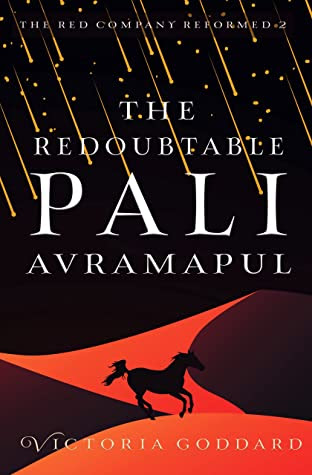
The Redoubtable Pali Avramapul is the next installment in Victoria Goddard's hugely epic Nine Worlds series of series, and I loved it! My second favourite after Hands of the Emperor, I think. It made me go back and reread The Return of Fitzroy Angursell, and with this book (and Petty Treasons, a novella) I have fallen completely in love with Fitzroy. Also Pali! Full review on Goodreads , but the TL;DR is go read this book! (After you read Hands and Return, though.)

And speaking of Victoria Goddard, I also thoroughly enjoyed Portrait of a Wide Seas Islander, which is an event in Hands of the Emperor told from Buru Tovo's point of view.


Nettle and Bone is T. Kingfisher's latest, and it is her trademark dark, funny, weird, folk-tale-ish story of unlikely heroines defeating evil with cleverness, unexpected magic and sheer stubbornness. This one is definitely adult fairytale—trigger warning for abuse—but not horror. (I can't read her horror!) I'm never disappointed in anything this woman writes.

I also read a couple of new novels in Rachel Neumeier's Tuyo world: Keraunani, which is a fun romantic adventure starring Esau, and Suelen, set right after the events of Tuyo and introducing a new character and a new, fascinating magic: the surgeon-dedicate. (I love the covers for this series!) 

Oh, and I don't seem to have mentioned her newest Death's Lady series on my blog (how is she so prolific?? the woman is a writing machine!). It's reverse-portal fantasy starring a psychiatrist and a woman warrior, and it's every bit as good as Tuyo with a different vibe. (My Goodreads reviews here and here.)The latest in that series, Shines Now, and Heretofore is a fun exploration of one of the minor characters in the main trilogy (I love the way she does this in her series: returning to the world we loved and seeing a new perspective on it.)

You may notice that I haven't been very adventurous in my reading: I've been mostly sticking to authors I love. Maybe I'll start exploring outside my box now: is there anything you think I should read that I might not otherwise try?


Sunday, March 27, 2022

Sherwood Smith's Phoenix Feather series solves The Protagonist Problem

 "The Protagonist Problem" is a great essay in Uncanny Magazine by Ada Palmer and Jo Walton, and I think you should read the whole thing, but here's the gist:

Jo Walton coined the word protagonismos in 2010 to mean “the kind of person stories happen to,” but I’m extending that meaning here. We tell a lot of stories in which one special person has the power to save the day, make the difference, solve the problem, and change everything. They might be superhero, a long-lost royal scion, the last of their race, a child of prophecy, or they might—like Frodo—be an everyman who has that special courage or other quality which saves the day. Protagonismos is the protagonist spark, that quality some characters possess which means the plot will not advance until our hero comes to lead the action, be it to victory or defeat.

The authors make the argument that while this kind of hero-centred story is great, it becomes a problem if that's the only kind of story we tell.

When some stories center protagonists, while others center teams, movements, families, etc., that teaches us that there are many ways a world can change, but when almost every story has protagonismos, it teaches us that all worlds work this way, and leads people to see the real world and real history as resting in the hands of real-world protagonists. This is harmful. It’s harmful when people see themselves as not protagonists, and differently harmful when people see themselves as protagonists.

Novels have become more and more protagonist-centred in recent decades, to the point that writing instruction often assumes protagonismos and considers it a flaw if a story lacks it (see writing advice like, "the plot has to be influenced by the protagonist; things can't just happen to her"). I had never thought about it before—and that's their point: we take it as a given, without examining the assumptions behind it. Like I said, read the whole essay; it's great.

I bring it up because I just finished the fourth (and final) book in Sherwood Smith's latest fantasy adventure series, The Phoenix Feather. Although it starts out seeming like a typical hero story (I described the first book as a martial arts hero origin story), it ends up with multiple POV characters, all of whom influence the outcome in essential ways. And it was very satisfying!


I absolutely loved that it's a story of a family—of more than one family, actually. It follows every member of the Afan family as they make their separate ways across an empire, always trying to protect each other no matter what other intrigue or danger or opportunity they are navigating. And in the meantime we get glimpses of the Imperial family—and the difference in the sibling bonds and parent-child relationships almost becomes heartbreaking, because we see genuine love and affection in both cases, even when twisted by ambition and fear.

I loved the conflict that is set up between the two families, and the way it plays out in long threads that tangle with each other and draw everyone inexorably together. I loved the braided nature of the narrative: following first one character, then another; hoping, fearing, knowing that their paths will intersect; watching the repercussions of each intersection ripple out and affect everyone else.

The Phoenix feather of the series title is an interesting plot device—an augur of greatness, it teases us over four books: to whom does this great fate belong? Who will fulfill the promised destiny? At different times you'll think you have it figured out, but you'll likely be wrong! In the meantime, you're rooting for all three Afan children, who pursue greatness in military, artistic and martial arts spheres, not to mention several other characters who befriend and help them and have great potential.

The setting is gorgeous; the magic is fun; the battles and spying and escapes and training montages and intrigue are everything you want from escapist fantasy: stressful enough to keep you engaged while never being in any doubt that everything will all work out somehow. I devoured all four books, and I can see myself rereading them frequently.

(The level of violence is almost middle-grade. It's not aimed at a young audience, but I think sophisticated younger readers would enjoy it. If you've read her earlier work, it's similar to the Inda series but less adult in theme and treatment.)