Saturday, December 17, 2011

Sharon Shinn, The Safe-Keeper's Secret

I picked this book up in a random library browse. Sharon Shinn's name rang a bell with me, but at the time I couldn't place why. The cover wasn't striking, but the concept seemed interesting, so I took the book home. (Have I mentioned that I love libraries?)

It turns out that I've read some of Sharon Shinn's adult books and really enjoyed them. Her Samaria novels read like fantasy but have a sci fi explanation in the end (which I won't give away): it's a non-technological society with angels to rule over and protect them. In Archangel, Rachel is chosen to be the bride of Gabriel the archangel, but she's not happy about it. There's reluctant romance, dangerous politics, Old-Testament-like mythology (in case the names didn't give it away), singing, and magic that's really science but everyone's forgotten. A good read, and now I want to go back and read the Samaria novels I missed.

The Safe-Keeper's Secret isn't anything like the Samaria books. Set in a small English-like village in some non-modern time period, it's a quiet story about people with the gifts of keeping secrets, telling the truth, and granting dreams. I love that secret-keeping and truth-telling are magical powers. The story opens with a child being delivered to the village Safe-keeper, the woman who will keep whatever secret she is told, and the child's identity is a secret she keeps for most of the novel. She raises the child with her own as if they were siblings. The story follows Fiona and Reed's coming of age and discovery of who they really are.

I loved this book, and I'm still not sure exactly why. It's not exciting, there's no great peril, no important quest, not a lot of action of any kind, really. For a while I couldn't figure out who the antagonist was. Almost every character is caring and nice, and just about everyone loves Reed and Fiona. I think I liked the book so much because I cared so much about the characters. They were all individuals with their own sorrows and dreams, however small, and I wanted them all to find their place in the world and I cheered when they did. I think, in the end, the antagonist is the secret: the truth about who Fiona and Reed really are that changes everything when it's revealed. But the story is subtle--there isn't burning suspense all the way through. Fiona and Reed don't particularly care that they don't know who their parents are. Except that they do, of course, and that niggling question really does propel the plot as they each struggle to fit where they think they belong.

I feel like I'm not selling this book as strongly as I want to. It's deftly written and a pleasure to read and it deals with all the important parts of life: who we love and what we want to be and telling the truth when the right time comes. There are lovely bits of symbolism woven all through, and it just, well, it just made me happy. It's a little jewel, well worth an afternoon of your time.

Sunday, November 13, 2011

Octavia Butler and Daughter of Smoke and Bone

It occurred to me that I might blog more often if I didn't spend three hours writing a blog entry. That last one could have been three posts, couldn't it?  Hmm. In the meantime, the writing is still happening, slowly. It feels rather like getting ketchup out of the bottle. I'm hoping for the sudden blurp when way too much ketchup ends up on your hamburger, but I'm still waiting. Like in the Heinz commercials. (It doesn't help that I checked on my geography today and discovered that a key plot point is impossible. (And this is geography I'm intimately familiar with, so I don't know why I came up with that plot idea in the first place.) The story is set in the future, though, so maybe I'm going to have to give Vancouver that earthquake that we're all waiting for and alter the geography so my plot still works. I love fiction.)

I know I mentioned Laini Taylor's newest a few weeks ago, and I've been meaning to blog about it, but I want to do it justice and I haven't felt like I could devote the time required. Which is stupid, because it means I'm not blogging about it at all.

But first I have to mention an adult science fiction writer I just discovered: Octavia Butler. I borrowed her novel Fledgling from a friend of mine. What a great title. (And I love the cover.) What an interesting, interesting book. This is a novel about vampires that you should not read if you generally like vampire novels. Intellectual is not quite the right word, but it's close. What if vampires didn't kill people; what if they entered into symbiotic relationships with them, relationships of love and trust in which the humans get whatever they want, but the vampires have all the control. Would that be okay? I found it fascinating how Butler kept my sympathy with the narrator: the young vampire does things that would be reprehensible if a human were to do them, but she does them within her own moral and ethical code, so they feel right. And the fact that they feel right feels seriously creepy. Fledgling has a plot with its own suspense, but to me the page-turning aspect wasn't what was going to happen next, it was what will I agree with next. Deliciously interesting. Like sushi.

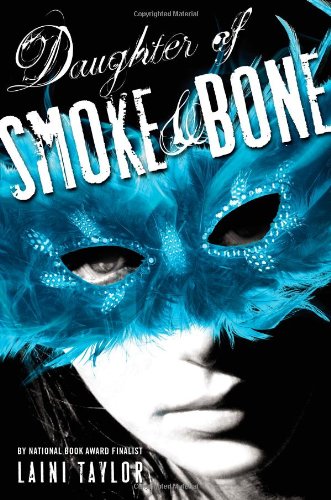
Okay, Daughter of Smoke and Bone, by Laini Taylor. It hardly needs my endorsement, since it's made all kinds of Best Books lists and everyone is raving about it, but I'll continue my Laini Taylor fandom and say you have to go read this book. It has everything I like about Taylor's writing:  lush prose, dense with colorful detail, incredibly imaginative world-building, traditional mythologies mined for their deepest gems and then turned into something entirely new (angels and devils, yes, but these are not the angels and devils anyone else is writing about). My favorite thing about this novel? It's set in Prague, the most beautiful, evocative, artistic city I've ever visited. I also loved Karou's best friend the puppeteer. And the shop with doors that open in places around the world. Best use of teeth in a fantasy. I could go on, but I don't need to. I was thinking I'd compare it to a Czech dish, something desserty you'd eat with coffee in the afternoon: maybe apple strudel or blueberry dumplings. I only hope that the success of this series (yeah, cliffhanger ending: there'd better be another book coming!) allows her to get back to the Dreamdark books.

Thursday, November 10, 2011

Books I'm Grateful for

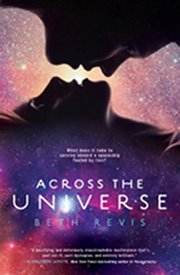
I just finished Beth Revis' book Across the Universe, and as I usually do when I finish a good book and don't want to let go, I went to her website. Good news: the next book is coming out in January! Also good news: Beth Revis has a terrific blog. She has a contest going that I thought was a great idea (even though the Canadian Thanksgiving is over!): Give Thanks for Good Books.


What books should I give thanks for? Beth already used Narnia, so ditto. I have to mention everything by Madeleine L'Engle, particularly A Ring of Endless Light, for getting me through an awkward adolescence. Jane Eyre and Pride and Prejudice, of course.  Oh, I can't leave out M.M. Kaye's Far Pavilions (I reread it a few years ago, and I have to admit I liked the Far Pavilions in my head better: it was still epic and sweeping and tragic and romantic and exotic, just not quite as much as I remembered it. But I was fourteen when I read it, so that explains a lot.)


But before I go on and on nostalgically, I think I'd like this post to be about books being written now. I'm grateful that people are writing books that are unique, quirky, crazy weird, or just thoughtful. Books that take you out of your head and then put you back in at a slightly different angle. Here are a few I've read recently:

There is No Dog, by Meg Rosoff. This is an author who definitely does her own thing; I dare anyone to try to categorize her books. They're not even like each other, except insofar as they are all brilliantly written and make you laugh and cry and go "huh." (Her titles are all great, too.) This one starts with the intriguing (and potentially blasphemous) premise that God is really a sex-crazed teenaged boy named Bob. If it was only about Bob and his attempts to make it with Lucy, the latest human he's fallen in love with, it might have become tiresome. But it's also about Lucy, the assistant zookeeper who loses a capybara, and about Lucy's mother, and Lucy's mother's priest, and it's about Mr. B, Bob's longsuffering assistant, who tries to keep up with all the prayers and mitigate Bob's various disasters, and Bob's floozy of a mother, who won Earth for him in a poker game, and the last Eck, Bob's pet, who is in danger of getting eaten and is rather sad about it. Normally I don't like novels that jump around between every character's point of view, but I liked all of these characters, with their flaws and needs and worries. I liked the way everything fell apart only to come together in unexpected ways. I loved the whales. (Fairly certain they're a nod to Douglas Adams, whose worthy successor Meg Rosoff could be (except not quite, because she isn't like him either).)This is not a blasphemous book: it's a funny, honest, touching and surreal exploration of what a God might be, and how one might still have faith despite how messed up everything is. This book was dense and sweet and full of flavours both familiar and unusual, rather like the sweet potato cake I made last week.

Vampire High, by Douglas Rees. I picked this book up from the librarian's Recommended shelf and loved the cover art. I assumed it would be a humorous take on the teen vampire thing (just making the protagonist a human guy already turns the stereotypes upside-down). It is, but it is so much more. I would almost go so far as to say it's a fable about outsiders and belonging, but then you might think it's preachy, which it isn't. It could just be a funny story about a kid who really doesn't fit in: Cody doesn't realize at first that almost everyone at his new school is a vampire. These aren't scary vampires, though (well, maybe some of them are, a little); they're just trying to fit into society--and here's where the book becomes brilliant. I loved that the vampires call themselves jenti and non-vampires gadje; I loved the sly pokes at bureaucracy everywhere; I loved Cody's dogged bravery; I loved the ridiculous assignments the teachers give the jenti that they don't expect the gadje to do, and I loved Cody's attempts to complete them; I loved that the divide between jenti and gadje is everyone's and no one's fault and that Cody unintentionally upsets the status quo by doing the right thing. This book is crunchy and salty and fun, like peanut butter and jelly on toast.

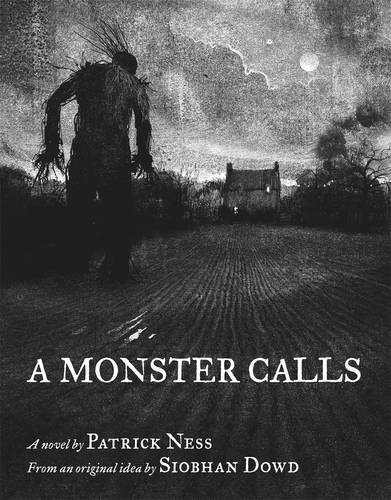
A Monster Calls, by Patrick Ness, inspired by Siobhan Dowd. You remember Patrick Ness, from Chaos Walking? I don't really need to say anything more, (and this blog post is getting too long, and I couldn't possibly do it justice anyway). Just go find this book. The illustrations are stunning, the story is strange, funny, powerful, and beautiful. You will cry. It will be cathartic. The concept is unique and yet feels inevitable, like a folk tale. The monster that shows up outside Conor's window is terrifying, but Conor isn't afraid of it because the monster from his nightmares is far more frightening. This is a fantasy book that's so realistic it tears your heart out. I'm going to compare this to the yak steak I had at a fancy restaurant once: beefy and tender with a sauce that hits all the ancient receptors in the brain.

Guess I should give a writing update: day 10, and I've written 9 1/2 pages. Not a whole lot, but I've done a bit every day, so I'm meeting my goal.

Thursday, November 3, 2011

Canadian Book Week: Kenneth Oppel

It's day three of Novel Writing Month, and so far so good: I have written something every day. Not much (I'm at about 4 pages longhand), but I'm getting to know my characters and setting and getting closer to figuring out my plot. (I think.)

This blog post has been sitting half-finished for weeks, now, so I figured I could procrastinate today's writing and finish it.

I have not forgotten my promise to focus on a Canadian author once a month, and this month it just has to be Kenneth Oppel, because his latest book has just come out, and it's awesome!

 That is an amazing cover, is it not? It gives you setting, mood, character; it reaches out and sucks you in; it promises you will be transported into the world beyond the keyhole. But really, all you have to read is the subtitle and you know you have to read this book. I mean, "The Apprentiship of Victor Frankenstein": how audacious is that?

But if anyone can tell a convincing story about fiction's most famous monster-maker, it's Kenneth Oppel. He's a versatile writer with a sure sense of story. He's written picture books, early readers, middle-grade and YA novels, all with strong characters and lots of action but also thematic depth and real emotion.

Does This Dark Endeavor live up to its cover? Yes. I had my reservations, because I wasn't sure I would like the character of Victor, but by the end of the novel I was convinced. If you have any interest in the Frankenstein story, if you love secret libraries and alchemy and finding impossible ingredients for the elixir of life, (and who doesn't?) then you have to read this book.


The Silverwing trilogy could be thought of as a middle-grade Watership Down, starring bats. It has animals that behave like animals, a mythology that makes sense and resonates with the story (Camazotz, the vampire bat-god, and an underworld, and possible apocalypse), and a very cool bat super-power that allows Shade to save the day more than once.  I'm making it sound more like fantasy than it is: most of the adventures are real-world/real-bat encounters with owls and humans and big nasty bats and suchlike. But the fantasy elements add that extra zing. I haven't read them in a while,  but these are books I reread happily because there's so much to them. A good choice for boy readers. I haven't read Guardians of Ga'hoole, but I'm betting if you liked those books you'll like these.


The Airborn series is for slightly older readers, and the airships and goggles on the covers do not lie: this is classic steampunk: an alternative history in which zepplins become the transportation of choice. (To be perfectly correct, I'm not sure it is steampunk, because I think the airships are powered with combustion engines, but I don't really care.) This is great fun: adventure, romance, pirates, young man proving himself, hitherto undiscovered flying creatures, ghost ships, a ladder into space. All that good stuff. Fast-paced and imaginative with characters you really care about. Highly recommended.


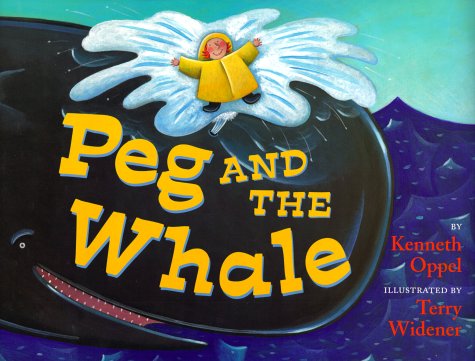
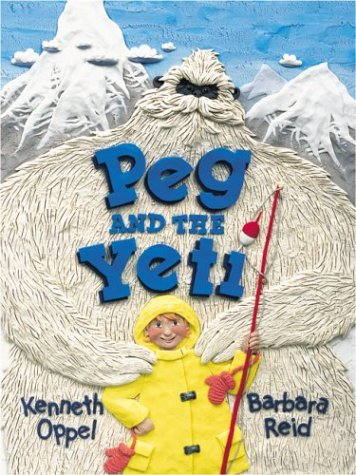
I also have to mention Oppel's two picture books about Peg. Peg and the Whale and Peg and the Yeti are so cute and upbeat and Peg is such an awesome heroine. Every young girl should have these books on her shelf. (And note the illustrations for Peg and the Yeti: Barbara Reid is so cool!)

Thursday, October 27, 2011

SIWC and The Kneebone Boy

I spent a great weekend at the Surrey International Writers' Conference. Susan Juby was there, and she's just as personable in person as her writing would lead you to believe. Ivan Coyote gave a brilliant workshop called Bootcamp for Procrastinators, which was exactly what I needed to hear. Mary Robinette Kowal gave an inspiring keynote speech and a terribly useful workshop on what puppeteering taught her about writing. (I bought her book just so I could get her to sign it, and it was great: Jane Austen plus magic.) And I got my "This Day We Write!" t-shirt to remind me of Robert Dugoni's brilliant Lord of the Rings-inspired rallying cry. I highly recommend all of these authors, and if you are a writer I strongly recommend attending the SIWC next year. It's all kinds of inspiring, and fun, too.

I was almost convinced that I should sign up for National Novel Writing Month, in which one commits to writing 50 000 words in 30 days (seriously!), but having checked it out, I think it might be more distracting than inspiring. (And, let's face it, there's no way I could do it. I can't even write a blog twice a month!) So instead I am going to commit, here, in this most public and non-retractable way, to writing some words in my new novel every day in November. Even ten words counts. And I commit to recording here in the blog the number of words I write.

So I'd better get caught up on all the books I've been meaning to recommend, since I may not have any time left for blogging in November.


A long time ago I mentioned that The Kneebone Boy, by Ellen Potter, was a great book. I still think so, but I'm going to cheat a little and direct you to Book Aunt's review, because she did such a good job! I second everything she says about the quirky characters, the atmosphere, the surrealism that feels like magic even though technically it isn't, and the very funny writing. I diverge from her opinion only at the end: I thought the ending of The Kneebone Boy was brilliant. Yes, it totally turns all your expectations on their heads, but that just gives the emotional punch more weight. And it makes you rethink everything that went before, in a resonant, many-layers-of-theme kind of way. It's like when you order chocolate mousse for dessert, and it seems all light and sweet and yummy, and then there's a raspberry truffle in the middle.

I just got completely distracted from this blog entry when I went looking for The Kneebone Boy's cover and I found Ellen Potter's blog. She has a great blog, you have to go read it! Particularly this entry: Blame it on Mary. I have a new motto now (to go along with This Day We Write!)(I need another t-shirt): I am the carpetbag. I Am the Carpetbag. If that isn't inspiring, I don't know what is. (Just go read her blog entry; I can't possibly do it justice.)

Thursday, October 13, 2011

Three completely different books

I haven't made it through the entire stack of library books. (I never do: it's one of the great things about libraries, being able to take books out and then not read them. I can always take them out again later. All that choice and no pressure, like the buffet dinners at all-inclusive resorts!) (And this time I was distracted by the arrival of both This Dark Endeavour and Daughter of Smoke and Bone, which I had to read immediately, of course.) But I made some good picks that I ought to share, especially since I think none of them are very well-known.

Wrapped, by Jennifer Bradbury, is a light-hearted historical adventure/romance with Egyptian mummies and spies. It opens with the main character, Agnes, getting fitted for her coming-out dress while reading the latest Jane Austen novel:

"Put the book down, darling," my mother said from her chair beside the mirror.
"The chapter's end is only a short way off," I replied, reaching out with my other hand to flip the page. Despite the ache in my shoulder from holding the book at arm's length so the dressmakers could work on my gown, I didn't want to give it up.
I loved Agnes at once. She longs for adventure at the same time as she is not sure she's ready to come out. She is thoughtless and impulsive but genuinely tries to be good. And she doesn't quite know what to do when the very eligible Lord Showalter begins to court her. But the fun of this book is the amulet she finds at a mummy unwrapping, and the secret message attached to it, and sneaking around--with the entirely unsuitable but good-looking museum assistant--trying to solve the puzzle before the unknown bad guys do. The plot is contrived--it's rather silly the various reasons why she never tells her father about the amulet--but it's all good fun, the conclusion is everything you could have hoped for, and the stage is set for further Agnes adventures. If you liked Sorcery and Cecelia, or if you're a Jane Austen fan, then check this out. I have no idea what syllabub tastes like, but I imagine it's the perfect analogy to this book (they're always having it for dessert in Jane Austen!)


 The Seer and the Sword, by Victoria Hanley, made me wonder why I've never heard of this author before, and made me want to find more of her books. It's traditional fantasy, as the title would suggest, but other than the crystal ball that gives Torina visions, there is little magical that happens. Rather, it is the story of a kingdom and the characters whose choices determine its fate. Torina's father comes home from a war of conquest with the son of the defeated king as a slave for his daughter. Torina immediately frees the boy, and they grow up together, and apart, as plots threaten the stability of the throne and enemies gather from across the sea. It reminded me of Robin McKinley's The Hero and the Crown, or Megan Whalen Turner's Attolia books: it has the sweep of politics and history, but its heart is the coming-of-age of two people who find out what they're made of when everything is taken from them. I cared very much about Torina and Landon and I liked what became of them. Good old-fashioned roast beef and Yorkshire pudding.

Questors, by Joan Lennon, looked original, and it was. I can't think of anything to compare it to exept perhaps some of Diana Wynne Jones' work. I'm going to claim Joan Lennon as Canadian, since she was born here, and say this is a Canadian author to watch out for. Three worlds exist in a complex balance, maintained by a mysterious Council in The London House, one of those great places where hallways and doors lead to different realities and Mrs. Macmahonney in the basement kitchen is the one person who knows all its secrets. Three children, one from each world, are brought to The London House and told that the balance is crumbling and they have been designed from birth to be the heroes who will put everything to rights. Except that things are worse than anticipated, and they have to complete their quest ten years before they were supposed to. So they're hardly the heroes they were meant to be. Maddy, Bryn, and Cam each have an ordeal in their own world, in which their choice of which Object to bring back will either save or doom all reality. The characters are convincing in their strengths and vulnerabilities, and in their difficulties getting along with each other. The worlds are imaginative, the ordeals interesting, the mythology mysterious and never completely explained, but not frustratingly confusing. I was intrigued by the concept and carried along by the plot. Fun and different, like chewy ginger cookies.

Thursday, September 22, 2011

We moved, and now I can walk to the library!

Has it really been more than a month since my last blog entry? Yikes. And right after I made my highly realistic two-blogs-a-month goal. (I should never set goals; it never turns out well for me.) In my defence, moving makes you put your entire life on hold. I haven't even been reading anything (other than all fourteen Harry Dresden books by Jim Butcher, but that was weeks ago.) We're still not unpacked and organized, because we're getting the place painted, so everything is a complete mess.

But it's a five minute walk to the local public library. Yesterday I escaped the chaos and went to get myself a new library card. I love libraries. Here are the first books I brought home with me:


Questors, by Joan Lennon, caught me with "three perfect heroes" who aren't quite perfect; it looks like an original concept

Epic, by Conor Kostick, looks like a cross between The Hunger Games and Omnitopia Dawn

The Minister's Daughter, by Julie Hearn, looks like a retelling of The Crucible

Wrapped, by Jennifer Bradbury, is Egyptology and Regency England; I picked it up because Book Aunt recommended it.

The Seer and the Sword, by Victoria Hanley, I picked up because of the cover by Trina Schart Hyman; love that artist.

City of Ships, by Mary Hoffman, is the latest in her Stravaganza series, which I've been enjoying.

Miles From Ordinary, by Carol Lynch Williams: this one actually didn't make it home from the library. I started reading the first few pages and I had to sit down and finish the whole thing right there. It's a deceptively simple story--it all takes place on one day, and not very much actually happens--but the emotional tension is ratcheted up tight all the way through. Brilliant writing, a brilliant voice. You are right inside this girl's head, and what a terrifying, heartbreaking place it is to be. Very impressive book.

Hex Hall and Demon Glass, by Rachel Hawkins. I needed something light and mindless after Miles From Ordinary, and this series fits the bill. Very typical plot: Sophie has never fit in because she is a . . . (which strange paranormal creature will it be this time?) a witch. She screws up and gets sent to a reform school for witches, vampires, werewolves etc., where she meets a guy who is wrong for her in every possible way, where the popular witches try to get her to join their dark magic coven, where people start getting attacked and the wrong people are accused of it . . . you get the picture. Not much original, but it's well-written, I like the characters, and it doesn't take itself too seriously. No brooding, lots of snarky comments. In the same vein as Paranormalcy.